2026-05-24
Why ‘Autologous Rib Cartilage’ is the Ideal Solution for Functional Rhinoplasty: Balancing Aesthetics and Breathing | By Director Young-moon Yoo of Vibe Plastic Surgery, Sinnonhyeon Station
Explore how autologous rib cartilage effectively addresses both nasal congestion and aesthetic concerns like bulbous tips and sunken nasolabial angles in functional rhinoplasty.
Are you experiencing discomfort in your daily life due to nasal congestion or rhinitis?
Among those who find it difficult to breathe due to structural problems inside the nose, many are also dissatisfied with the shape of their nose (hump, crooked nose, bulbous nose, etc.).
Today, we will look at a case where a bulbous nose and a sunken nasolabial angle were corrected simultaneously using autologous rib cartilage along with *functional nose surgery (septoplasty and turbinate reduction)*, and explore in detail why autologous rib cartilage is particularly effective for functional rhinoplasty.
1. Accompanied by Nasal Congestion & a Blunt Nasal Tip
Functional issues: Chronic nasal congestion caused by a deviated septum, where the ‘septal cartilage’ (the pillar supporting the inside of the nose) is severely curved, and hypertrophic turbinates, where the inner nasal mucosa is enlarged.
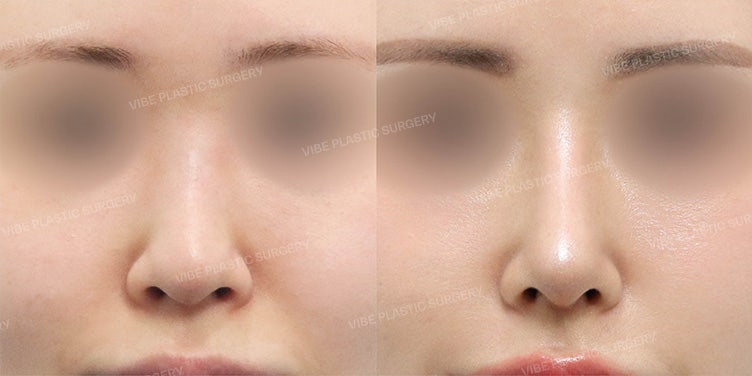
Aesthetic issues: A bulbous nose shape where the tip looks wide and blunt from the front, and a state where the mouth appears somewhat protruded because the angle where the nose and upper lip meet (nasolabial angle) is sunken when viewed from the side.
2. Functional Nose Surgery with a Severely Deviated Septum: Why ‘Autologous Rib Cartilage’?
In rhinoplasty, cartilage is needed to raise and support the nasal tip firmly. Generally, septal cartilage or ear cartilage is frequently used, but in functional nose surgery where the septal deviation is severe, as in this case, the use of ‘autologous rib cartilage (cartilage from one’s own ribs)’ is highly recommended. The reasons are as follows:
Providing the strongest and sturdiest support: If the septum is severely curved, straightening it is essential. In this process, the original septal cartilage is often weakened or does not provide enough strength and quantity to support the nasal tip. Autologous rib cartilage is the sturdiest and most abundant cartilage that can be harvested from our body, making it excellent for powerfully rebuilding a collapsed nasal pillar.
Optimal material for correcting a sunken nasolabial angle: To pull the nasal tip forward and fill the sunken nasolabial angle (the angle connecting the nose and lips) with volume, a ‘sturdy framework’ that can strongly push the nasal pillar up from the base is required. With weak cartilage, the nasal tip may droop again over time, but autologous rib cartilage maintains that strength firmly.
High biocompatibility as autologous tissue: Since it is biological tissue harvested from your own body rather than an artificial implant, it is safe with a relatively lower risk of side effects such as inflammation or contracture.
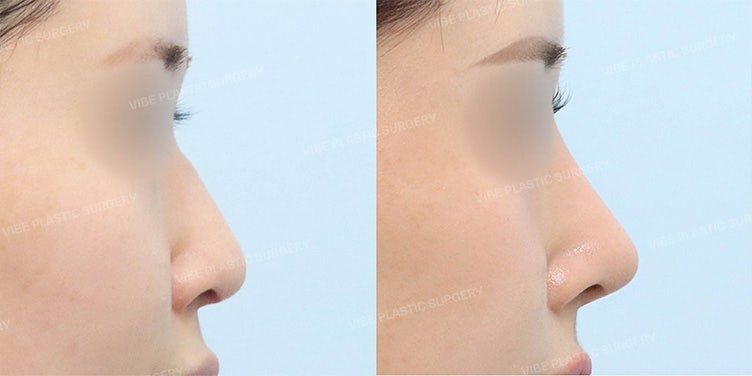
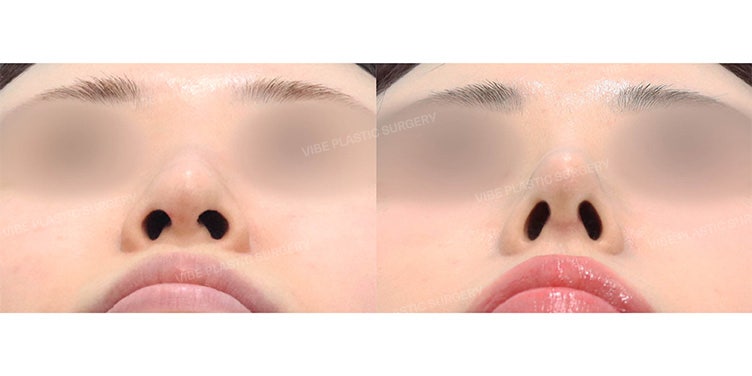
3. Surgical Results: Perfect Improvement of Function and Aesthetics
Front (Bulbous Nose Correction): The blunt and spread-out nasal tip was gathered slimly and three-dimensionally based on the firm support of the autologous rib cartilage, changing to a much more sophisticated impression.
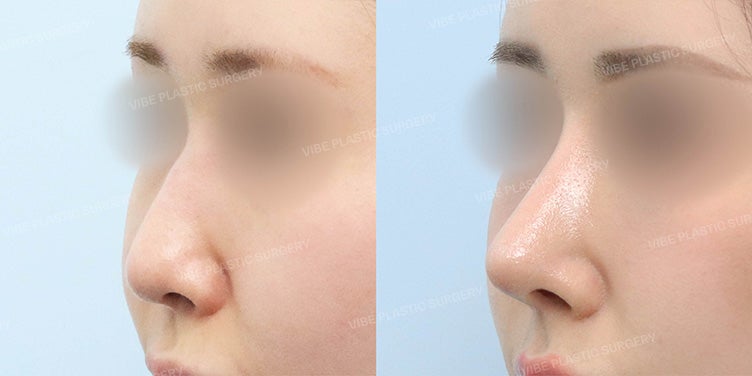
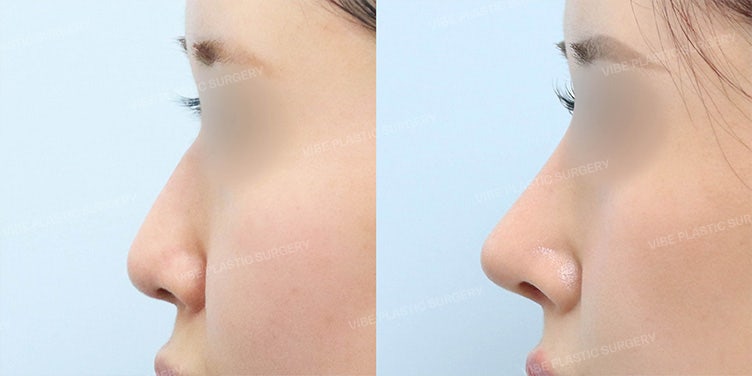
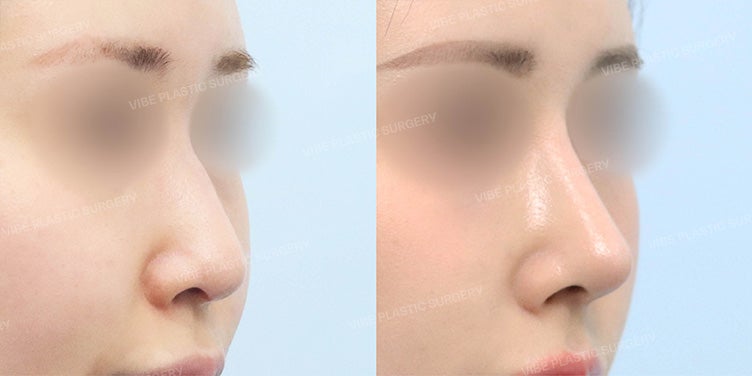
Side (Nasolabial Angle Correction): As the sunken lower part of the nose (nasolabial angle) moved forward powerfully through the rib cartilage, the line leading to the lips was elegantly improved, and the effect of the mouth appearing relatively retracted was achieved.
Bottom (Symmetry and Nostril Improvement): By straightening the severely deviated septum, the symmetry of both nostrils was matched, and the nostril shape was also improved from a round, spread-out form to a long, sleek oval. Along with this, turbinate reduction was performed, making the breathing path through the nose wider and more comfortable.
💡 Summary: Why is ‘Autologous Rib Cartilage’ the answer for severe functional nose surgery?
Patients like this case, who have severe nasal congestion due to a deviated septum, often want to correct the curved pillar inside the nose while simultaneously resolving aesthetic complexes such as a bulbous nose or a sunken nasolabial angle. In such cases, autologous rib cartilage performs an irreplaceable role that other materials cannot fulfill.
Overcoming the limitations of insufficient materials: Even if a severely deviated septal cartilage is straightened during surgery, its strength and quantity are often woefully inadequate to set the nasal tip high and firmly. Autologous rib cartilage provides sufficient quantity to perfectly overcome these limitations.
Unchanging sturdiness over time: It boasts the strongest supporting power among the cartilages that can be harvested from our body. Thanks to this sturdy framework, it powerfully advances the sunken nasolabial angle and gathers the blunt bulbous nose slimly, so the nasal tip does not lower over time and remains sharp.
Function, aesthetics, and even safety: Since it is 100% your own body tissue and not an artificial implant, the risk of rejection or inflammation is relatively low. You can regain the comfort of breathing by treating the stuffy nasal mucosa and septum, and at the same time, complete a sophisticated nose line without worrying about inflammation.
In conclusion, if you want to achieve both ‘breathing comfort (function)’ and a ‘three-dimensional, beautiful nose line (aesthetics)’ in the sturdiest and safest way, functional rhinoplasty using autologous rib cartilage will be the most satisfying answer.
Frequently Asked Questions
When is functional rhinoplasty necessary?
Functional rhinoplasty is necessary for individuals who experience breathing difficulties due to structural problems inside the nose, such as nasal congestion or rhinitis, and also have cosmetic concerns like a bulbous nose or a crooked nose. It may include correction of a deviated septum or hypertrophied inferior turbinates.
Why is autologous costal cartilage used for severe deviated septum?
In cases of severe deviated septum, the original septal cartilage may be weak or insufficient in quantity. Autologous costal cartilage is the strongest and most abundant, making it effective for powerfully reconstructing a collapsed nasal bridge and firmly supporting the nasal tip.
Why is autologous costal cartilage a good material for rhinoplasty?
Autologous costal cartilage provides the strongest support among cartilages that can be harvested from the body, and it is abundant. Furthermore, as it is autologous tissue rather than an artificial implant, the risk of side effects such as inflammation or contracture is relatively low, making it highly biocompatible.
Is nasolabial angle correction also possible with autologous costal cartilage?
Yes, it is possible. Autologous costal cartilage acts as a strong framework that can powerfully push up the nasal column from the base, filling out a deeply recessed nasolabial angle with volume and firmly maintaining the nasal tip so it doesn't drop over time.
How does the nose shape change after autologous costal cartilage functional rhinoplasty?
A blunt and spread-out nasal tip becomes slim and three-dimensionally gathered, and a deeply recessed nasolabial angle is elegantly improved. Additionally, a deviated septum is corrected, leading to symmetrical nostrils and an improved, sharp oval nostril shape.
Are there any risks of side effects when using autologous costal cartilage?
Since it is autologous tissue harvested from your own body rather than an artificial implant, the risk of side effects such as inflammation or contracture is relatively low, making it safe. Its high biocompatibility allows for the creation of a sophisticated nose line without concerns about rejection.