2026-05-24
Severe Eye Asymmetry Due to Congenital Ptosis: Why Incisional Ptosis Correction is Essential by Dr. Young-moon Yoo of VIBE Plastic Surgery
Learn why incisional ptosis correction is necessary for severe asymmetry and congenital cases, featuring a real transformation of a male patient in his 20s.
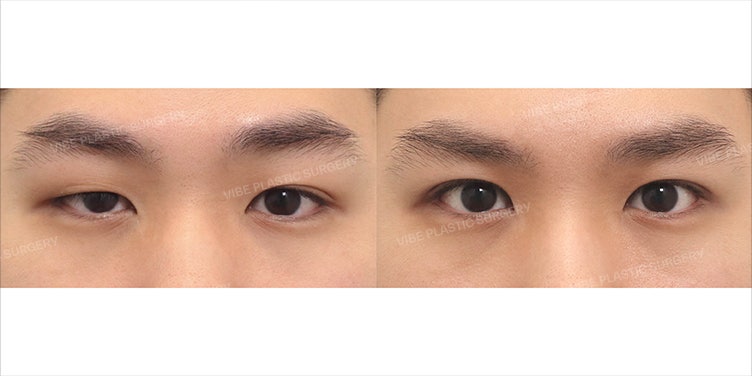
Severe eye asymmetry caused by congenital ptosis—in these cases, ‘incisional ptosis correction’ is absolutely necessary!
Hello.
I am Dr. Young-moon Yoo, Director of VIBE Plastic Surgery.
Today, I would like to use a case study of a male patient in his 20s to explain in detail 👉 why and in which specific cases incisional ptosis correction is an absolute must.
📌 Pre-operative Condition | A case where the eye-opening strength itself differs
This patient had a case where the eye-opening strength (function of the levator palpebrae superioris muscle) was fundamentally different between the two eyes due to congenital ptosis.
One eye opened relatively well,
But in the opposite eye, the black pupil was not sufficiently visible even when the eye was open.
The eye asymmetry was always the first thing noticed when taking photos or meeting people face-to-face.
As a male patient, he was not particularly interested in a double eyelid line, but he suffered a lot of stress from frequently hearing comments like ‘You look sleepy,’ ‘You look tired,’ or ‘It looks like you haven’t opened your eyes properly.’
❗ Why are simple methods limited for ptosis with severe asymmetry?
There are various methods for ptosis correction, such as non-incisional, partial incisional, and full incisional methods.
👉 In cases like this where the asymmetry is very severe, the limitations of non-incisional or partial incisional methods are clear.
When the eye-opening strength (muscle function) itself is very weak or has a congenital cause, simply pulling the skin or fixing it with buried sutures
👉 makes fundamental correction impossible.
✔ In these cases, ‘incisional ptosis correction’ is required!
Incisional ptosis correction is essential if the following apply:
✔ Weak eye-opening strength due to congenital ptosis
✔ Significant asymmetry in eye shape or size between both eyes
✔ A habit of using the forehead muscles to open the eyes
✔ When non-incisional methods are judged to provide insufficient correction
✔ When seeking stable, long-term correction
🔎 What is Incisional Ptosis Correction?
Incisional ptosis correction is a surgery where an incision is made in the upper eyelid to directly check the eye-opening muscle (levator muscle) and then adjust the eye-opening strength itself.
✔ It is not simply a ‘surgery to make the eyes bigger’
✔ It is a functional surgery to normalize the eye-opening function itself.
🌟 Advantages of Incisional Ptosis Correction
1️⃣ The most accurate method for asymmetry correction
By directly checking the muscle condition, the eye-opening strength of both eyes can be finely adjusted, leading to 👉 the most stable results in cases of severe asymmetry.
2️⃣ Lower chance of recurrence
Compared to non-incisional methods, it is less likely to loosen or sag again over time.
3️⃣ Clear and vivid impression improvement
The pupils are naturally revealed, changing a sleepy look into a 👉 sharp and confident impression.
4️⃣ Function + Aesthetics simultaneously
As the eyes open better, less forehead strength is used, improving fatigue in both the eyes and forehead.
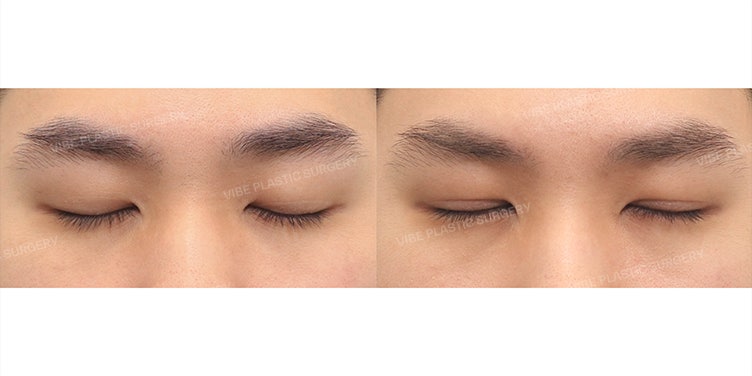
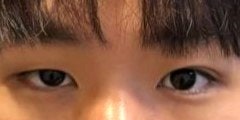
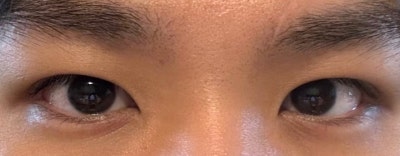
📸 Post-operative Change Points
In this patient’s case:
The balance of eye-opening strength between both eyes was achieved, significantly improving eye asymmetry when viewed from the front.
The impression changed to be much clearer and more stable.
Feedback included ‘People seem to stare at my eyes less.’
👉 It wasn't just an aesthetic change; it resulted in reduced stress in daily life.
✔ In Conclusion
Ptosis is not just a matter of double eyelids, but a matter of the ‘function’ of opening the eyes. Especially in cases of:
✔ Congenital ptosis
✔ Severe asymmetry
👉 It is most important to correct it accurately through incisional ptosis correction.
The surgical method must vary depending on the individual’s eye condition, muscle function, and degree of asymmetry, which is why accurate diagnosis and experience are key.
📌 Recommended for:
Those worried about eye asymmetry due to ptosis
Those who were dissatisfied after non-incisional surgery
Those who want to improve a sleepy-looking impression
Those who want functional ptosis correction
Consultation and surgery should be performed by a board-certified plastic surgeon!
VIBE that comes from rich experience
Young-moon Yoo, Chief Director of VIBE Plastic Surgery
VIBE Plastic Surgery complies with medical laws. These before-and-after photos were taken under the same conditions with the patient’s consent. Complications and side effects such as bleeding, inflammation, infection, and asymmetry may occur after surgery and vary by individual, so caution is required.
Frequently Asked Questions
Why is incisional ptosis correction necessary for congenital ptosis?
Yes, incisional ptosis correction is often necessary for congenital ptosis because the strength of opening the eyes (the function of the levator palpebrae superioris muscle) itself is weak, or there is severe asymmetry between both eyes. In such cases, fundamental correction is difficult with non-incisional or partial incisional methods, and stable improvement is only possible by directly adjusting the eye-opening muscles through incisional ptosis correction.
What kind of surgery is incisional ptosis correction?
Incisional ptosis correction is a surgical procedure that involves incising the upper eyelid to directly visualize the levator palpebrae superioris muscle, which is responsible for opening the eye, and adjusting its strength to normalize the eye-opening function. It is not merely a cosmetic surgery to make the eyes bigger, but a functional surgery focused on improving eye function.
What are the advantages of incisional ptosis correction?
Incisional ptosis correction is the most accurate method for correcting severe asymmetry because it allows for direct visualization and precise adjustment of the eye-opening muscle's condition. Furthermore, compared to non-incisional methods, it has a lower recurrence rate as it is less likely to loosen or sag again over time, and it significantly improves a sleepy impression to a clear one, while also reducing eye and forehead fatigue.
In what cases is incisional ptosis correction recommended?
Incisional ptosis correction is recommended for cases of congenital ptosis where the strength of opening the eyes is weak or there is significant asymmetry between both eyes, and for those who have a habit of using their forehead to open their eyes. It is also suitable for individuals who had insufficient results after non-incisional surgery or who desire long-term stable correction.
How does the impression change after incisional ptosis correction?
After incisional ptosis correction, eye asymmetry is significantly improved as the balance of eye-opening strength is restored. A sleepy or tired impression transforms into a much clearer and more confident one, and the pupils are naturally revealed, which can give a positive image.