2026-05-25
Deviated Nose (Revision Rhinoplasty)
A case study of a 20s female patient undergoing revision rhinoplasty to correct a deviated nose, drooping tip, and columella issues using donated rib cartilage.
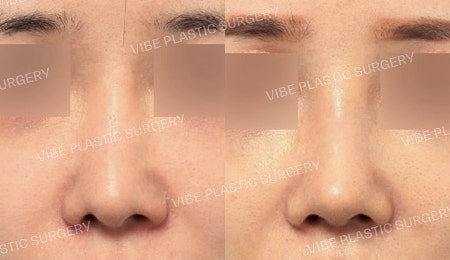
* Basic Information
# Female in her 20s
# Had rhinoplasty using septal cartilage 4 years ago, but the nasal tip has gradually drooped and the nose appears deviated.
* Consultation
# Although she underwent rhinoplasty using septal cartilage, she was dissatisfied with the shape as the nasal tip gradually drooped over time, causing the area above the tip to bulge out.
# The nose was also leaning to the right, making it look crooked.
# We planned to correct the deviated nose and drooping tip using donated rib cartilage.
* Plan
# Nasal Tip Surgery (Deviated Nose & Drooping Tip & Columella Correction)
# Nasal Bridge Surgery (Implant Replacement & Correction of Dorsal Bulge)
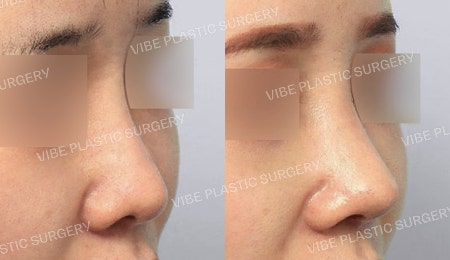
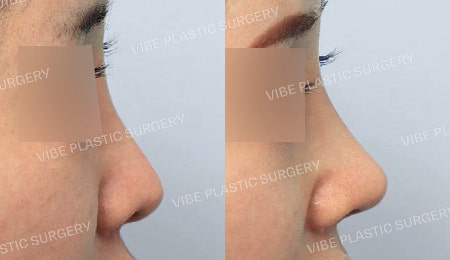
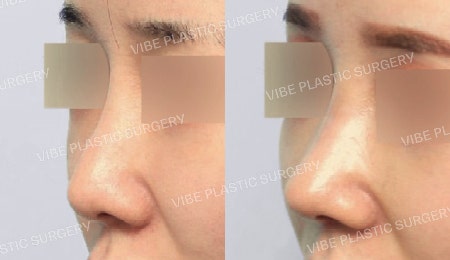
* Intraoperative Findings
# There was significant scar tissue, which was thoroughly removed, and the area was irrigated with an anti-scarring agent.
# The septum was severely deviated, and the previous septal extension graft was weakly fixed to that area. This was the cause of the deviated nasal tip.
# The septum was reconstructed. A sturdy septal pillar was newly created using the existing septal cartilage combined with new donated rib cartilage.
* Postoperative Findings
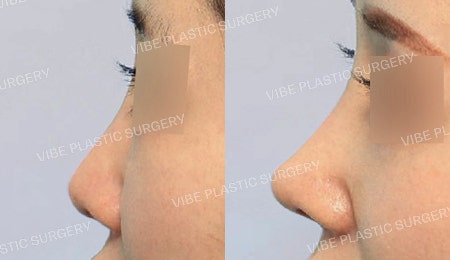
# You can see that the deviated nose has been straightened and the drooping tip has been fully resolved.
# As the retracted columella (nasal pillar) was corrected, the nasolabial angle improved, resulting in a more ideal nasal profile.
# When performing revision surgery, it is crucial to establish a perfect plan and prepare thoroughly beforehand. One must consider various variables in advance to respond flexibly to unexpected situations during surgery!
Consultations and surgeries should be performed by a board-certified plastic surgeon!
Take care of both your health and beauty today :)
Right Mind, Right Plastic Surgery – Yu Young-moon
Complications and side effects such as bleeding, inflammation, infection, and asymmetry may occur after surgery, and caution is required as results vary by individual.
Frequently Asked Questions
In what cases can revision surgery for a crooked nose be considered?
Yes, it can be considered. Revision surgery can be considered if the nasal tip has dropped and the nose appears crooked after a septal surgery four years ago, or if you are dissatisfied with a bulging appearance in the upper part of the nasal tip.
Can a dropped nasal tip also be corrected with revision surgery?
Yes, it can be corrected. In this case, donated costal cartilage was used to correct the crooked nose along with the dropped nasal tip, and it was confirmed that the dropped nasal tip was sufficiently resolved after the surgery.
What type of cartilage is used for revision surgery for a crooked nose?
Donated costal cartilage can be used. In this case, a new strong septal pillar was created using existing septal cartilage along with new donated costal cartilage to correct the crooked nose.
How are existing septal problems resolved during revision surgery?
If the existing septum is severely deviated or the septal extension graft is weakly fixed, causing the nasal tip to be crooked, the septum is newly reconstructed to resolve the problem. If there is severe scar tissue, it may be removed and a preventive agent used.
Can the nasal bridge also be corrected during revision surgery for a crooked nose?
Yes, it can be corrected together. In this case, a plan was made to improve the overall nasal line through nasal tip plasty, replacement of nasal bridge implants, and correction of dorsal bulging.
What is the most important aspect of revision nose surgery?
During revision surgery, it is crucial to plan and prepare perfectly before the operation. Various potential variables should be considered in advance to flexibly respond to unexpected situations.