2026-05-25
1. Anatomy
Plastic surgeon Dr. Young-moon Yoo explains the fundamental anatomy of the nose, focusing on soft tissue layers, SMAS, muscles, and blood vessels for successful rhinoplasty.
Hello.
I am Dr. Young-moon Yoo, a board-certified plastic surgeon.
Among the many fields of plastic surgery, I have a particular interest and specialization in ‘eyes’ and ‘noses.’ This is because I believe they are the most critical structures in determining a person’s impression and beauty.
Patients and acquaintances often ask me which surgery suits my aptitude better or which one is more difficult.
To be honest, it is hard to give a definitive answer. Each surgery has its own distinct charms, pros, and cons. ^^;
First, the eye is a dynamic structure that blinks about 15-20 times per minute. Because it reacts very sensitively to anesthesia, achieving bilateral symmetry is crucial. Therefore, the most important point during surgery is to finish by matching symmetry with quick judgment under constantly changing conditions—before swelling occurs! If the surgery takes too long, swelling sets in, and to make matters worse, if the patient cries due to pain or discomfort, it swells even more, making the procedure difficult. T.T
On the other hand, rhinoplasty feels more like constructing a building. I feel it is similar to architecture in that you build up from a solid foundation to create a shape. Of course, the nose cannot be seen as a completely static structure either. It moves whenever you make expressions or speak, and some even wish for a ‘piggy nose’ flexibility... Therefore, if it is too fixed, it inevitably looks unnatural. However, since a sturdy foundation is necessary to maintain a satisfactory shape that doesn't droop over time, it is true that a more firm fixation is required.
Furthermore, because the nose is located right in the center of the face, it is a very sensitive structure where any deviation, nostril asymmetry, or it being too short or long is immediately noticeable. ^^;
Usually, since many rhinoplasty cases involve raising a low nose, silicone implants or other materials (e.g., donated rib cartilage, mesh, Medpor, etc.) are used. We must be more cautious about issues arising from these (exposure, inflammation, thinning of the skin due to excessive tension, etc.).
So, in the ‘Archive - Nose’ series, I would like to share simple knowledge and information necessary for such rhinoplasty. ^^
The first topic is Anatomy.
* Soft Tissue
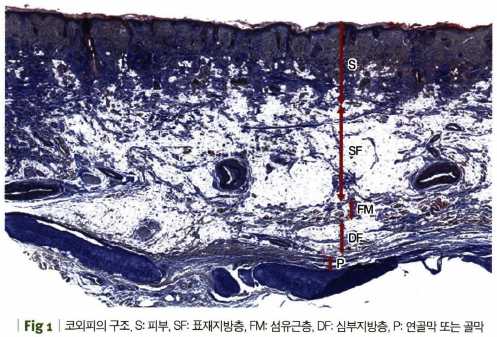
The soft tissue covering the nose consists of a total of 5 layers.
1. Skin
2. Superficial fatty layer
3. Fibromuscular layer
4. Deep fatty layer
5. Perichondrium / Periosteum
* Fibromuscular Layer (SMAS)
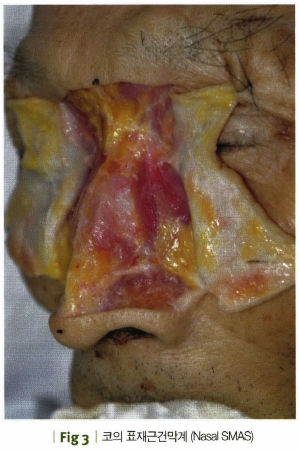
While all layers are important, the fibromuscular layer deserves special attention. It might sound like an unfamiliar name, right? This corresponds to the layer commonly referred to as the SMAS layer during lifting surgeries.
Why is it important?
1. The most core layer
- Movement of the envelope
- Blood supply
- Maintenance of skin thickness
To avoid damaging the major blood vessels responsible for the nose’s blood circulation, the SMAS layer must be identified and carefully dissected ‘below the deep fatty layer, i.e., above and below the (peri)chondrium.’ This layer is easier to separate because it has fewer major vessels and less fibrous septa, and it provides movement for the musculoaponeurotic system.
2. Damage can cause secondary contracture deformities.
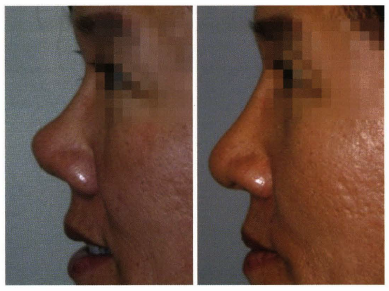
Severe contracture caused by post-operative inflammation, as seen in the photo, usually occurs in the fibromuscular layer. Sufficient release of scar contracture is a key process for successful correction.
* Muscles
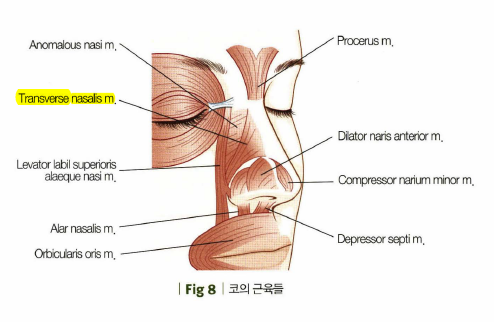
1) Elevator muscles: Shortening of nasal length, dilation of nostrils
- Procerus muscle
- Levator labii superioris alaeque nasi muscle
- Anomalous nasi muscle
2) Depressor muscles: Lengthening of nasal length, dilation of nostrils
- Dilator naris posterior muscle
- Depressor septi nasi muscle
3) Compressor muscles
- Transverse nasalis muscle
- Compressor narium minor muscle
4) Minor dilator muscle
- Dilator naris anterior muscle
* Blood Vessels
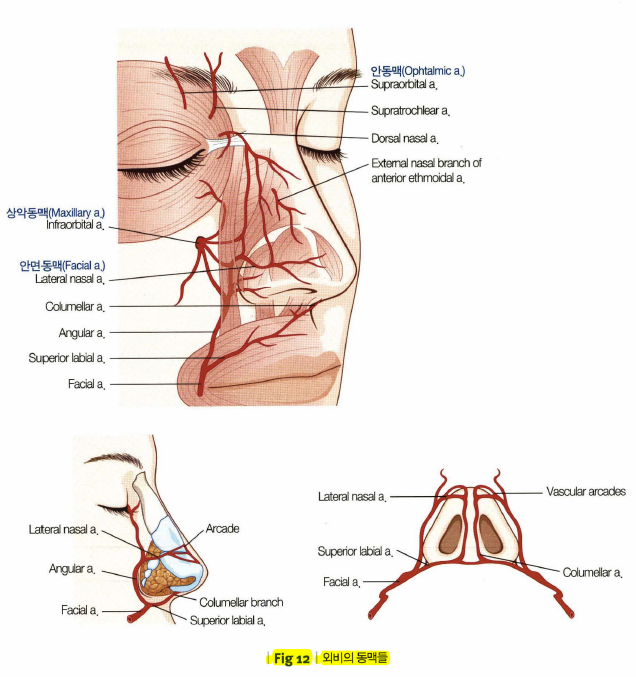
Most blood vessels run within or above the nasal SMAS. Therefore, it is safer for the dissection layer to be below the nasal SMAS. Since they have overlapping regions, blood flow disorders rarely occur even if a few branches are damaged.
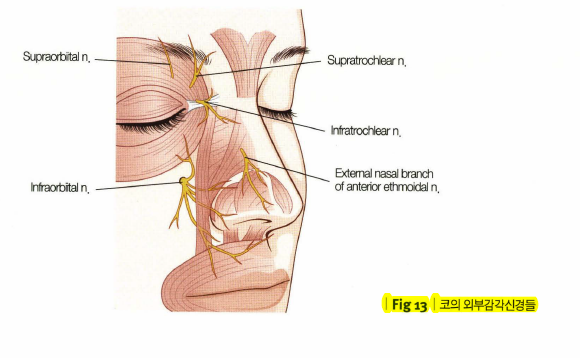
* Sensory Nerves
* Skeleton
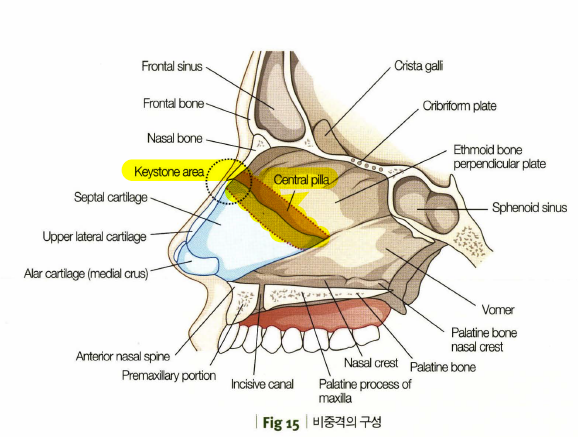
* Nasal Tip Cartilage Anatomy
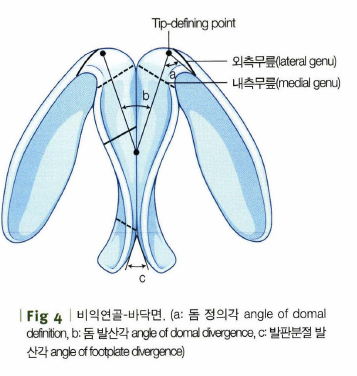
This covers the basic anatomy of the nose. There are many difficult terms, and you don’t necessarily need to know them all, but if you have an interest in the subject, it would be good to read through them at least once. ^^
Next time, I will discuss what points I pay attention to when creating a surgical plan before the procedure.
Wishing you health and beauty today. ^^
Right Thinking, Right Plastic Surgery
Plastic Surgeon Young-moon Yoo
Frequently Asked Questions
What is the biggest difference between eye surgery and nose surgery?
Yes, the two surgeries have different approaches. Eye surgery deals with dynamic structures, so quick symmetrical correction before swelling is important, while nose surgery is about building a strong foundation like architecture. The nose is located in the center of the face, making asymmetry noticeable, and caution is required when using implants.
How is the soft tissue covering the nose structured?
It consists of a total of 5 layers. From the outside, it is composed of skin, superficial fat layer, fibromuscular layer (SMAS), deep fat layer, and the innermost perichondrium and periosteum. During surgery, it is important to safely dissect considering the characteristics of each layer.
Why is the fibromuscular layer (SMAS) important in nose surgery?
It is a key layer responsible for blood supply and maintaining skin thickness. Preserving this layer and carefully dissecting below the deep fat layer is crucial to avoid damage to major blood vessels, and damage can lead to a risk of secondary contracture deformity due to inflammation.
How can I prevent blood vessel damage during nose surgery?
Dissection should be performed below the fibromuscular layer (SMAS). Most blood vessels in the nose run within or above the fibromuscular layer, so carefully dissecting above and below the perichondrium or periosteum, which is below the deep fat layer, is a way to prevent circulatory disorders and perform safe surgery.