2026-05-25
Rhinoplasty for a Low Bridge and Drooping Tip
A case study of a 20s female patient who achieved a sleek, straight-semi-curved nose profile using donated rib cartilage after previous Hiko and filler procedures.
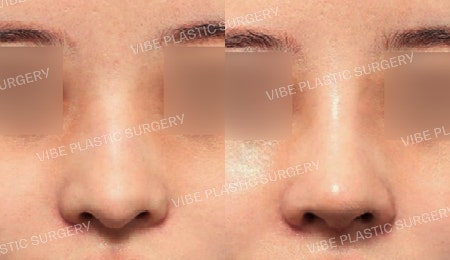
* Basic Information
- Female in her 20s
- Previous procedures: Hiko threads and fillers (twice)
- Low nasal bridge and drooping nose tip
- Uneven bridge line due to a slight hump
* Consultation
- Despite having two rounds of Hiko and filler treatments, she was concerned that her bridge looked wide and the line remained uneven due to her dorsal hump.
- As many are aware, Hiko thread lifts have limitations and cannot effectively create a sharp, elevated nose tip.
- The patient’s nose was naturally low and the septal cartilage was too soft, making it insufficient for surgery using only autologous cartilage. Therefore, we planned the surgery using donated rib cartilage.
- She desired a ‘straight-semi-curved’ (Jik-ban) tip that extends clearly without exposing the nostrils excessively.
* Surgical Plan
- Dissolving existing fillers
- Removal of foreign substances (Hiko thread remnants and capsules)
- Bridge rhinoplasty (hump reduction, silicone implant)
- Tip rhinoplasty (Donated rib cartilage: Septal extension graft + Septal cartilage: Onlay graft)
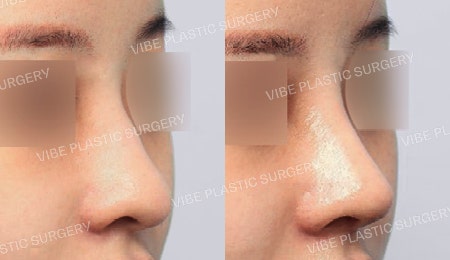
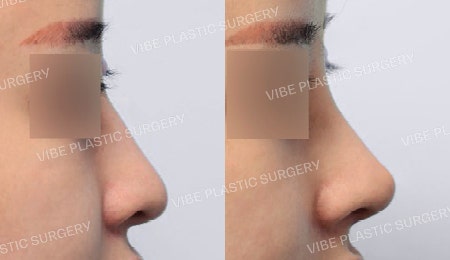
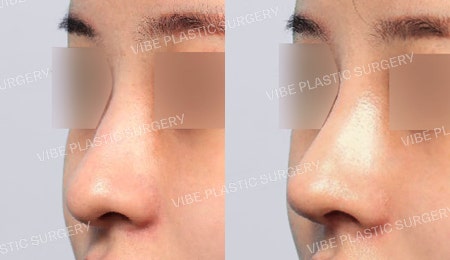
* Post-operative Progress
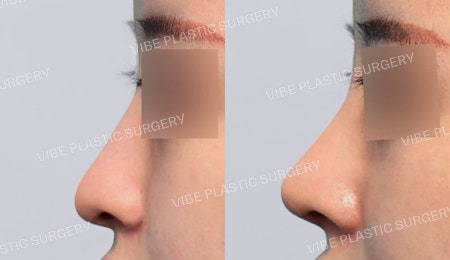
- Following the procedure, a natural yet sharp straight-semi-curved tip was achieved without excessive nostril exposure, exactly as requested.
- The bridge became sleek and elevated, drawing focus to the center of the face. This added dimension to her previously flat features, creating a slimming effect on the overall face, which the patient found very satisfying.
* Key Points
- There are varying opinions among both patients and surgeons regarding the use of donated rib cartilage. While I do not recommend it unconditionally, I believe it is a viable option when truly necessary.
- The primary concerns with donated rib cartilage are inflammation and tip drooping. Since it is a foreign material, the risk of inflammation may be slightly higher compared to using only autologous cartilage. Additionally, depending on the absorption rate, the tip may unexpectedly droop or deviate.
- However, I believe these issues mostly occur when the tip is raised excessively beyond what the individual can support, or when influenced by factors like smoking. If a proper surgical plan is established and negative factors like smoking are avoided, donated rib cartilage is a sufficiently good and sometimes necessary material.
- I advise against Hiko thread procedures if possible. Hiko uses threads to lift the tip, but it is virtually impossible to maintain that lift long-term. Furthermore, these threads become significant obstacles during future rhinoplasty surgery.
Consultations and surgeries should always be performed by a board-certified plastic surgeon!
Wishing you health and beauty :)
Right Thoughts, Right Plastic Surgery – Yoo Young-moon
Note: Complications such as bleeding, inflammation, infection, and asymmetry may occur depending on the individual, and caution is required.
Frequently Asked Questions
Why is donated costal cartilage used for low nose augmentation?
Yes, donated costal cartilage can be used when autologous cartilage alone is not sufficient for nose surgery. It can be an effective alternative, especially when the nose itself is low and the septal cartilage is soft and lacks support.
What are the possible side effects of using donated costal cartilage?
Inflammation and drooping of the nasal tip are the biggest issues when using donated costal cartilage. As it is a foreign material, the chance of inflammation may be slightly higher compared to autologous cartilage, and the nasal tip may droop or warp depending on the degree of absorption.
How can I reduce the side effects of donated costal cartilage?
Yes, you can reduce side effects by planning appropriate nose surgery and avoiding factors that can negatively affect the nose, such as smoking. The probability of side effects can increase if the nasal tip is raised excessively.
Is nose augmentation possible after a Hiko procedure?
Yes, it is possible, but the Hiko procedure can be a significant obstacle when performing nose surgery later. Therefore, it is best to avoid the Hiko procedure if possible, and a foreign body removal process is required before surgery.
Does low nose augmentation also have the effect of making the face look smaller?
Yes, after surgery, as the nasal bridge becomes smoothly higher and attention is focused on the center, the face gains dimension, and a previously flat-looking face can appear smaller. This is one of the factors that increases patient satisfaction.