2026-07-03
Clear and Defined Eyes Achieved Through Revision Surgery and Four-Directional Canthoplasty! by Dr. Yoo Young-moon, Vibe Plastic Surgery, Sinnonhyeon Station
Discover how revision eyelid surgery with ptosis correction and four-directional canthoplasty can create clear, defined eyes, especially when previous non-incisional methods have failed.
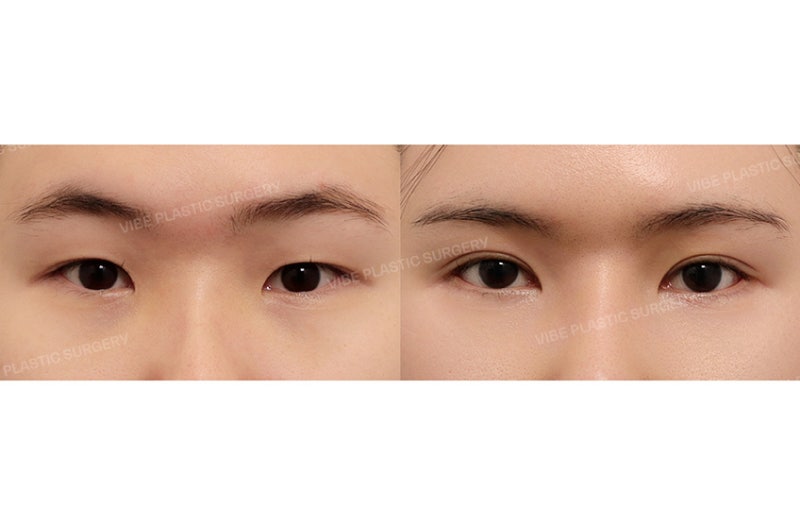
Revision surgery for loosened double eyelids requires more than just ‘pinching’ the line again.
Clear and defined eyes achieved through incisional ptosis correction revision + four-directional canthoplasty (epicanthoplasty, upper, lateral, and lower canthoplasty) tailored to your eye structure.
Hello.
I am Dr. Yoo Young-moon, head of Vibe Plastic Surgery.
Many patients visit our clinic because their double eyelid lines have faded or loosened over time after their initial surgery.
In particular, many people think,
‘I definitely had a double eyelid before, but it is gradually fading and becoming faint,’
or ‘Can’t you just pinch the line again?’
However,
in actual revision surgery, ‘finding out why it loosened in the first place’ is the most important step.
The patient I am introducing today also underwent natural adhesion double eyelid surgery and epicanthoplasty a few years ago,
but over time, the double eyelid almost completely loosened, and her eyes did not look as defined as she wanted, leading her to decide on revision surgery.
In this surgery, rather than simply recreating the double eyelid,
we performed ‘incisional ptosis correction (revision) and four-directional canthoplasty’ together
to achieve a clearer and more refreshing eye shape.
Characteristics of the Eyes Before Surgery
Looking at the photos, the following characteristics can be observed before surgery:
✔ The previous natural adhesion double eyelid had mostly loosened.
✔ The line was barely visible even when the eyes were open.
✔ The pupils were not sufficiently exposed, giving a somewhat heavy or tired impression.
✔ The effects of the previous epicanthoplasty were not adequately maintained over time.
Above all, the most critical observation was the ‘structure of the eyes.’
This patient
had a relatively prominent brow bone and relatively deep-set (sunken) eyes.
With this type of structure,
the eyelids easily cover the eyes,
and if the double eyelid is fixed simply using the non-incisional method,
the likelihood of it loosening again over time is relatively high.
Why did the natural adhesion loosen?
The natural adhesion method is an excellent surgical technique,
but it is not suitable for every pair of eyes.
In particular,
when the skin is thick,
when the eye-opening muscle is weak,
when the eyelids are heavy,
or when the patient has deep-set eyes and a prominent brow bone,
the fixation can become weak.
In such cases, the ‘incisional method,’ which allows for firmer fixation,
is often more advantageous in terms of long-term retention.
Plan for This Revision Surgery
① Incisional Ptosis Correction Revision
This is the most important part of the surgery.
Instead of simply recreating the existing line,
we supplemented the function of the eye-opening muscles
to improve pupil exposure for a clearer look.
Additionally, by directly examining the tissues through an incision,
we securely fixed the double eyelid
to minimize the possibility of recurrence.
② Epicanthoplasty / Upper Canthoplasty Revision
Epicanthoplasty is not just about opening the inner corners excessively.
In revision surgery, it is crucial to naturally improve the blocked-looking Mongolian folds
while considering the existing scars and tissue condition.
By performing an upper canthoplasty simultaneously, we designed the previously stuffy inner eye area to look much softer and longer.
③ Lateral / Lower Canthoplasty
To secure a bit more horizontal length
and alleviate the harsh, upward-slanted look of the outer corners,
we performed lateral and lower canthoplasty together.
The key is not to force them to be excessively large, but to naturally expand them in proportion to the face.
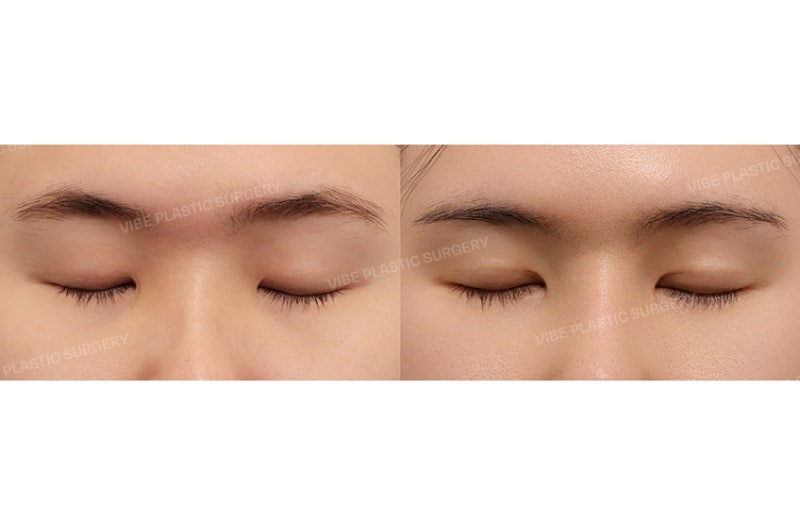
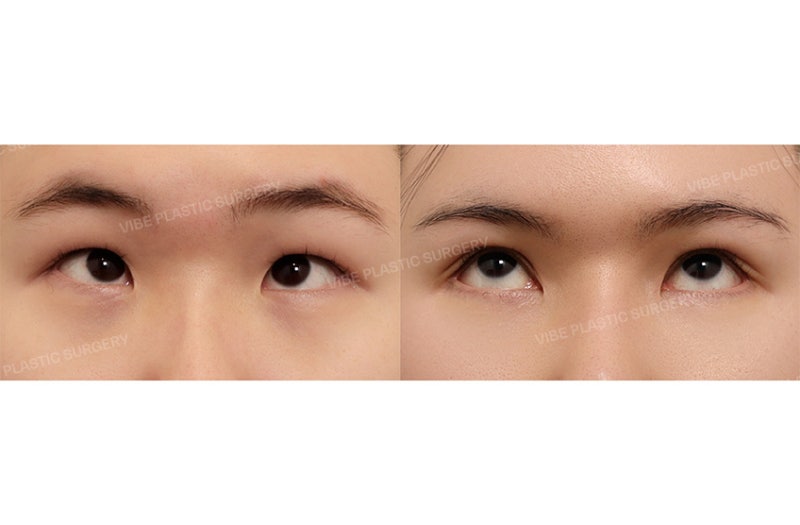
Changes After Surgery
① The pupils are exposed much more clearly.
This is the first noticeable change.
As the eye-opening power improved, the dark pupils became more exposed than before,
creating a much more vibrant and defined impression.
The sleepy look was also naturally corrected.
② The double eyelids are clear but not overly dramatic.
Just because it is a revision surgery does not mean we unconditionally create a high line.
The line became more defined at a height that best suits the patient’s face,
and it was securely fixed so it won’t easily loosen over time.
③ The horizontal length of the eyes has noticeably increased.
With the combined effects of the epicanthoplasty and lateral/lower canthoplasty, the eyes look longer overall.
It is impressive that the change looks natural, as if the eyes were originally large, rather than looking artificially over-opened.
④ The eye shape has become much more refreshing.
While the eyelids strongly seemed to cover the pupils before surgery,
the eyes are more open after surgery,
making the gaze look much clearer.
In particular, as the presence of the eyes in the overall face increased,
the impression itself transformed to look more sophisticated and confident.
Revision surgery is more difficult than the initial surgery.
Eye revision surgery
must consider the existing tissues, scars, adhesion status, previous surgical methods, and the overall eye structure.
Therefore, approaching it with the simple concept of ‘just recreating the line’
makes it difficult to achieve satisfactory results.
Especially in cases like this patient, where the eye structure itself increases the risk of recurrence,
the underlying cause must be addressed together to expect more stable results.
Vibe Plastic Surgery’s Principles for Revision Surgery
At Vibe Plastic Surgery, the first step in revision surgery
is analyzing why the previous surgical results were not maintained as desired.
Individual eye structure
Skin thickness
Eye-opening power
Eyelid weight
Scarring and adhesion status
Previous surgical methods
By comprehensively considering all the factors above, we establish the most suitable revision surgery plan for the patient.
The goal of revision surgery is not simply to recreate the line,
but to create a natural eye shape that harmonizes with the face while remaining stable for a long time.
We recommend this to the following people:
Those whose natural adhesion or non-incisional double eyelids have loosened
Those whose double eyelids have faded after their first surgery
Those who also need ptosis correction
Those who feel the effects of their previous epicanthoplasty were insufficient or disappointing
Those who want to naturally expand the horizontal length of their eyes
Those who want a natural change that doesn’t look like a revision surgery
Eye revision surgery is not simply a ‘do-over surgery.’
It is a process of analyzing the limitations of the previous surgery and considering the anatomical structure of the eyes to create a more perfected result.
As seen in this case, when incisional ptosis correction and canthoplasty tailored to the individual’s eye structure are appropriately combined,
not only do the double eyelids become clearer, but the overall impression of the eyes can transform to be much more defined and refreshing.
Frequently Asked Questions
What causes natural adhesion double eyelids to loosen?
Yes, it can loosen if the skin is thick or the power to open the eyes is weak. Also, in structures with heavy eyelids or sunken eyes and protruding brow bones, the fixation becomes weak, increasing the likelihood of the double eyelid line becoming blurred or loosening over time.
When is incisional double eyelid revision surgery necessary?
Incisional surgery may be advantageous if previous non-incisional or natural adhesion methods have loosened. By directly checking the tissue through incision, it is possible to supplement the function of the eye-opening muscle and stably fix the double eyelid, which helps to increase long-term retention and reduce the possibility of recurrence.
What are the effects of performing all four types of canthoplasty (epicanthoplasty, upper canthoplasty, lateral canthoplasty, lower canthoplasty) together?
Yes, it has the effect of naturally extending the horizontal length of the eyes and improving a stuffy impression. Epicanthoplasty and upper canthoplasty gently improve Mongolian folds, and lateral canthoplasty and lower canthoplasty alleviate upward-slanted outer corners of the eyes, completing a refreshing eye shape that matches facial proportions.
Why is eye revision surgery more difficult than the first surgery?
This is because both scars and adhesions from the previous surgery must be considered. It is much more difficult and requires a precise approach than the first surgery because the cause of failure must first be identified and resolved by comprehensively analyzing the previous surgical method and the individual's eye anatomical structure.