2026-05-25
2. Forehead Reduction Surgery
Learn about forehead reduction surgery, a procedure for those with wide foreheads, covering its necessity, ideal candidates, surgical process, and potential complications.
Hello.
I am Yoo Young-moon, a board-certified plastic surgeon.
In the last session, we discussed ‘forehead lift surgery’. If individuals with narrow foreheads and many wrinkles are good candidates for forehead lift surgery,
this time, we will explore ‘forehead reduction surgery’, which may be of interest to those with wide foreheads.
Recently, as interest in forehead cosmetic surgery has grown,
a lot of information is circulating online, and I have prepared this opportunity to provide accurate information.
* Why is forehead reduction surgery necessary?
If the forehead is too wide, the face can appear larger and older, so reducing the size of the forehead can achieve satisfactory results.
Another method to reduce forehead size is hair transplantation. Since each has clear advantages and disadvantages, it would be good to compare them if the opportunity arises.
* Who are the most satisfied with the surgery?
1. Those with a wide forehead who cover it with bangs.
2. Those who desire a beautiful hairline.
3. Those who are afraid of hair transplantation or have not seen results after surgery.
4. Those who want M-shaped hairline correction (only restrictively possible if the scalp stretches well).
5. It is also possible to perform the surgery simultaneously to prevent the forehead from widening due to endoscopic forehead lift surgery.
Among these, individuals with an M-shaped hairline (especially men) often experience less satisfaction because their scalp is firm and moves less. Therefore, I believe hair transplantation is a better option in these cases.
* Surgical Process
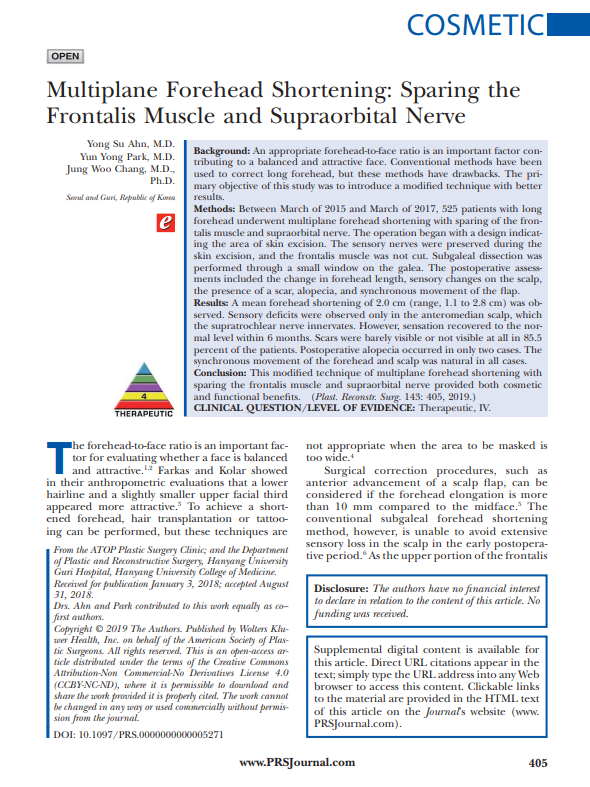
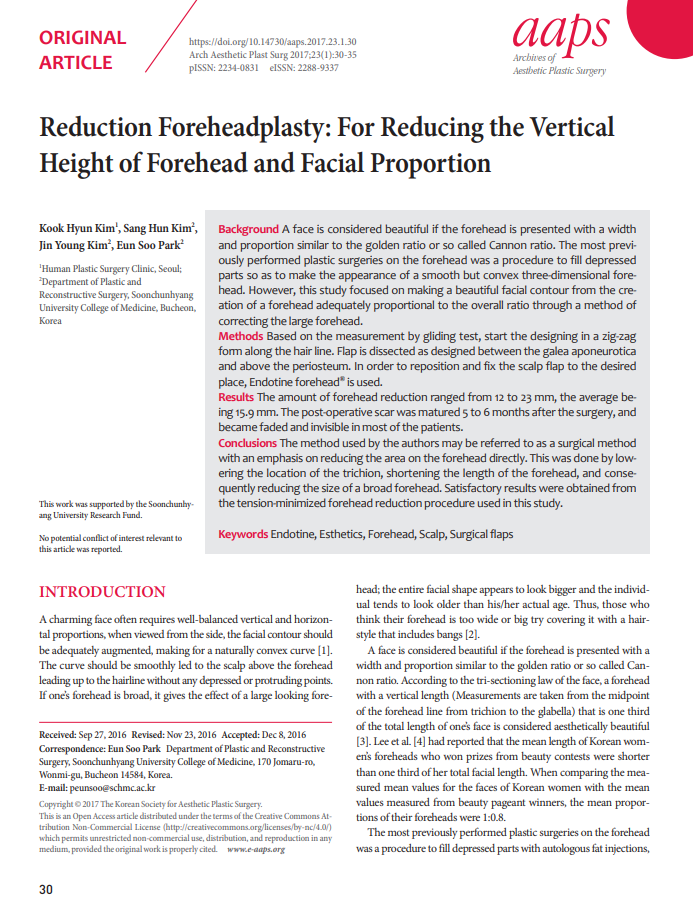
These are the reference papers for my surgical method.
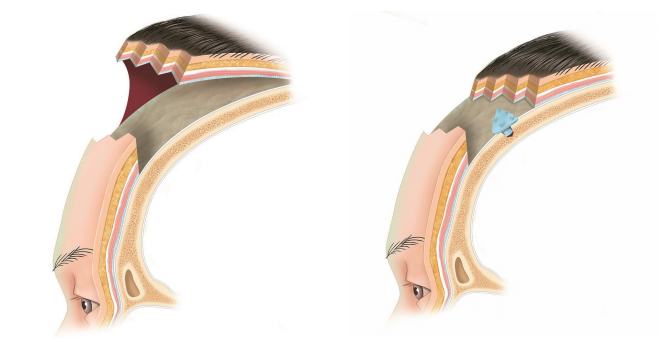
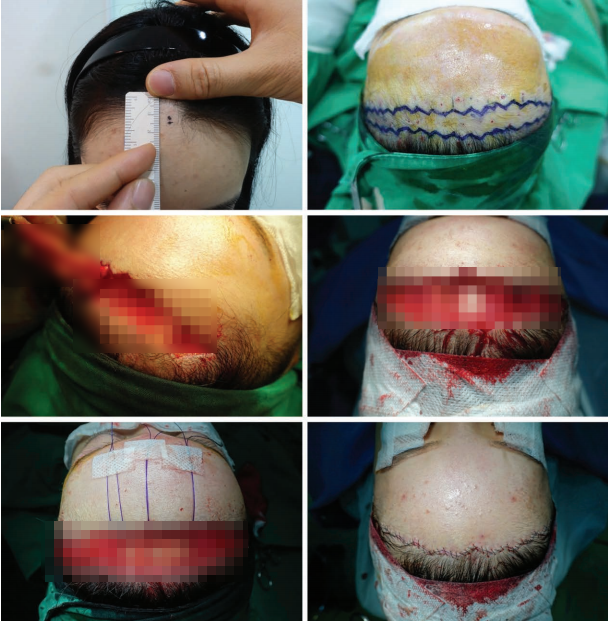
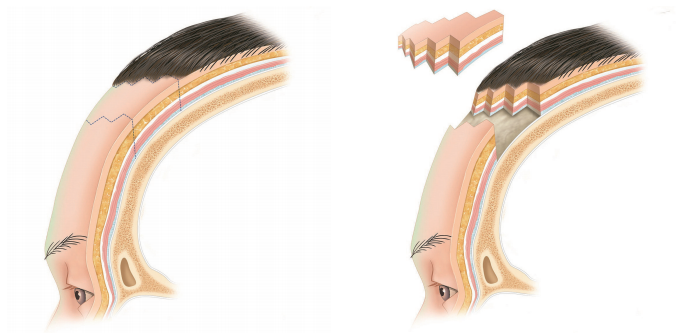
1. Design a zigzag incision 2mm inside the hairline.
2. Determine the excision range through a gliding test (generally around 2cm).
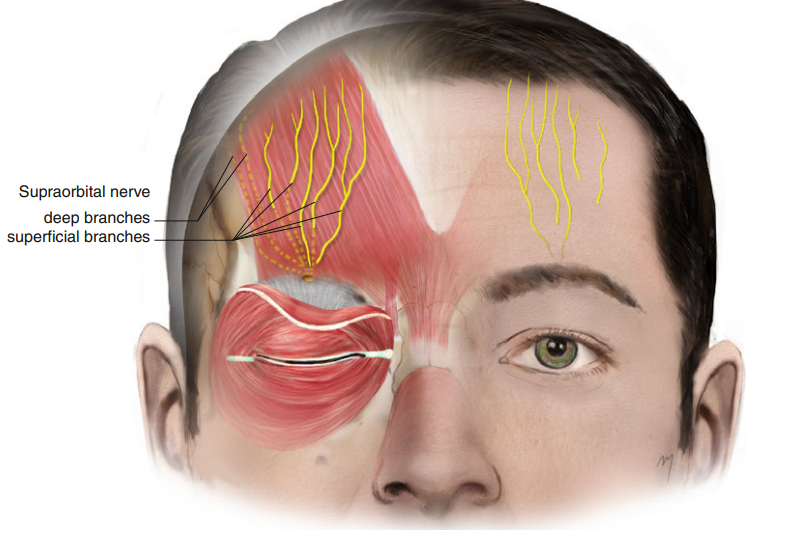
3. Excision of skin at a 30-45 degree angle to avoid damaging hair follicles (caution to avoid damaging branches of the supraorbital nerve).
4. Dissection under the scalp.
5. Fix the scalp flap in the space between the two frontalis muscles (suture or Endotine).
6. Layered suturing.
* Possible complications and treatment methods after surgery
1. Alopecia
Excessive tension can lead to hair loss. Therefore, careful excision without overstretching is necessary to avoid side effects like hair loss.
2. Sensory abnormalities
Avoiding damage to the branches of the supraorbital nerve is a very important part of the surgery. Since it is clearly visible to the naked eye, careful dissection at the anticipated location should prevent any problems.
3. Scarring
If an excessively wide area is excised, or if the process of fixing the scalp to the base is omitted, excessive tension can lead to wide scars. If suturing is performed layer by layer from the deepest layer, there is no need to worry much about scarring.
For those who have been interested in forehead cosmetic surgery,
I hope this has helped answer your questions,
and I will return with more useful topics next time. ^^
Thank you.
Frequently Asked Questions
Who is forehead reduction surgery effective for?
Forehead reduction surgery is effective for those who hide their wide forehead with bangs or desire a beautiful hairline. It can also be a good option for those who are afraid of hair transplantation, have not seen results from it, or wish to prevent their forehead from widening after an endoscopic forehead lift.
Can male M-shaped hairlines also be corrected with forehead reduction surgery?
Yes, it is possible to a limited extent, but it is only recommended if the scalp is very elastic. Especially for male M-shaped hairlines, the scalp tends to be firm with less movement, which can lead to lower satisfaction with the surgery; in such cases, hair transplantation may be a more suitable method.
What is the typical excision range during surgery?
Generally, about 2 cm will be excised. A gliding test to check scalp movement is performed before surgery to determine a safe excision range tailored to the individual's scalp elasticity, thereby preventing excessive surgery.
Are there any side effects like hair loss or scarring after forehead reduction surgery?
Excessive excision can lead to hair loss or wide scars. To prevent this, it is crucial to excise within a reasonable range, firmly fix the scalp to the base, and meticulously suture layer by layer from the deepest layer to minimize tension on the skin.
Can sensory abnormalities occur on the forehead after surgery?
Sensory abnormalities can occur if nerves are damaged, but this can be prevented with careful surgery. It is very important to visually confirm the branches of the supraorbital nerve during surgery and carefully dissect at the expected location to avoid injury.