2026-09-09
Eyelid Revision Surgery: Struggling with Loose Double Eyelid Lines and Asymmetry? by Dr. Young-moon Yoo of VIBE Plastic Surgery
Discover how non-incisional ptosis correction effectively resolves loose creases and eye asymmetry for natural, balanced revision results by Dr. Young-moon Yoo.
Hello.
I am Dr. Young-moon Yoo, Director of VIBE Plastic Surgery.
Many patients feel satisfied right after their initial double eyelid surgery, but as years pass, they notice that the double eyelid line becomes thinner, begins to loosen, or the two eyes start looking asymmetrical.
Especially for individuals in their 20s, whose eyelid skin does not yet show severe sagging, undergoing a full-incisional revision isn't always the best first choice. Instead, it is often better to accurately evaluate the current condition and perform an eyelid revision that corrects only what is strictly necessary.
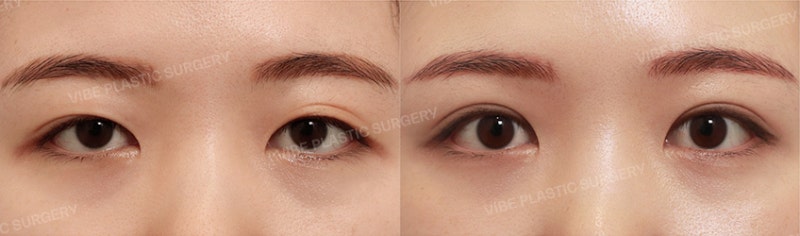
The patient featured in this case also had partial incision double eyelid surgery and epicanthoplasty about 5 years ago. Over time, the crease became thinner and partially unraveled, leading to noticeable asymmetry. She visited our clinic seeking revision surgery.
This time, we chose "non-incisional ptosis correction" to preserve her natural eye shape as much as possible while creating a more natural and balanced appearance.
Why Do Double Eyelid Lines Become Thinner and Loosen Over Time?
Just because you have double eyelid surgery does not mean the crease will stay identical forever. As time passes, eyelid tissues and adhesion states change, and depending on opening muscle strength and eyelid movement, the crease can become thinner or faint.
In such cases, the key is not simply thinking:
"I need to create a crease that will never, ever loosen again."
Instead, we must first assess how strong the eye-opening muscles currently are, evaluate the state of the existing tissue adhesion, and determine where the asymmetry originates.
When Non-Incisional Ptosis Correction Can Help
✔ When the double eyelid line has become thinner than before
If the existing line has not completely disappeared but has become faint and thin, a non-incisional approach can be used to adjust both the eye-opening strength and the crease formation simultaneously.
✔ When the eyes lack definition due to weak eye-opening muscle strength
While it may look like an issue with the double eyelid crease itself, a lack of eyelid-opening strength (mild ptosis) is often the real underlying cause. In these instances, improving eye-opening power via ptosis correction is much more effective than simply cutting a new fold.
✔ When the eyes appear unequal in size or crease shape
Eye asymmetry is far more common than people think. Eyelid skin thickness, fat volume, crease adhesion, and muscle strength are rarely identical on both sides. Therefore, in revision surgery, it is essential to analyze each factor to achieve the most harmonious, natural balance possible.
Taking all these points into account, we performed non-incisional ptosis correction on this patient to restore natural symmetry.
What Are the Advantages of Non-Incisional Ptosis Correction?
The greatest advantage of non-incisional ptosis correction is that it minimizes surgical intervention and maximally preserves existing tissues.
① Minimal incision scar concerns
Because it corrects the eyelid without making a long skin incision, visible external scarring is significantly less of a concern compared to incisional ptosis correction. This is especially advantageous for patients in their 20s who do not have excess sagging skin.
② Reduced swelling and faster recovery
While it varies based on individual tissue conditions and surgical scope, this method generally causes less post-operative swelling and downtime compared to incisional revision surgery. For active individuals in their 20s with busy schedules, this is an important factor when selecting a surgical approach.
③ Maximizing the use of existing creases
Revision surgery does not always mean completely removing the old crease and carving out a brand-new one. If the existing fold looks natural and has no major structural flaws, utilizing it while refining only the insufficient areas produces a much softer, more natural result.
④ Avoiding an overly "operated" look
This is especially critical for eyelid revisions in younger patients. Because their eyelid skin retains good elasticity with minimal laxity, excessive skin excision or an excessively high crease can result in an unnatural appearance. Wherever possible, preserving the natural anatomy and crease while making targeted adjustments is paramount.
Revision Surgery Requires Even Greater Delicacy Than Primary Surgery!
Revision surgery is inherently more challenging because the eye has already undergone surgical alteration. Internal scar tissue and adhesions may be present, and tissue conditions often differ between the left and right eyes.
Rather than simply approaching the procedure as "make my double eyelid again," one must first thoroughly analyze:
Why did the line loosen? → Why does it look asymmetrical? → Is there any issue with eyelid-opening strength?
Excessively excising tissue or making an unnaturally high crease during revision surgery can lead to stiff, awkward results.
The Core of Eyelid Revision in Your 20s: 'Only What Is Needed', Not 'More'
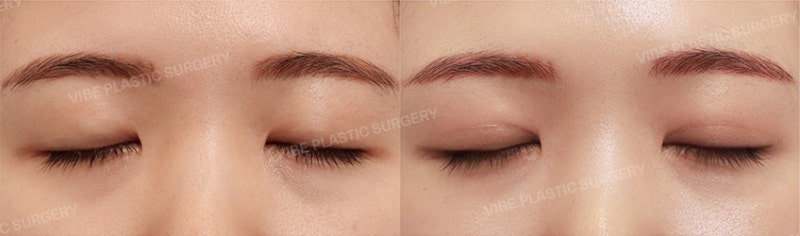
This patient had previously undergone partial incision double eyelid surgery and epicanthoplasty 5 years prior. Therefore, rather than performing a large full incision to completely rebuild the eyelids, it was crucial to make the most of her remaining tissue and existing lines.
Her creases had grown thin and faint, resulting in slight asymmetry. By using non-incisional ptosis correction to balance muscle strength while reviving the natural fold, we achieved:
Clearer, more defined lines over the faint creases,
Well-balanced symmetry between both eyes,
A refreshed, natural eye size and expression,
All without creating an excessively high or harsh crease, delivering vivid yet natural-looking eyes.
Eyelid Revision in Your 20s: Incision Is Not Always the Only Answer!
When thinking of revision surgery, many patients assume:
"Since it's a revision, doesn't it have to be an incisional procedure?"
However, that is not necessarily true. If the eyelid skin is in good condition with minimal sagging, the previous crease tissue can be utilized, and the concern can be resolved by adjusting eye-opening strength, non-incisional ptosis correction can be an excellent option.
Conversely, if there is substantial skin laxity or severe scarring and deep adhesions from prior surgery, an incisional method may be more appropriate. Ultimately, the crucial step is not deciding on "incisional vs. non-incisional" upfront, but accurately assessing which technique suits your current eyelid anatomy best.
What Matters Most for Natural Revision Results
The goal of eyelid revision is not merely re-creating a crease. The ideal outcome is:
"Eyes that feel entirely like your own, yet clearer and more defined than before."
Patients in their 20s show virtually no periocular aging, making it vital to minimize unnecessary tissue removal and accentuate existing strengths. If you share a similar story—underwent surgery 5 years ago, noticed fading lines, and are bothered by asymmetry—it is wise to evaluate whether a subtle, minimally invasive fix like non-incisional ptosis correction can address your needs before jumping into extensive revision surgery.
Eyelid Revision at VIBE Plastic Surgery
Even a millimeter's difference around the eyes can alter your entire impression. Because eyelid revision involves operating on previously treated tissue, thoroughly assessing current tissue conditions and prior surgical traces is paramount.
At VIBE Plastic Surgery, we meticulously examine:
Double eyelid lines / Eye-opening muscle strength / Bilateral asymmetry / Skin and fat conditions / Traces of previous surgeries
We then plan the procedure around precise, targeted adjustments. If you are troubled by loose creases or asymmetric eyes in your 20s, remember that creating overly big, dramatic folds is rarely the solution. Enhancing your eye's natural strengths while refining only the necessary elements is what ensures lasting satisfaction.
Frequently Asked Questions
What causes double eyelid lines to become thinner or loosen after surgery?
It occurs because the eyelid tissues and the internal adhesion change over time. Changes in eyelid-opening muscle strength or blinking movement can also cause the original crease to become gradually thinner or fade.
Does revision eye surgery always have to be performed using an incisional method?
No, it does not. If skin sagging is minimal and existing tissues can be utilized, revision is entirely possible through non-incisional ptosis correction. The optimal technique should be selected based on the degree of skin laxity and tissue adhesion.
What are the advantages of non-incisional ptosis correction in revision eye surgery?
It minimizes the recovery burden, such as incisional scarring and swelling. By making the best use of existing creases, it reduces unnecessary tissue trauma and creates a natural eye shape without noticeable surgical marks.
Can eye asymmetry, such as differences in eye size or eyelid shape, be corrected?
Yes, it is possible. By precisely analyzing the differences in skin thickness, fat volume, and eyelid-opening strength between both eyes, balance is restored using methods like non-incisional ptosis correction.