2026-07-19
If you're concerned about a nose bridge that's too narrow and artificial, consider 'Fit Me 3D Custom Implants'! by Dr. Youngmoon Yoo, Vibe Plastic Surgery, Sinnonhyeon Station
This article discusses a rhinoplasty revision case for a patient concerned about an artificial-looking, narrow nose bridge and a drooping tip. It highlights the use of Fit Me 3D custom implants, autologous costal cartilage, and internal alar reduction for a natural, refined result.
Hello.
I am Dr. Youngmoon Yoo from Vibe Plastic Surgery.
‘My nose is higher, but something feels unnatural.’
This is the most common comment I hear from patients who come for revision surgery consultations.
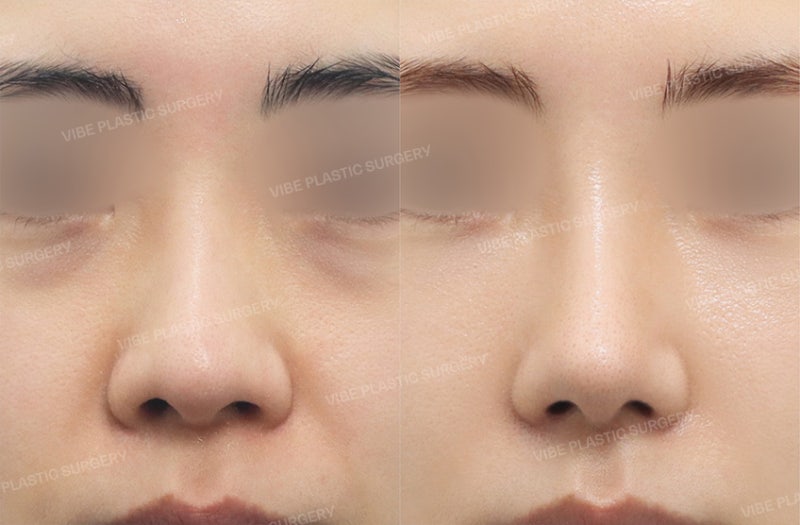
The case I'm introducing today is also a rhinoplasty revision for a woman in her 30s who was concerned about an artificial impression due to a drooping nasal tip over time and a nose bridge that looked too narrow and straight.
Pre-surgery concerns
This patient had previously undergone rhinoplasty with:
Nasal bridge implant insertion
Nasal tip mesh insertion
However, over time,
✔ An excessively narrow nose bridge, giving a stuffy and artificial feeling
✔ A round and drooping nasal tip
✔ Asymmetrical nostrils
became increasingly bothersome, and she decided on revision surgery for a more natural and refined nose line.
1. The nose bridge was designed with a 'custom 3D implant (Fit Me)'.
In this surgery, after removing the existing implant,
a new nose bridge was designed using a custom 3D implant (Fit Me).
What is a custom implant (Fit Me)?
While existing off-the-shelf implants were chosen from a predetermined shape,
the 'Fit Me 3D custom implant' analyzes the patient's face and nose structure
to create a customized 3D implant that matches the individual's height, width, length, and curve.
In other words, its biggest advantage is that it can design the most natural nose bridge tailored to each person's unique facial proportions and bone structure.
<Advantages of custom 3D implants>
✅ Fine adjustment of desired height is possible
It achieves the height that best suits you, neither too high nor too low.
✅ Design of the nose bridge width is possible
More people than you might think say,
‘My nose stands out not because it's too high, but because it's too narrow.’
Fit Me implants consider the patient's facial width, glabella, and nasal bone shape
to design a natural and appropriate width.
This aspect is especially crucial in revision surgery.
✅ Design considering harmony with the entire face
It can create a smoothly connected line not only from the front but also from 45 degrees and the side.
Therefore, it can create a natural nose that harmonizes with the entire face, not just a nose that has been made taller.
<Recommended for these individuals.>
If the existing implant is too noticeable
If the nose bridge appears excessively narrow
If you desire a natural straight-to-upturned line
If you want a design tailored to your face from the first surgery
If you desire more precise results in revision surgery
2. The nasal tip was stably corrected using autologous costal cartilage.
One of the most important aspects of rhinoplasty revision is
how stably the nasal tip is supported.
After removing the mesh, this patient's nasal tip was newly reconstructed using autologous costal cartilage (her own rib cartilage).
Why was autologous costal cartilage used?
In revision surgery, existing tissue may be damaged or
cartilage may be insufficient.
In such cases, the most reliable material is
autologous costal cartilage.
<Advantages of autologous costal cartilage>
✅ Sufficient quantity can be secured.
In revision surgery, existing cartilage is often insufficient,
but autologous costal cartilage can be used as much as needed, allowing for various corrections.
✅ Provides strong support.
It is very advantageous in preventing the nasal tip from drooping again.
This is a significant advantage, especially for drooping nasal tips, short noses, and revision surgeries.
✅ Excellent biocompatibility as it is the patient's own tissue.
Since it is autologous tissue, the possibility of foreign body reactions or rejection is very low,
and stable long-term results can be expected.
✅ Precise carving into various shapes is possible.
Autologous costal cartilage
allows for fine adjustment of the nasal tip's height, shape, and angle,
helping to create a more natural and three-dimensional nasal tip.
<Autologous costal cartilage is especially recommended in these cases>
Rhinoplasty revision
When reconstruction is needed after mesh removal
When the nasal tip is significantly drooping
When cartilage is insufficient
When stable, long-lasting results are desired
3. Nostril asymmetry was corrected with internal alar reduction.
This patient was concerned not only about her nasal tip but also about the difference in the size of her left and right nostrils.
To improve this, 'internal alar reduction' was performed concurrently.
<Advantages of internal incision>
Since the internal incision is made primarily inside the nostril,
external scars are barely visible.
Furthermore, the key is not to excessively reduce the alar base unnecessarily,
but to create a natural shape while balancing the left and right sides.
Especially in cases like this patient's, where nostril asymmetry is present,
correcting the alar base and nostrils together, rather than just the nasal tip, enhances overall completeness.
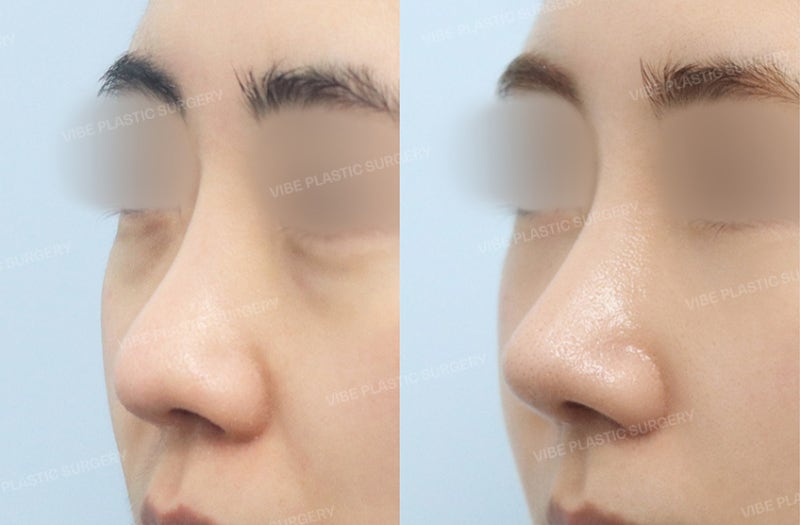
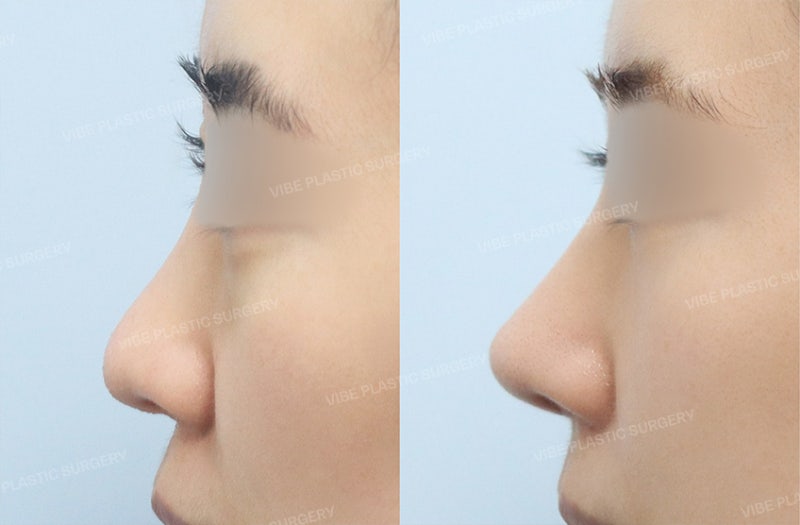
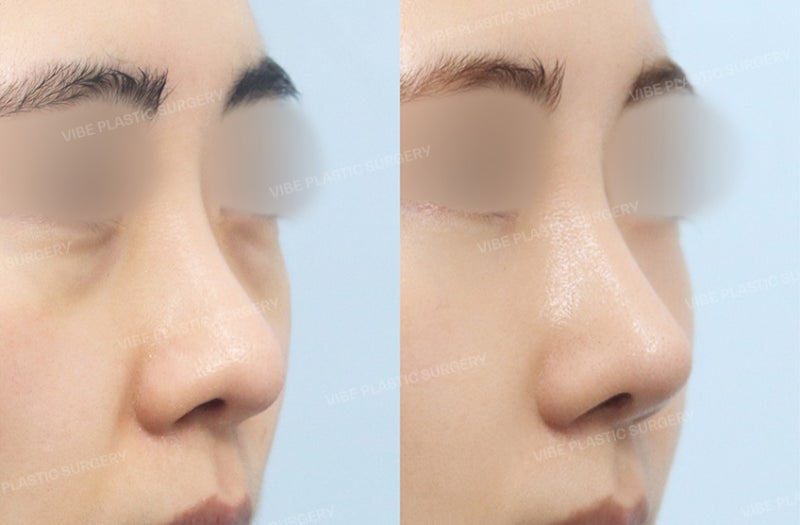
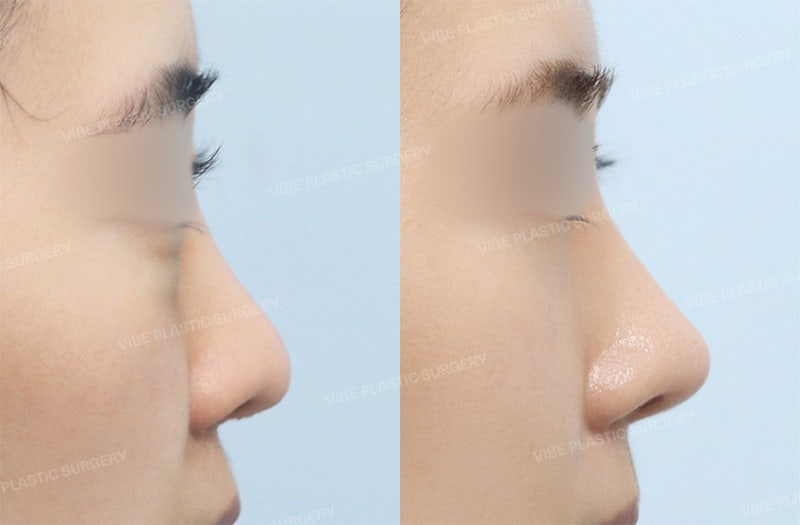
Rhinoplasty revision is not simply a surgery to make the nose higher again.
Revision surgery cannot be solved by merely replacing existing implants.
✔ Why did it look unnatural?
✔ Why did the nasal tip droop?
✔ Why did the nostrils become asymmetrical?
It is crucial to accurately analyze these causes and then redesign the nose in a way that harmonizes with the patient's face.
In this case,
a natural nose bridge was designed with a custom 3D implant (Fit Me),
the nasal tip was stably reconstructed with autologous costal cartilage,
and nostril asymmetry was also improved through internal alar reduction,
resulting in a more natural and refined nose.
I recommend a rhinoplasty revision consultation if you:
Have a nose bridge that looks too narrow and artificial after previous nose surgery
Have a blunt or drooping nasal tip after mesh use
Are considering rhinoplasty revision
Desire a natural nose bridge with a custom 3D implant
Want stable nasal tip surgery using autologous costal cartilage
Wish to improve nostril asymmetry and alar base shape together
Naver SEO Core Keywords
Rhinoplasty revision, revision nose surgery, custom implant, Fit Me implant, 3D custom implant, autologous costal cartilage rhinoplasty, autologous costal cartilage revision, drooping nasal tip, mesh removal, alar reduction, internal alar reduction, nostril asymmetry, natural rhinoplasty, bulbous tip correction, Gangnam rhinoplasty revision, Vibe Plastic Surgery
Frequently Asked Questions
What is a Fit Me 3D custom implant?
A Fit Me 3D custom implant is a personalized 3D implant created by analyzing the patient's face and nose structure to customize its height, width, length, and curve. Its biggest advantage is that it can design the most natural nose bridge tailored to each person's unique facial proportions and bone structure.
Why is autologous costal cartilage used in rhinoplasty revision?
In revision surgery, existing tissue is often damaged or cartilage is insufficient, so autologous costal cartilage, a reliable material, is used. It allows for sufficient quantity, provides strong support, and, being the patient's own tissue, has excellent biocompatibility, leading to stable long-term results.
How does a Fit Me 3D custom implant help improve a narrow nose bridge?
Yes, a Fit Me 3D custom implant is effective in improving a narrow nose bridge because it can design the width of the nose bridge. It considers the patient's facial width, glabella, and nasal bone shape to design a natural and appropriate width, reducing an artificial appearance.
Can nostril asymmetry also be corrected with rhinoplasty revision?
Yes, nostril asymmetry can be corrected through internal alar reduction. The incision is made primarily inside the nostril, so external scars are barely visible, and the key is to create a natural shape by balancing the left and right sides.
In what cases is a Fit Me 3D custom implant recommended?
It is recommended for those whose existing implant is too noticeable or whose nose bridge appears excessively narrow, who desire a natural straight-to-upturned line, who want a design tailored to their face from the first surgery, or who desire more precise results in revision surgery.