2026-09-18
Is Male Rhinoplasty Only About Looking Good? | Functional Rhinoplasty Correcting a Deviated Septum by Dr. Young-Moon Yoo of Vibe Plastic Surgery near Sinnonhyeon Station
Dr. Young-Moon Yoo of Vibe Plastic Surgery details a male functional rhinoplasty case using rib cartilage to reconstruct a severely deviated septum and refine a short, bulbous nose.
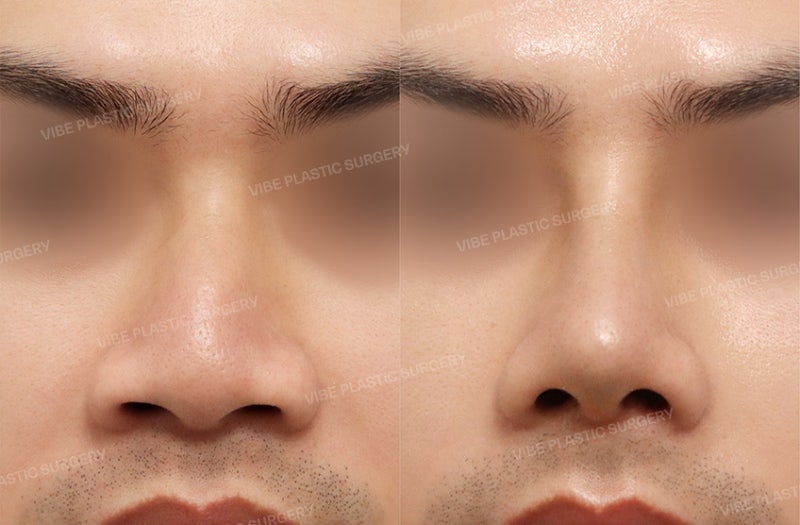
Is male rhinoplasty merely a surgery to make your nose look good?
A case where a severely deviated septum was corrected and the structural support of the nose was rebuilt using rib cartilage.
Hello.
I am Dr. Young-Moon Yoo of Vibe Plastic Surgery.
When thinking of rhinoplasty, most people
first envision aesthetic aspects such as the height of the nasal bridge, the shape of the nasal tip, and harmony with the face.
However, the nose is not just an aesthetic structure sitting in the middle of the face.
It is a respiratory organ through which air passes, as well as the central framework of the face.
Therefore, when planning a rhinoplasty,
it is crucial to evaluate not just “How can the nose look more attractive?”
but also “Could the current internal nasal anatomy be obstructing breathing?”
This male patient is an excellent case demonstrating these exact points.
The patient presented with
functional discomfort, such as nasal congestion caused by a severely deviated septum,
along with a low nasal bridge and a short, bulbous nasal tip.
Thus, in this procedure,
we planned both functional rhinoplasty to resolve breathing difficulties
and aesthetic rhinoplasty to refine the outward appearance simultaneously.
1. Why is a severely deviated septum a problem?
Inside the nose, there is a central dividing wall known as the nasal septum.
When this septum is severely deviated, the nasal airway on one or both sides becomes narrowed,
making breathing through the nose difficult.
In cases like this patient's where the septal deviation is severe,
the issue goes beyond just external crookedness;
the internal airway itself is physically constricted.
In such instances, assessing the septum's condition during rhinoplasty and correcting it as necessary is essential.
Not all rhinitis is the same.
Nasal congestion does not always originate from identical causes.
For instance, allergic rhinitis is an inflammatory and immune response
to allergens such as pollen and dust mites, leading to a runny nose, sneezing, and congestion.
On the other hand, structural defects inside the nose, such as a deviated septum or hypertrophic turbinates,
can also induce nasal obstruction.
Simply put:
* Allergic Rhinitis
→ Primarily caused by inflammation and immune reactions to allergens
* Structural Nasal Obstruction
→ The physical airway space is restricted due to a deviated septum or enlarged inferior turbinates
Therefore, functional rhinoplasty essentially plays a critical role in correcting these structural issues.
However, functional rhinoplasty does not cure allergies themselves.
If allergic rhinitis is concurrently present, additional medical management—such as oral medications or nasal sprays—may be necessary.
2. How is functional rhinoplasty performed?
For this patient, functional correction proceeded along two main tracks.
① Septoplasty (Deviated Septum Correction)
This step straightens the severely deviated septum
to secure adequate space in both nasal cavities.
Rather than simply resecting large portions of curved cartilage,
it is vital to preserve as much essential supporting structure as possible
while realigning the crooked portions to re-establish an open airway.
Because the nasal septum is the central structural pillar of the nose,
it plays an indispensable role not only in respiration, but also in providing stable support for the nasal tip and bridge.
Consequently, in patients with severe septal deviation,
function and aesthetics cannot be treated separately.
② Inferior Turbinate Reduction / Resection
If hypertrophic inferior turbinates coexist with a deviated septum,
the nasal passage becomes even more constrained.
In this scenario, reducing the size of the inferior turbinates appropriately
can open up a clearer pathway for airflow.
The goal is not to aggressively remove the turbinate, but to reduce it just enough
while preserving the physiological function of the nasal mucosa as much as possible.
Ultimately, the core of functional rhinoplasty is
"to resolve structural blockages inside the nose and establish smoother airflow."
3. However, this patient had an additional challenge
Namely, the septum was not only severely deviated, but it was also deficient in size.
If there is ample septal cartilage available, various structural corrections can be accomplished with it alone.
However, in cases like this patient,
where the septum is severely curved
and the amount of harvestable cartilage is insufficient,
supplemental cartilage is required to build the necessary support framework.
This is where "rib (costal) cartilage" plays an essential role.
4. Why use rib cartilage?
Many people assume that rib cartilage
is used solely "to make a nose extremely high."
However, the greatest advantage of costal cartilage is far more than just adding height.
It is the ability to obtain "an abundant volume and strong structural rigidity."
Septal and ear cartilages have clear limits in terms of harvestable volume.
In contrast, costal cartilage provides a generous amount of material,
allowing the surgeon to carve various structural grafts whenever firm support is needed.
It is a crucial choice, especially when septal cartilage is depleted and extensive structural reconstruction is required.
Indications for considering rib cartilage include:
Significant shortage of septal cartilage
Severe septal deformities
Short or contracted nose
Weak structural nasal support
Reconstruction required due to severe deformity or trauma
Revision rhinoplasty lacking available septal or ear cartilage
Cases requiring simultaneous lengthening and robust tip projection
Especially when the septum itself is undersized and heavily deviated as in this patient,
rib cartilage serves not simply as a "filler for height,"
but as a fundamental material to reliably reconstruct the central nasal framework.
The essence of rib cartilage lies in 'structure', not just 'height'
This principle was the primary reason for utilizing rib cartilage in this case.
If the sole objective had been simply raising the nose a bit,
alternative options might have sufficed.
However, for this patient, we needed to:
* Correct the deviated septum,
* Support and project the nasal tip,
* Lengthen the short nose structure, and
* Stably establish the overall nasal silhouette.
Hence, using rib cartilage—with its ample supply and structural strength—
was vital to rebuild the foundational framework of the nose.
In other words, costal cartilage can be defined as "a reconstructive material that rebuilds and supports the nasal architecture, rather than merely an implant to raise height."
This definition perfectly fits this case.
5. Aesthetic concerns were refined in parallel
Resolving functional problems alone does not address all of a patient's concerns.
Aesthetically, this patient was troubled by
a low bridge, a bulbous tip, and a short nose length.
Therefore, alongside the functional correction, the external appearance was refined as well.
Low Nasal Bridge
Instead of raising the bridge excessively,
we aimed for a natural height that harmonized with the patient's facial features.
A silicone implant of natural thickness was placed to delineate a clean nasal dorsum.
The emphasis was not on achieving an "unrealistically high bridge,"
but on providing appropriate three-dimensional definition to a previously flat profile.
Defining the Bulbous Nasal Tip
The goal at the tip is not merely making it smaller.
Particularly in male rhinoplasty,
making the nasal tip excessively sharp or pinched can look unnatural and out of place.
It is crucial to establish firm structural tip support,
refine the bulbous tip into a sharper, defined contour,
and achieve a smooth, masculine transition connecting the bridge to the tip.
Correcting the Short Nose
Lengthening the short nose was another critical component for this patient.
When a nose is short, simply elevating the bridge is rarely enough.
One must carefully assess the position and direction of the tip, the septal support structure, and the nasolabial angle.
Accordingly, rib cartilage was utilized in this surgery
to secure a solid structural anchor,
simultaneously extending the length of the nose and reshaping the tip contour.
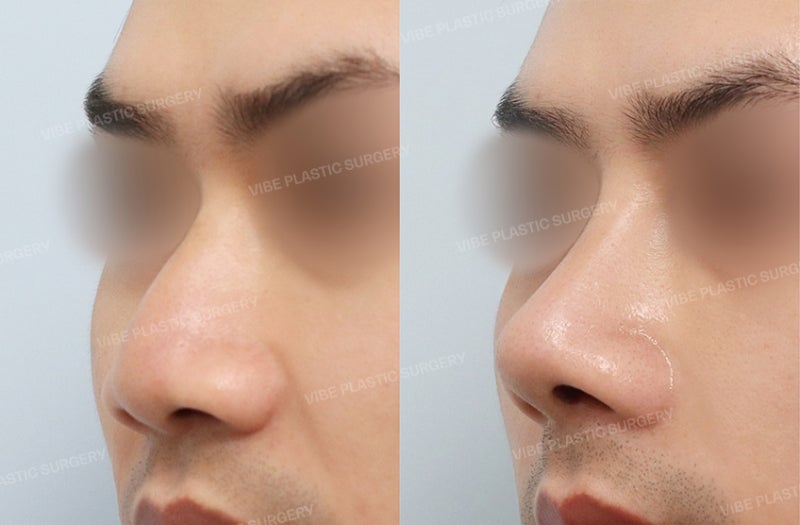
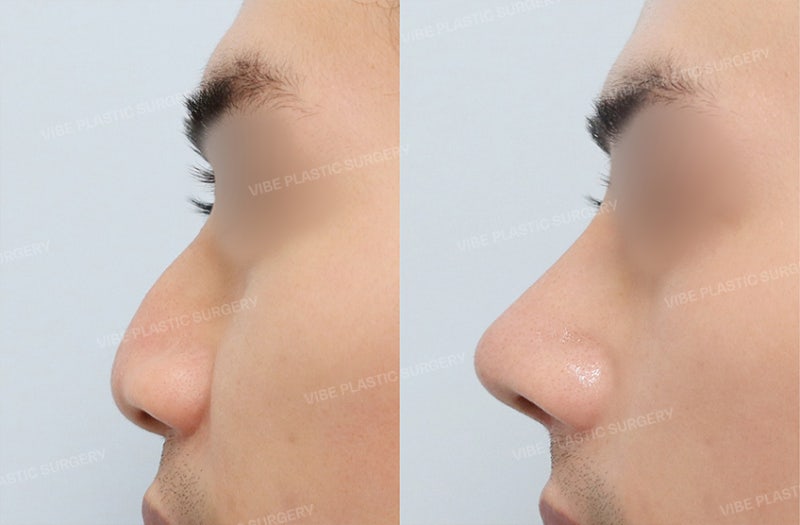
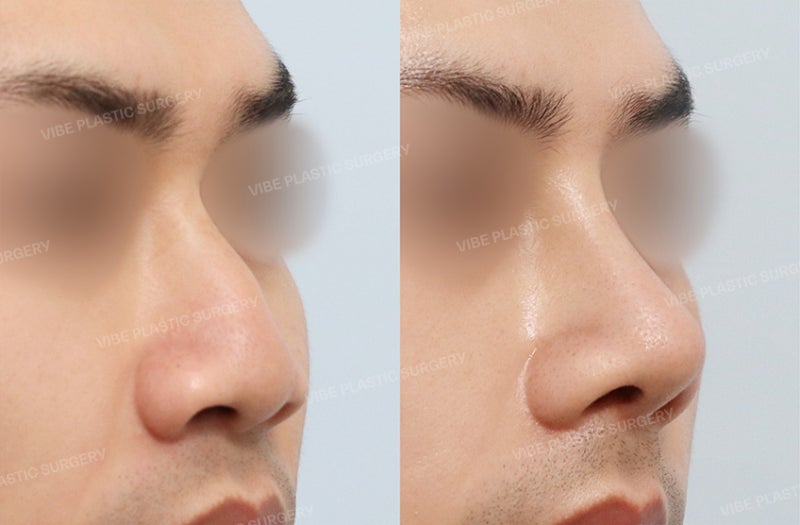
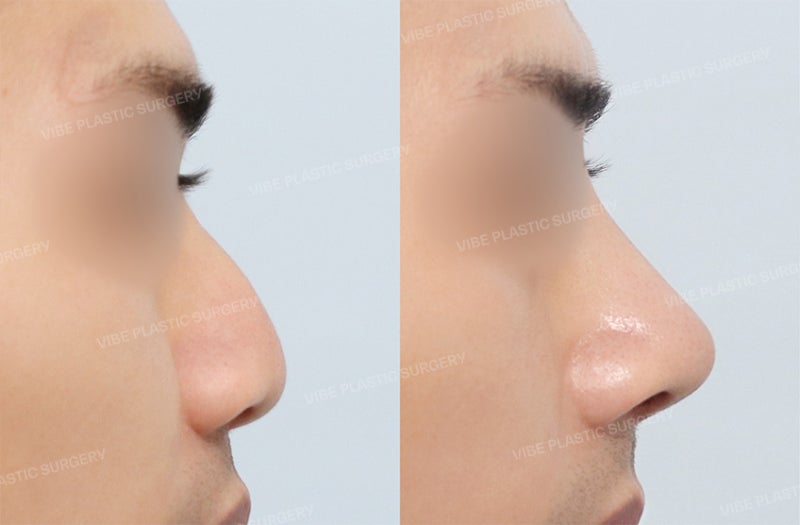
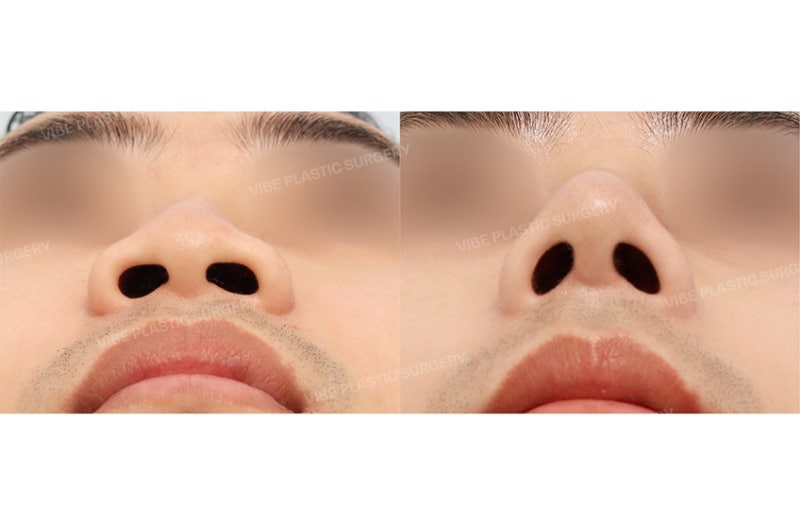
Ultimately, the core of this surgery was combining 'Function + Aesthetics'!
A summary of this patient's procedure is as follows:
<Functional Aspects>
1. Septoplasty
→ Corrected the severe septal deviation to resolve internal structural narrowing
2. Inferior Turbinate Reduction / Resection
→ Expanded the airway constricted by turbinate hypertrophy
<Structural & Aesthetic Aspects>
1. Use of Costal (Rib) Cartilage
→ Compensated for insufficient septal cartilage and established strong structural support
2. Aesthetic Refinements
* Dorsal Implant
→ Naturally elevated the low nasal bridge
* Tip Plasty
→ Refined the bulbous nasal tip into a crisp, masculine contour
* Nasal Length & Proportions
→ Elongated the short nose into balanced harmony with the whole face
Rhinoplasty can also make breathing remarkably easier!
This represents the most rewarding aspect of this case.
For this patient, rhinoplasty was never simply
"a surgery to raise a low nose."
By straightening the severely deviated septum
and addressing inferior turbinate hypertrophy,
internal anatomical obstructions were eliminated.
Simultaneously, using rib cartilage provided the necessary structural foundation to correct the low bridge, bulbous tip, and short length,
delivering an aesthetic transformation.
In other words,
both functional and aesthetic concerns were addressed holistically within a single procedure.
A well-functioning nose is even more important than a pretty nose
The nose is both the focal point of the face and a vital respiratory organ.
Therefore, when planning rhinoplasty,
checking "Is the internal nasal structure healthy?"
is just as crucial as asking "How high should it be raised?"
Especially if you experience:
Severe chronic nasal congestion
Difficulty breathing primarily through one nostril
A noticeably deviated septum
Significantly enlarged turbinates
Coexisting external deformities and functional breathing issues
Then undergoing a thorough functional evaluation alongside an aesthetic consultation will be immensely beneficial.
Conclusion
This male patient faced overlapping challenges:
"Severe septal deviation + deficient septal cartilage + low nasal bridge + bulbous, short nasal tip."
Hence, inserting an implant onto the bridge alone would have fallen far short.
We approached the case by first correcting internal airway structures,
reinforcing the weak foundation with rib cartilage,
and then layering aesthetic refinement to balance the bridge and tip.
As a result,
breathing function was restored,
while achieving a refined nasal shape and enhanced facial dimension.
This is the true value of functional rhinoplasty.
Rhinoplasty is not merely a surgery to make a nose look attractive.
The outer appearance and inner structure of the nose are inextricably linked.
Thus, exceptional rhinoplasty must be a surgery that
considers function + reconstructs anatomy + adds aesthetic beauty on top.
At Vibe Plastic Surgery, whenever we plan rhinoplasty,
we do not look solely at the exterior profile of the bridge and tip.
We thoroughly analyze the septal condition, internal nasal framework, respiratory function, tip structural support, and facial proportions to design the ideal surgical plan.
Addressing both aesthetic desires and functional needs within a single, integrated surgical plan
remains one of the greatest benefits of functional rhinoplasty.
Frequently Asked Questions
Can functional rhinoplasty completely cure allergic rhinitis?
No, functional rhinoplasty cannot cure allergic rhinitis itself. The procedure corrects structural causes of nasal obstruction, such as a deviated septum or hypertrophic inferior turbinates. Symptoms triggered by allergens like pollen or dust mites will still require medical treatments, such as oral antihistamines or nasal sprays, after surgery.
When is rib cartilage typically used in rhinoplasty?
Rib cartilage is primarily used when strong structural support is required or when septal cartilage is depleted. Rather than being just a filler to raise the bridge, rib cartilage provides abundant volume and firmness, making it ideal for severe septal reconstruction, lengthening short or contracted noses, and building durable tip support.
Does septoplasty require the complete removal of the deviated cartilage?
No, curved cartilage is not aggressively removed. Septoplasty aims to preserve the crucial framework needed for stable nasal support while selectively realigning or trimming the deviated portions to reopen the airway.
Can septoplasty and aesthetic rhinoplasty be performed at the same time?
Yes, both can be performed together in a single operation. The nasal septum functions both as a breathing passage and as the central structural pillar for the nasal bridge and tip. Therefore, combining functional septoplasty with aesthetic bridge and tip refinement ensures both structural stability and optimal cosmetic results.