2026-10-02
Rhinoplasty for Women in Their 50s: How to Naturally Correct a Bulbous, Drooping Tip & Dorsal Hump! by Dr. Young-moon Yoo of VIBE Plastic Surgery (Gangnam / Sinnonhyeon Station)
Discover how rhinoplasty in your 50s can naturally correct a bulbous, drooping tip and dorsal hump using firm cartilage support and tailored implants at VIBE Plastic Surgery in Gangnam.
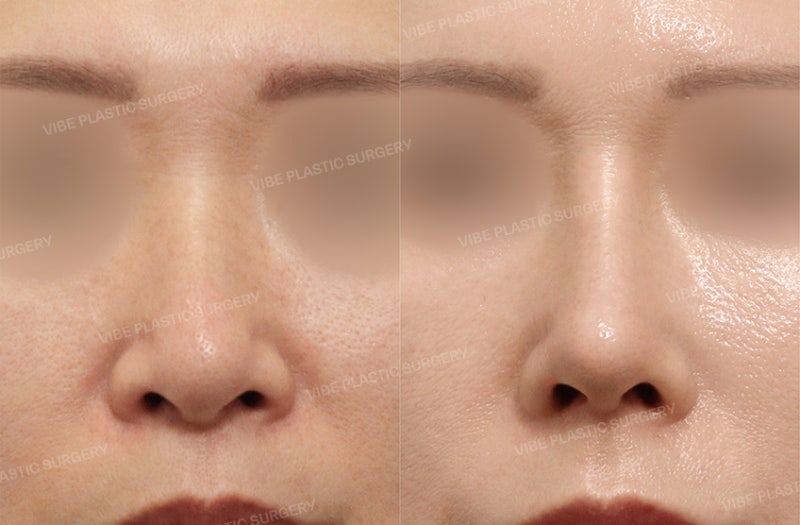
Hello.
I am Dr. Young-moon Yoo, Director at VIBE Plastic Surgery.
Today, I would like to introduce a rhinoplasty case of a female patient in her 50s.
As we age, subtle changes can occur in the shape of our nose.
In particular, the tip of the nose may gradually droop downward or appear bulbous,
and as the nasal bridge becomes relatively lower, the overall impression of the nose can appear blunt or heavy.
This patient also visited our clinic wishing to improve:
A bulbous and drooping nasal tip,
A dorsal hump on the nasal bridge,
And a low nasal bridge.
Rather than simply making the nose taller,
it was crucial in this case to firmly reinforce the structure of the nasal tip
while balancing the nasal bridge with the tip.
1. A Firm Support Structure Is Essential for a Bulbous, Drooping Nasal Tip
In rhinoplasty for patients in their 50s and beyond,
simply suturing the cartilages together to lift the tip
is often not enough.
Especially if the nasal tip is bulbous and sagging downwards,
it is vital to build a sturdy framework
so that the tip can be reliably maintained in the desired position.
In this case, we used rib (costal) cartilage and septal cartilage to create a robust tip support structure.
Rather than merely elevating the tip,
we focused on establishing a stable structure that simultaneously takes into account the direction, height, and projection of the nasal tip.
Through this, we naturally lifted the drooping tip
and refined the previously bulbous tip into a much clearer, defined contour.
2. Correcting the Dorsal Hump and Low Nasal Bridge
Along with the nasal tip, the patient also wanted
to address the dorsal hump and her low nasal bridge.
First, the dorsal hump was shaved down to create a smoother bridge line.
Afterward, an implant was placed to adjust the height of the nasal bridge and correct the low profile.
The key here is not simply building an excessively tall bridge.
It is important to create a line where the bridge and tip connect naturally,
taking into account both the overall facial proportions and the elevation of the nasal tip.
In this case as well, rather than creating an overly high and artificial appearance,
our focus was on finding the ideal height and angle that best suited the patient's face.
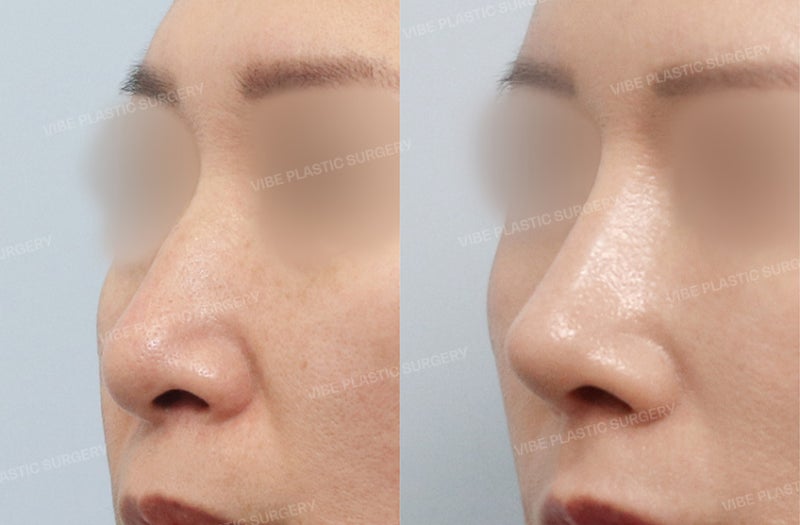
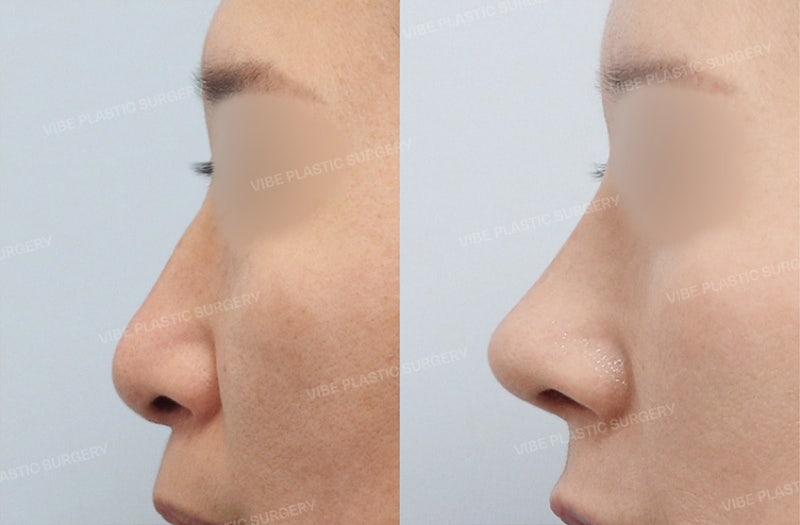
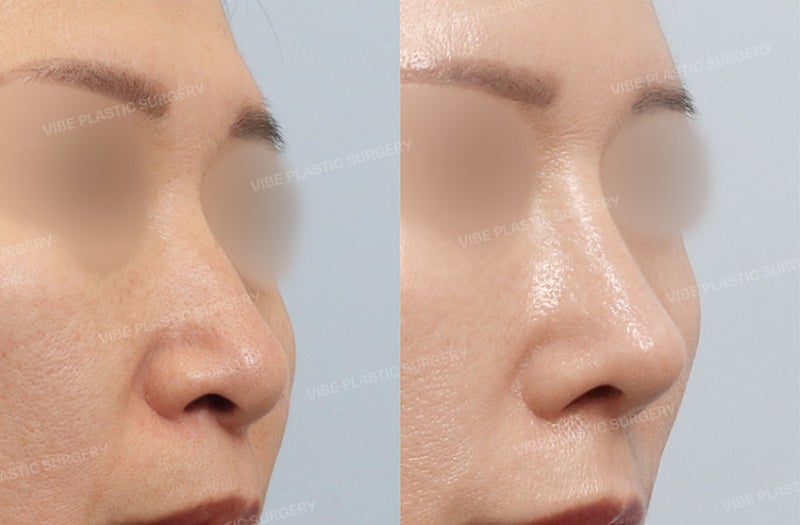
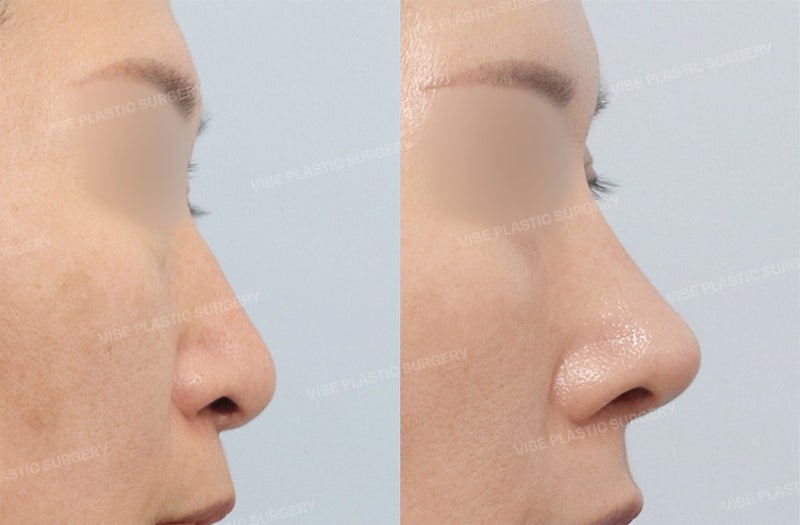
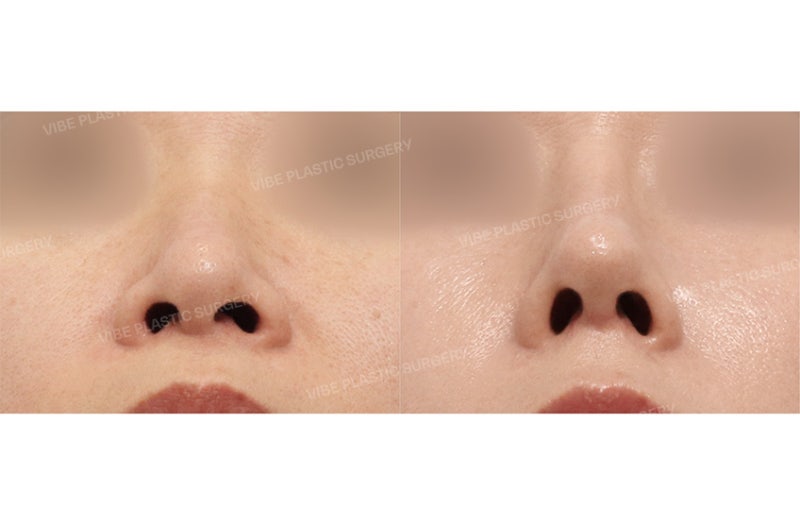
Postoperative Changes
After the surgery,
you can see that the bulbous and sagging tip has become more defined,
the dorsal hump has been smoothed out,
and the low bridge has been naturally elevated.
In particular, the line flowing from the bridge down to the tip
is not overly bent or steeply angled,
but rather finishes into a naturally flowing semi-straight (jik-ban) profile.
For rhinoplasty in one's 50s and older, rather than attempting to raise the nose to the exact same shape or angle as seen in younger demographics,
it is far more important to consider natural aesthetics and overall facial harmony.
Rhinoplasty in Your 50s: The Priority Is 'How to Harmonize' Rather than 'How High to Build'
Middle-aged rhinoplasty cannot be approached as a simple procedure to just raise a flat nose.
One must comprehensively evaluate the degree of tip drooping, the condition of the skin and cartilage, the presence of a dorsal hump, and the overall facial proportions.
Especially when the tip is bulbous and drooping,
creating a structure that can securely support the tip
is a crucial factor that determines the success of the surgical outcome.
In this female patient in her 50s, we secured reliable tip support using costal and septal cartilage,
smoothed the hump, and elevated the bridge with an appropriately sized implant.
As a result:
Bulbous and drooping nasal tip → Defined, natural nasal tip
Humped nasal bridge → Smooth, sleek nasal bridge
Low nasal bridge → Natural height harmonizing with the facial features
With these refinements, we achieved an overall more sophisticated and youthful appearance.
If you are considering rhinoplasty in your 50s,
rather than focusing solely on height,
we recommend scheduling an in-depth consultation that evaluates the tip's underlying structure, the transition between the bridge and the tip, and harmony with the entire face.
Frequently Asked Questions
How is a drooping nasal tip corrected in 50s rhinoplasty?
It is corrected by rebuilding a firm support framework. For patients in their 50s and older, simple tip suture techniques may not provide lasting results; using costal and septal cartilage allows us to establish a secure support structure that sustains the desired tip height and angle over time.
How are a dorsal hump and a low nasal bridge treated surgically?
The hump is carefully rasped or reduced, followed by implant placement. By trimming down the protruding hump to even out the dorsal contour and then inserting an implant tailored to the facial balance, the bridge height is refined and connects seamlessly with the nasal tip.
What is the most critical consideration in middle-aged rhinoplasty?
Overall facial harmony and a stable anatomical foundation take priority over sheer height. It is essential to comprehensively assess tip sagging, skin thickness, cartilage elasticity, and dorsal irregularities to create a natural, unexaggerated contour.
What nasal profile line is typically achieved after surgery?
The procedure achieves a natural semi-straight (jik-ban) profile that transitions smoothly from the bridge to the tip. By avoiding excessively steep or artificial contours and defining a previously bulbous, drooping tip, the result is a refined, revitalized look.