2026-05-25
Rhinoplasty for Low, Short Nose & Functional Improvement
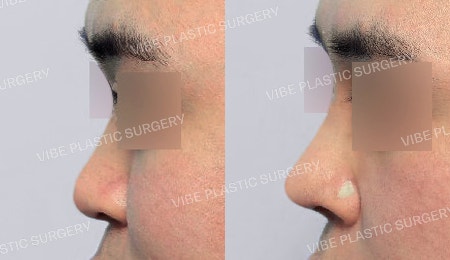
A case study of a male patient in his 20s who underwent functional and aesthetic rhinoplasty to correct a low bridge, short nose, and nasal congestion.
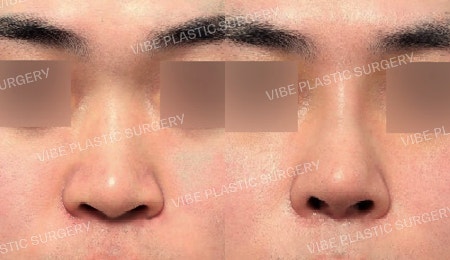
* Basic Information
- Male in his 20s
- Very low nasal bridge
- Short and upturned nose
- Chronic nasal congestion due to rhinitis since childhood
* Consultation
1. The patient visited due to a very low bridge and short nose, which made his face appear wide and flat, similar to an ‘oblique bowl’ shape.
2. Pre-operative CT scans revealed a severely deviated septum, causing the nasal congestion he complained of. He hoped for improvement in both aesthetic and functional aspects.
3. Therefore, we planned to use the septal cartilage, ear cartilage, and additional donated rib cartilage to correct the deviated septum while simultaneously creating a more defined nasal tip.
* Surgical Plan
1. Functional Rhinoplasty
- Septoplasty (correction of deviated septum)
- Turbinate reduction
- Internal valve reconstruction
2. Aesthetic Rhinoplasty
- Nasal bridge: Silicone implant
- Nasal tip: Donated rib cartilage (short nose correction via septal extension graft), septal cartilage (onlay graft)
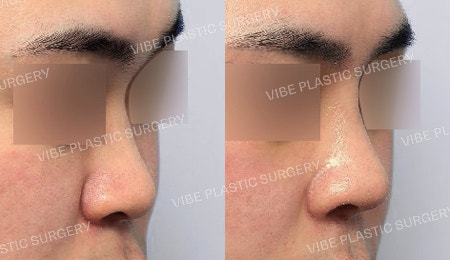
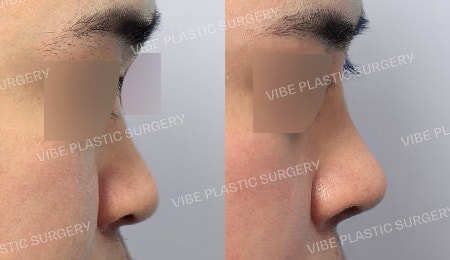
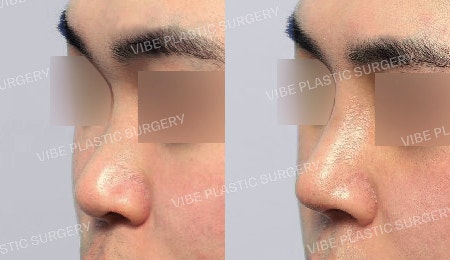
* Post-operative Progress
1. The patient reported that breathing has become much easier thanks to the functional rhinoplasty!
2. He was very satisfied not only with the sharp, masculine bridge line but also with the added dimension to his previously flat face.
3. Satisfaction is doubled when aesthetic and functional improvements are achieved simultaneously.
* Key Points
1. Functional Rhinoplasty: Generally, breathing discomfort is caused by a combination of three factors: ‘1. Deviated septum, 2. Hypertrophied turbinates, 3. Narrowed internal valve.’ Addressing each of these factors leads to satisfying functional results.
2. Short nose correction is achieved by sufficiently dissecting the skin and cartilage to extend the length, then creating a strong support structure to prevent it from returning to its original position.
3. Regarding the use of donated rib cartilage, opinions vary among both patients and surgeons. While I do not recommend it unconditionally, I believe it is a good option when truly necessary.
4. The main concerns with donated rib cartilage are inflammation and tip drooping. As it is a foreign material, the risk of inflammation may be slightly higher compared to using only autologous cartilage. Also, depending on the absorption rate, the tip may droop or warp unexpectedly.
5. However, I believe these issues mostly occur when the tip is raised excessively beyond what the individual can handle, or when influenced by factors like smoking. If a proper surgical plan is established and negative factors like smoking are avoided, donated rib cartilage is a sufficiently good and sometimes necessary material.
Consultations and surgeries should be performed by a board-certified plastic surgeon!
Stay healthy and beautiful :)
Right Thought, Right Plastic Surgery - Dr. Yu Young-moon
Complications and side effects such as bleeding, inflammation, infection, and asymmetry may occur after surgery and vary by individual; caution is required.