2026-05-25
4. What is Ptosis (Droopy Eyelids)?
Learn about the definition, causes, and diagnosis of ptosis (droopy eyelids) from plastic surgeon Dr. Young-moon Yoo.
Hello.
I am Dr. Young-moon Yoo, a specialist in plastic surgery.
When searching for information on eye plastic surgery, one of the most common terms you will encounter is ‘ptosis’.
If you have ever looked into eye surgery, you will likely relate to this :)
Q. What is ptosis?
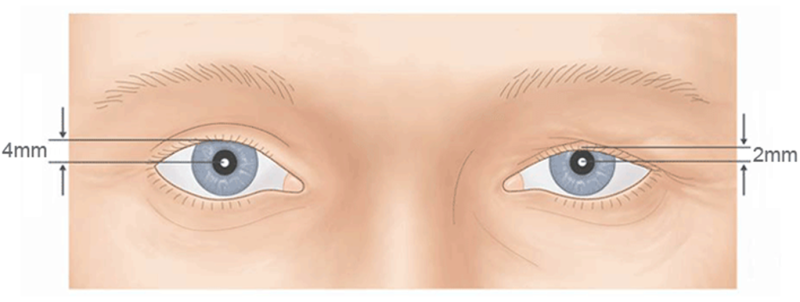
A. In a normal eye, the distance from the center of the pupil to the upper eyelid margin is about 4mm. Ptosis refers to a condition where the pupil is not sufficiently exposed. Depending on the severity, it can be classified as mild (2–4mm), moderate (0–2mm), or severe (< 0mm).
Q. How do I know if I have ptosis?
A. It is not easy to notice it yourself because you cannot see your own face at all times. Also, when looking in a mirror, people tend to naturally apply force to their eyes, making them look more alert than usual.
If you think you are opening your eyes well, but people around you often say things like ‘You look tired,’ ‘You look sleepy,’ ‘You look lethargic,’ or ‘Are you upset about something?’ then you should suspect ptosis. Sometimes, others can observe us more accurately than we can ourselves ^^;
Of course, sometimes ptosis can give off a ‘sexy’ or ‘mysterious’ vibe.
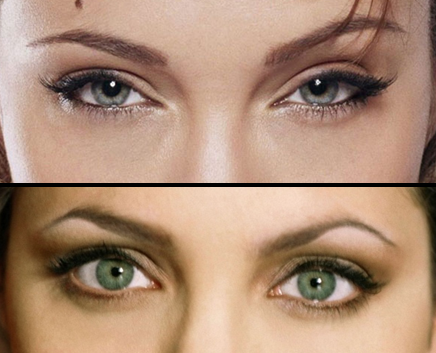
However, in most cases, it is difficult to pull off that look ㅠ
Since a clear, vivid impression and defined lines usually suit people better, many choose to undergo ptosis correction along with their surgery.
Q. Why does ptosis occur?
The causes can be broadly classified into four categories:
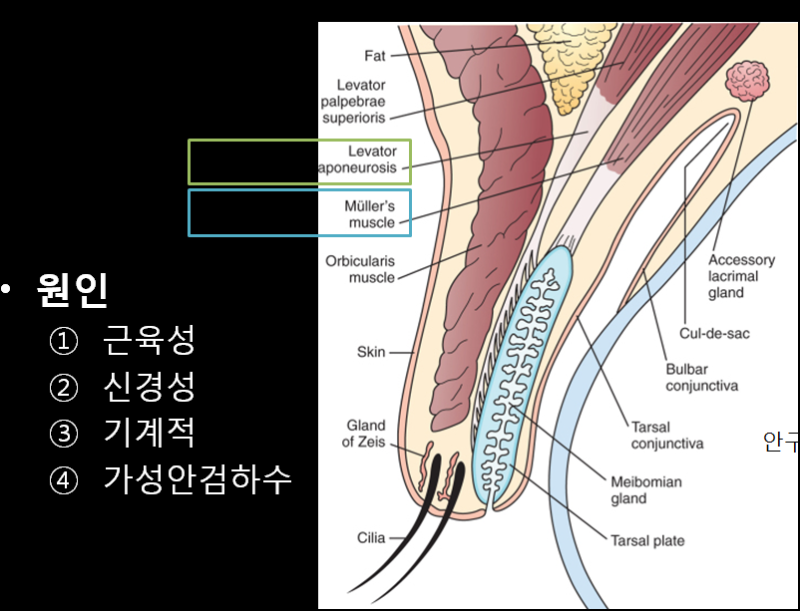
1. Myogenic (Muscular) Causes
This is the most common case and where ptosis correction (eye shape correction) surgery shows the greatest effect.
In some cases, the strength (quality) of the levator muscle is congenitally weak, or the connection is loose, leading to ptosis.
Recently, color contact lenses (especially very large ones) have been identified as a significant cause.
Even though lenses are very thin, from the perspective of the eyelid muscles, they are like thick, sharp, and formidable weapons.
You can think of it as the eyelid muscle getting caught on the lens every time you blink, gradually tearing or loosening it. ;;
2. Neurogenic Causes
This is associated with conditions such as third cranial nerve palsy or Horner’s syndrome.
3. Mechanical Causes
This can occur due to orbital tumors, anophthalmos, etc.
4. Pseudoptosis (False Ptosis)
This is a case where the strength of the levator muscle is good, but sagging skin makes it look as if the person has ptosis. Therefore, it is called ‘pseudo’ ptosis. In these cases, the eyes can look much larger simply by addressing the sagging skin.
Q. Then, how can ptosis be corrected?
A. Regarding the eye area specifically, methods include levator advancement, Mueller’s tucking, levator + Mueller resection, and the Fasanella-Servat (tarsoconjunctival resection) procedure. Beyond the immediate eye area, various methods like frontalis advancement, frontalis sling, or fascia lata sling may be required.
We have looked at the definition, diagnosis, and types of ptosis.
Next time, I will take a closer look at correction methods, specifically ‘eye shape correction’ surgery.
I hope you have a wonderful day!
Right Thinking, Right Plastic Surgery - Dr. Young-moon Yoo
Frequently Asked Questions
What exactly is ptosis?
It refers to a condition where the pupil is not sufficiently exposed. In normal individuals, the distance from the center of the pupil to the upper eyelid margin is about 4mm, but with ptosis, the degree of exposure is less, and it is classified into mild, moderate, and severe.
Is there a way for me to tell if I have ptosis myself?
It's difficult to notice when looking in a mirror by yourself because you tend to strain your eyes. Instead, if people around you often say that you look sleepy, tired, or lacking energy, you should suspect ptosis.
What are the main causes of ptosis?
The most common cause is a muscular one, where the strength of the muscle that opens the eye weakens. In addition to congenital factors, frequent wearing of large colored contact lenses is recently cited as a major cause of ptosis, as it can loosen the eyelid muscles.
What is pseudoptosis?
It refers to a condition where the strength of the eye-opening muscle is normal, but it appears like ptosis due to sagging skin. In this case, since it's not an actual muscle problem, simply addressing the sagging skin appropriately can make the eyes look much larger and clearer.
What surgical methods are there to correct ptosis?
There are various methods such as levator advancement, Müller's muscle tucking, and levator and Müller's muscle resection. Depending on the symptoms and extent, methods like frontalis suspension or fascial sling might be necessary, so a specialist's diagnosis is essential.