2026-05-25
5. Ptosis Correction Surgery (Eyelid Ptosis Correction)
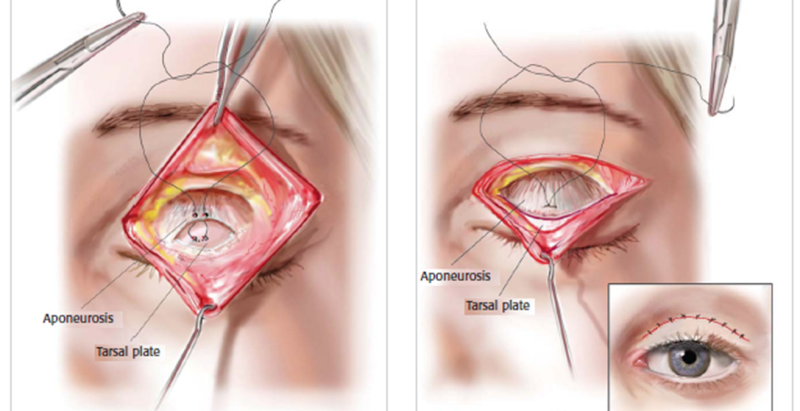
Learn about ptosis correction surgery, commonly known as ‘eye shape correction surgery.’ This article explains the two main types: non-incisional and incisional, detailing the muscles involved and suitable cases for each.
Hello.
I am Yoo Young-moon, a board-certified plastic surgeon.
It's time to learn about methods for correcting #ptosis.
This is commonly referred to as #eyeshapecorrectionsurgery.
It's called ‘eye shape correction’ because it transforms blurry, sleepy, and tired-looking eyes into a clear, sharp, and bright impression.
Depending on the approach and the muscle to be corrected during surgery,
it is broadly classified into #nonincisionalptosiscorrection and #incisionalptosiscorrection.
To understand this, accurate anatomical knowledge is essential.
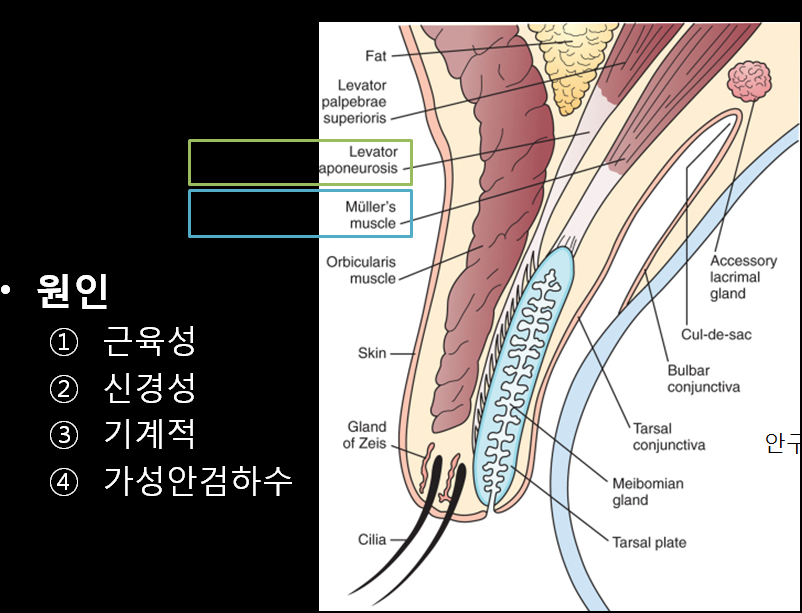
In the upper eyelid,
there are two muscles responsible for opening the eye:
1. Levator aponeurosis (levator palpebrae superioris muscle)
2. Muller's muscle
Both muscles have in common that they open the upper eyelid,
but there are slight differences.
The levator aponeurosis plays about 80% of the role in opening the eye (major),
while Muller's muscle plays about 20% of the role in opening the eye (minor).
Furthermore, if the levator aponeurosis plays a major role in the initial process of opening the eye,
Muller's muscle plays a role in the final stage of opening the eye and maintaining the open state.
There's a slight difference, isn't there?
1. Non-incisional Ptosis Correction
Non-incisional ptosis correction involves flipping the upper eyelid
and performing the surgery through the conjunctiva,
so it primarily corrects ‘Muller's muscle.’
Therefore, the degree of eye shape correction is necessarily small (1-2mm).
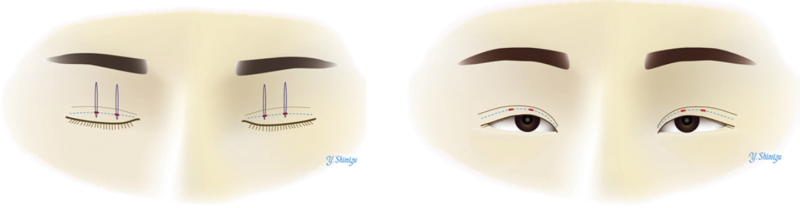
As shown in the diagram above,
this surgery involves folding Muller's muscle like a blind through the conjunctiva.

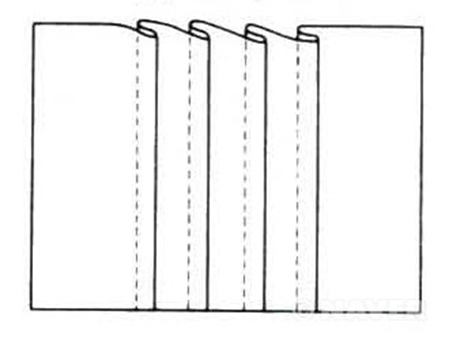
Like this.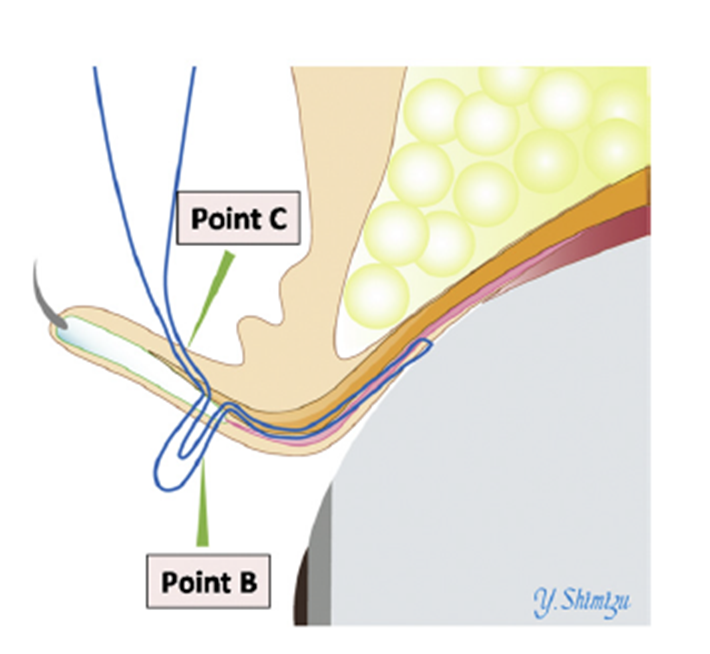
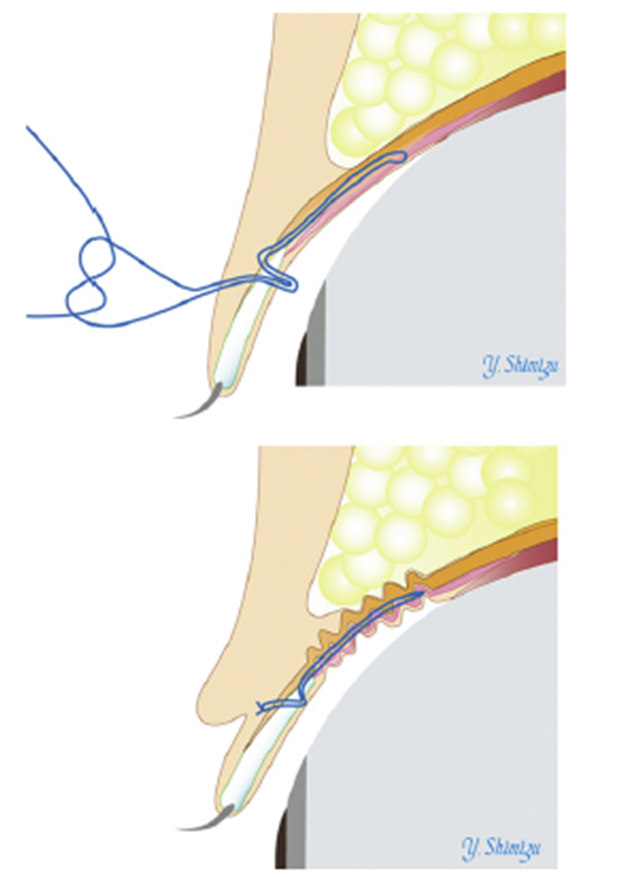
When the eye opens this way,
it will open even wider along the folded muscle, right?
Q. Advantages of non-incisional ptosis correction surgery?
Since there's no incision, there's no scar,
and recovery is fast with less swelling, right?
It's a relatively simple surgery, so the burden of revision surgery is low.
(Though it's best not to have revision surgery ^^;)
Q. Disadvantages?
Since the degree of correction is small,
it would be difficult to apply in cases of severe ptosis, right?
There's a slightly higher chance of it loosening or coming undone if you rub your eyes vigorously.
Immediately after surgery, you might feel a foreign body sensation due to the folded conjunctiva.
Q. What are good cases for non-incisional ptosis correction surgery?
Based on the explanation above, in which cases
would non-incisional ptosis correction be beneficial?
Cases where the eyelid skin is thin, there's little fat,
skin sagging is not severe, and ptosis is not severe.
2. Incisional Ptosis Correction
Incisional ptosis correction surgery involves directly opening the skin,
so you're bound to encounter the levator aponeurosis first, aren't you?
This is a surgical method that involves incising the skin and directly manipulating the levator aponeurosis.
Therefore,
cases with skin sagging,
cases with thick skin,
cases with a lot of fat,
cases with severe ptosis
....
...
..
would be good cases, wouldn't they?
Today, we looked at ptosis correction surgery. ^^
Was it helpful?
Were some of your questions answered?
Next time, we'll look at canthoplasty (epicanthoplasty/lateral canthoplasty/lower canthoplasty) surgery.
Not just double eyelids, but also front/back/lower canthoplasty
can complement the shortcomings of your eyes
and create a more refreshed and brighter impression,
making them important surgeries!
Frequently Asked Questions
How does non-incisional ptosis correction work?
Non-incisional ptosis correction is performed by folding the Müller's muscle through the conjunctiva. The upper eyelid is everted, and the surgery is performed through the conjunctiva, folding the Müller's muscle, which plays an auxiliary role in opening the eye, like a blind to help the eye open wider.
What are the advantages and disadvantages of non-incisional ptosis correction?
The advantages include no scars due to the absence of incisions and faster recovery. However, the degree of correction is small, only 1-2mm, making it difficult to apply to severe ptosis. There is also a possibility of the correction loosening if the eyes are rubbed vigorously, and a foreign body sensation may be felt immediately after surgery.
Who is suitable for non-incisional ptosis correction?
It is suitable for individuals with thin eyelid skin and less fat. Good results can also be expected when the non-incisional method is applied to cases where skin sagging is not severe and ptosis symptoms are relatively mild.
In what cases is incisional ptosis correction necessary?
Incisional ptosis correction is necessary when there is skin sagging or thick eyelid skin. By directly incising the skin and manipulating the levator palpebrae superioris muscle, which is the main muscle for opening the eye, it is a very effective surgical method for patients with a lot of fat or severe ptosis.
What muscles are involved in opening the eye?
There are two muscles in the upper eyelid: the levator palpebrae superioris muscle and the Müller's muscle. The levator palpebrae superioris muscle plays the main role, accounting for about 80% of eye opening, while the Müller's muscle accounts for the remaining 20% and helps maintain the open state.