2026-09-22
Creating a Natural In-Out Double Eyelid Line with Partial Incision Ptosis Correction | Dr. Young Moon Yoo of VIBE Plastic Surgery
Achieve a natural in-out crease with Dr. Young Moon Yoo at VIBE Plastic Surgery using partial incision ptosis correction and epicanthoplasty.
Hello.
I am Dr. Young Moon Yoo, Director of VIBE Plastic Surgery.
During eyelid surgery consultations, many patients share similar concerns:
“I do have double eyelids, but my eyes still look heavy and tired.”
“If I open my eyes clearly, will it look unnatural or strained?”
“I'm worried that epicanthoplasty or upper canthoplasty might look too artificial.”
In reality, eyelid surgery is not just about creating a double eyelid fold to achieve your desired transformation.
If the eyelid-opening muscle is weak, ptosis correction may be necessary. If prominent Mongolian folds make the eyes appear restricted, epicanthoplasty or upper canthoplasty can be considered concurrently.
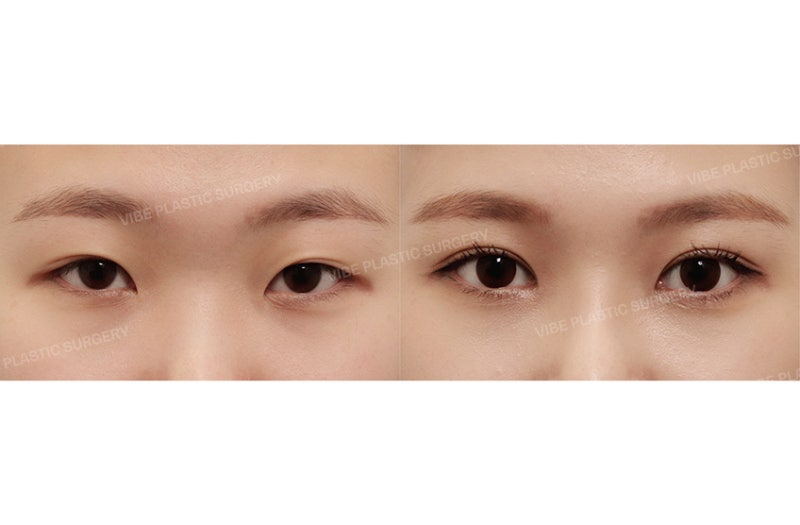
The case I am introducing today involved a patient with these exact characteristics.
For this patient, we aimed to create clearer, more refreshing eyes through "partial incision ptosis correction + epicanthoplasty / upper canthoplasty."
What were the patient's concerns prior to surgery?
Looking at the eyes before surgery, the overall impression appeared slightly harsh. When opening the eyes, the upper eyelids covered a portion of the pupils, giving a somewhat muffled, less defined look.
Additionally, Mongolian folds at the inner corners made the eyes appear shorter in horizontal length than they actually were.
In cases like this, simply setting a high double eyelid line could result in an unnatural outcome.
The key point is:
Rather than merely making the eyes larger,
it is crucial to naturally reinforce eyelid-opening muscle function,
relieve heaviness at the inner corners,
and highlight the eye's inherent contours with clarity.
Taking these factors into account, we performed partial incision ptosis correction along with epicanthoplasty and upper canthoplasty.
What is Partial Incision Ptosis Correction?
Ptosis correction evaluates the eyelid-lifting muscles and tissue condition to enable a more vivid, effortless eye opening.
It is especially beneficial when the pupils are significantly hidden or the gaze looks chronically sleepy.
Unlike full incision, partial incision ptosis correction involves only minimal, targeted incisions along the necessary sections of the eyelid.
When applied appropriately based on individual eyelid anatomy, it delivers a natural double eyelid line and a distinct, clear gaze with minimal scarring.
Advantages of Partial Incision Ptosis Correction
1. Reduced recovery burden due to a minimal incision size!
Because the partial incision method approaches only specific required areas, the incision length is significantly smaller than that of a full incision.
While individual outcomes depend on eyelid condition and procedural scope, it generally helps minimize unnecessary tissue trauma and reduces downtime.
It is a preferred option for those prioritizing a swift return to daily life.
2. Designed to keep scars barely noticeable!
Partial incision ptosis correction avoids cutting across the entire crease line, relying instead on limited access points.
As healing progresses and the incision marks settle naturally into the crease line, visible scarring concerns are substantially minimized.
Of course, healing speed and scar maturation vary depending on individual skin characteristics and postoperative care.
3. Offers a more defined, stable eye transformation than the non-incisional method!
Unlike simple suture-based fixation, the partial incision approach allows direct visualization of internal structures during contouring.
This makes it ideal when precise adjustments are required, taking eyelid skin thickness, fat volume, and muscle strength into consideration.
4. Designs an effortless, natural aesthetic!
Ptosis correction should not focus solely on widening the eyes as much as possible.
Overcorrection can cause a startled or artificial look; hence, respecting the patient's original eye shape and overall facial balance is vital.
At VIBE Plastic Surgery, our focus is not simply enlarging the eyes, but achieving the most natural, comfortable, and well-defined expression suited to each individual.
When is Epicanthoplasty or Upper Canthoplasty Needed?
When prominent Mongolian folds constrict the inner corner or make horizontal eye length appear truncated, epicanthoplasty is worth considering.
However, over-resecting the inner corners can look unnatural. It is not about cutting as much as possible, but rather opening the angle smoothly and moderately.
Upper canthoplasty helps clear out heaviness in the upper diagonal contour of the inner corner.
Combining epicanthoplasty and upper canthoplasty avoids sharp, unnatural points at the tear duct, gently refining the inner and upper borders to produce softer, wider, and more refreshed eyes.
Who is a Good Candidate for Partial Incision Ptosis Correction and Epi/Upper Canthoplasty?
You might consider this combination after a consultation if you experience any of the following:
✔ The pupils are noticeably covered when opening your eyes, creating a sleepy appearance.
This occurs when weak eyelid-opening strength gives a heavy, dull look.
✔ You have a double eyelid crease, but the eyes lack definition.
Rather than simply building another crease, muscle-lifting strength often needs to be addressed.
✔ Mongolian folds make the inner corners look hooded and constricted.
If the eyes look shorter than their true length due to inner corner coverage, canthoplasty can be considered.
✔ You desire a natural transformation.
Rather than overly dramatic or artificial lines, this suits patients looking to preserve their natural eye frame while achieving refined clarity.
✔ Quick recovery is a priority.
If your eyelid anatomy is suitable, partial incision limits surgical trauma compared to full incision, leading to a smoother, faster recovery.


What changes occurred after the procedure?
The key change in this case is not merely the creation of a double eyelid fold.
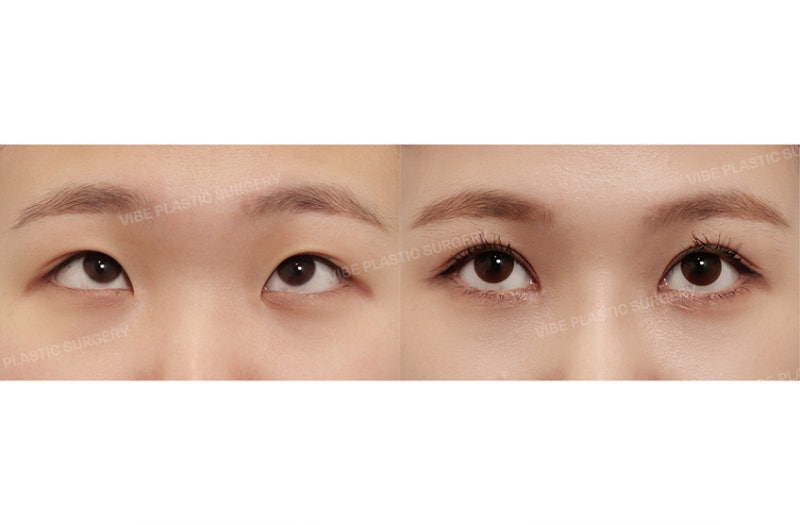
Before surgery, the eyelids partially covered the pupils, yielding a slightly stern, constricted look. Post-operatively, eye-opening dynamics are visibly improved, creating a clean, vibrant gaze.
In particular, epicanthoplasty and upper canthoplasty naturally opened the restricted inner corners caused by Mongolian folds, better showcasing the eye's true horizontal span.
Summary of Changes:
Before Surgery
Partially covered pupils giving a heavy, hooded look
Blurry and indistinct eye contour
Inner corners hooded by Mongolian folds
Horizontal eye length appearing shorter than actual
After Surgery
Improved, crisp eye-opening action
Pupils naturally revealed for a luminous look
Heaviness around the inner and upper corner alleviated
Natural elongation of horizontal eye width
Overall clear, open, and refreshing appearance
Crucially, the eyes do not look over-enlarged or synthetic; rather, the patient's existing gentle features were retained while optimizing the natural strengths of the eye shape.
Blepharoplasty is Not Merely About Making Eyes Larger!
Many people considering eyelid surgery think, "I just want my eyes to be as big as possible."
However, functional anatomy and harmony with overall facial features matter far more than sheer size.
Levator muscle strength, eyelid skin thickness, degree of Mongolian fold presence, and preexisting crease structures determine which method is most suitable.
For some, non-incisional methods are ideal; for others, partial incision ptosis correction produces superior results.
Similarly, canthoplasty can be transformative for one person, while omitting it may be more natural for another.
Rather than applying a standardized cookie-cutter technique, choosing the right surgical approach customized to your specific ocular anatomy is vital.
Why VIBE Plastic Surgery Prioritizes Personalized Eye Design
At VIBE Plastic Surgery, we avoid following fleeting trends. Instead, we comprehensively evaluate each patient's existing eye frame and unique facial harmony.
Even within ptosis correction, the degree of adjustment shifts the aesthetic outcome, and canthoplasty design can alter facial expressions drastically.
During pre-operative consultation, we meticulously analyze:
✔ Eye-opening levator strength
✔ Eyelid skin and soft tissue thickness
✔ Preexisting crease lines
✔ Shape and tension of Mongolian folds
✔ Anatomy of the inner and upper canthal zones
✔ Desired aesthetic goals and overall facial proportions
For those pursuing natural results, moderate ptosis adjustment paired with delicate canthal work is essential.
Transforming Heavy Eyes into a Natural, Defined Gaze
Rather than viewing partial incision ptosis correction, epicanthoplasty, and upper canthoplasty as separate procedures, combining them with a holistic anatomical view yields optimal results.
In this case, rather than creating an excessively high crease, our priority was:
Naturally reinforcing eye-opening strength,
Clearing away heaviness at the inner corner,
And maintaining natural facial character while achieving a brighter, well-defined gaze.
If you are contemplating eyelid surgery, it is important to first identify which anatomical factors require refinement for the most natural and pleasing outcome, rather than simply pursuing eye enlargement.
At VIBE Plastic Surgery, we design natural, clear, and harmonious eyes tailored precisely to each patient's individual features.
Frequently Asked Questions
What are the primary benefits of partial incision ptosis correction?
It minimizes the incision area, reducing both recovery downtime and visible scarring. Compared to full incision, it inflicts less tissue trauma for a faster return to daily activities. Unlike suture-only techniques, it allows direct visualization of deeper structures, yielding more precise and lasting eye definition.
When are epicanthoplasty and upper canthoplasty recommended?
They are ideal when Mongolian folds make the inner corner appear hooded or cause the eye's horizontal length to seem short. Performing epicanthoplasty and upper canthoplasty together naturally releases the inner and upper corner tension, avoiding an overly sharp or artificial look while creating a soft, open eye contour.
Can sleepy-looking eyes be corrected?
Yes, ptosis correction effectively improves sleepy or tired eyes. If weak levator muscles cause the upper eyelid to veil part of the pupil, ptosis correction reinforces eye-opening action so the pupil is naturally exposed, resulting in a vivid, awake look.
Does partial incision ptosis correction leave noticeable scars?
No, it is carefully designed to minimize scar visibility. Because incisions are limited to small, targeted spots, the scars integrate seamlessly into the double eyelid crease as they heal, significantly mitigating scar visibility. Healing timelines can vary based on personal skin type and aftercare.