2026-10-19
Eye Surgery in Your 50s: How Surgical Options Vary by Drooping Pattern
Eyelid drooping in your 50s can have different causes, so the right surgery depends on the pattern. This guide compares upper blepharoplasty, subbrow lift, and forehead lift.
Hello. I am Dr. Yoo Young-moon, director of Vibe Plastic Surgery.
As we age, the skin of the eyelids may sag, and the shape of the eyes may look different from before.
When you open your eyes, the lids may feel heavy, the double eyelid may appear smaller, and the skin on the outer corners may sag, making the eyes look heavy.
When these changes appear, there is no single surgical option to consider.
Mid-life eye surgery can broadly be divided into three types: 1. Upper blepharoplasty, 2. Subbrow lift, and 3. Forehead lift.
Each method adjusts the position of the skin and eyebrows differently, and the shape and overall impression of the eyes after surgery may vary depending on the method chosen.
This article will explore the causes of eyelid drooping in the 50s, the differences between the main mid-life eye surgery methods,
and cases in which a subbrow lift is considered together with natural-adhesion double eyelid surgery.
1. Mid-life Eyelid Drooping: Why Does the Surgical Approach Differ from Person to Person?
Changes around the eyes after middle age cannot be explained simply by stretching of the eyelid skin.
Several factors may act together, including the following:
Sagging of the upper eyelid skin: The skin may cover the lashes or the existing double eyelid line, making the eyes look heavy.
Changes in brow position: When the brows drop, more of the upper eyelid skin may appear covered.
Changes in the double eyelid crease: Skin laxity or tissue changes may cause the existing crease to become obscured or to appear as multiple folds.
Changes in eye-opening function: If the levator muscle weakens, the ability to open the eyes may decline independently of skin sagging.
Changes in the shape around the outer corners: Changes in the skin and soft tissue at the outer corners may make the eyes appear short or cramped.
What matters is that even similar-looking eyelid drooping can have different underlying causes.
Therefore, when planning mid-life eye surgery, it is important not to focus only on the amount of excess skin,
but to evaluate the brow position, existing double eyelid, eyelid thickness, eye-opening function, and the width and height of the eyes together.
2. Three Representative Mid-life Eye Surgery Methods
① Upper blepharoplasty: Adjusting sagging eyelid skin and the double eyelid line
Upper blepharoplasty is a procedure performed by considering factors such as sagging of the upper eyelid skin and the shape of the double eyelid.
Various methods are available, from incision-based techniques that trim loose skin and create a double eyelid line,
to non-incision double eyelid surgery (such as natural adhesion) that uses small punctures for suturing, depending on individual conditions.
When considering upper blepharoplasty, we assess how much the skin has stretched,
the thickness of the skin and soft tissue,
and the condition of the existing double eyelid line, among other factors.
If there is a problem with eye-opening function, ptosis correction surgery should also be considered separately.
② Subbrow lift: Adjusting the skin just below the eyebrow
A subbrow lift removes and closes the skin directly beneath the eyebrow to adjust the sagging skin of the upper eyelid.
It can be considered when the skin between the brow and the eye has stretched and covers the eyelid, taking into account the brow position and eyelid thickness.
This surgery differs from upper blepharoplasty, which directly creates the double eyelid line, in that it adjusts the skin below the eyebrow.
When planning a subbrow lift, the distance between the eyebrow and the eye,
the shape of the eyebrow,
the thickness and elasticity of the skin,
and the scarring characteristics of the area where the incision will be made should be carefully reviewed.
Because the incision is made just below the eyebrow, a scar may remain,
and you should receive a thorough explanation before surgery about how the scar matures and about possible changes in sensation around the eyebrow.
Also, a subbrow lift is different from surgery that lifts the eyebrow itself upward.
If the main goal is to raise the eyebrow position, other surgical options may be considered.
③ Forehead lift: Addressing eyebrow position and sagging around the forehead
A forehead lift repositions the tissue of the forehead and around the eyebrows upward to adjust eyebrow position and the shape of the upper face.
It may be considered when the eyebrows have descended and cover the upper eyelids,
or when sagging of the forehead and eyebrow area affects the appearance of the eyes.
Because it adjusts the eyebrow position, it differs from a subbrow lift, which removes skin below the eyebrow.
However, a forehead lift may involve a wider surgical field and broader dissection,
and recovery and side effects also vary depending on the technique.
If the eyebrows are lifted too high, the expression may look unnatural,
so the original brow position and the balance of the entire face must be considered.
3. What Are the Differences Between Upper Blepharoplasty, Subbrow Lift, and Forehead Lift?
All three procedures can be considered to improve changes around the eyes in middle age, but they mainly target different anatomical areas and serve different purposes.
Upper blepharoplasty: Evaluated mainly based on sagging of the upper eyelid skin and the shape of the double eyelid.
Subbrow lift: Adjusts the sagging skin just below the eyebrow.
Forehead lift: Adjusts sagging of the forehead and eyebrow tissue and the position of the eyebrow.
Therefore, it is not appropriate to apply the same surgery to every case simply because the eyelid skin has stretched.
For example, if the eyebrows are sufficiently high but the skin below them is sagging, a subbrow lift may be considered.
On the other hand, when the eyebrow itself has descended and covers the eyelid, it can be assessed whether a method such as forehead lift is appropriate.
When eyelid skin sagging and changes in eyebrow position occur together, a "combination" of two or more procedures can also be considered.
4. Considering a Subbrow Lift Together with Natural-Adhesion Double Eyelid Surgery
A subbrow lift and natural-adhesion double eyelid surgery address different areas.
A subbrow lift adjusts the sagging skin below the eyebrow,
while natural-adhesion double eyelid surgery creates a double eyelid line by forming adhesions between the internal tissue of the upper eyelid and the skin.
Therefore, when it is judged that both adjusting skin sagging and creating a double eyelid line are needed,
the two procedures can be considered together.
However, whether natural-adhesion double eyelid surgery is suitable is not determined by age alone.
The thickness of the skin and soft tissue, the degree of skin sagging, the shape of any existing double eyelid, and the function of the eyelid must all be comprehensively evaluated.
The following conditions may be used as reference when reviewing a surgical plan:
① When there is sufficient distance between the eyebrow and the eye
Check whether adequate space between the eyebrow and eye can be maintained even after the skin below the eyebrow is adjusted.
If the original gap is narrow or the eyebrow sits low, the possibility that the space will look even narrower after surgery should be considered.
② When the eyelid skin and soft tissue are not excessively thick
Suitability for natural-adhesion double eyelid surgery depends on the condition of the skin and soft tissue.
If the skin is thick, has excess fat, and sagging is severe, it may be difficult to achieve the desired double eyelid shape with a non-incision method alone.
③ When a new double eyelid line needs to be created or adjusted
A subbrow lift alone does not create a new double eyelid line.
If there is no existing double eyelid or the line needs adjustment, a separate double eyelid procedure may be considered together.
④ When eye-opening function needs to be evaluated separately
Sagging eyelid skin and reduced eye-opening function are different problems.
If there is an issue with levator muscle function, it should be carefully evaluated whether natural-adhesion double eyelid surgery or a subbrow lift alone is sufficient.
These conditions are reference factors for determining the surgical approach, and suitability for surgery cannot be confirmed based on any single condition.
5. When the Eyes Look Short and Heavy, What Roles Do Lateral Canthal and Lower-Lid Incisions Play?
Changes around the eyes are influenced not only by the upper eyelid but also by the horizontal width of the eyes and the shape of the outer corners.
When the outer part of the eye looks relatively short or the shape around the outer corner affects the appearance of the eyes, a lateral canthal incision may be considered.
A lateral canthal incision adjusts the area around the outer corner of the eye (lateral canthus) to change the horizontal shape of the eye.
A lower-lid incision adjusts the position and shape of the lower eyelid to change the contour of the lower part of the eye.
Because the two procedures target different areas and serve different purposes, the need for each should be assessed separately.
However, a lateral canthal incision or lower-lid incision does not make every eye look longer or create the desired eye shape.
Depending on the horizontal width of the eyes, the position of the outer corners, the support of the lower eyelid, the degree of conjunctival exposure, and the degree of eyeball protrusion,
the suitability and limitations of surgery can vary.
In particular, when lower eyelid support is weak or the eyeball is relatively protruding,
the risks related to changes in lower eyelid position should be carefully reviewed.
6. Surgical Planning Based on a Case of Eye Surgery in a Patient in Their 50s
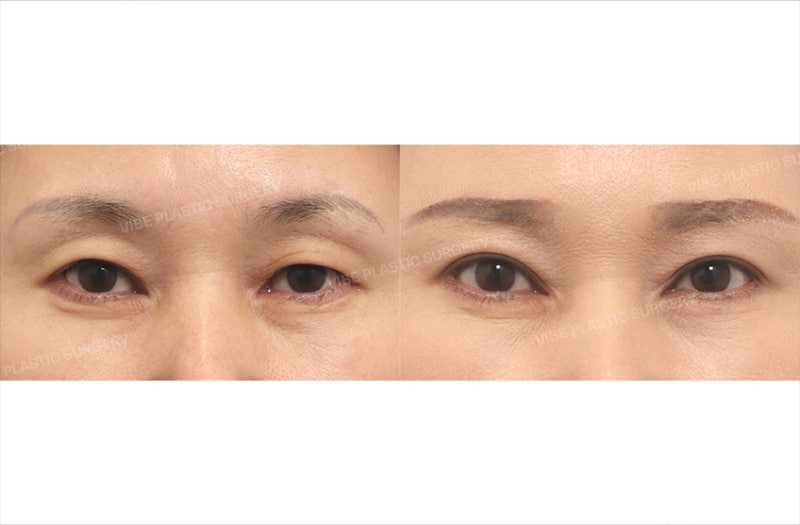
This case involves a patient in their 50s who underwent a subbrow lift together with natural-adhesion double eyelid surgery,
and in whom lateral canthal and lower-lid incisions were performed in combination, taking into account the horizontal and lower shape of the eyes.
When understanding the surgical plan, the important point is that each procedure has a different purpose.
Subbrow lift: A method to adjust the sagging skin below the eyebrow
Natural-adhesion double eyelid surgery: A method to form the double eyelid line
Lateral canthal and lower-lid incisions: Methods to adjust the shape of the outer corners and the lower eyelids
Such a combination is not suitable for every patient in their 50s.
Depending on the eyebrow position, the condition of the eyelid skin, the tissue conditions suitable for forming a double eyelid, the function of the eyelids, and the anatomical features around the outer corners,
the surgical approach may differ.
Front view with eyes open: before (left), heavy upper eyelids droop over the eyes; after (right), the eyes look more open.
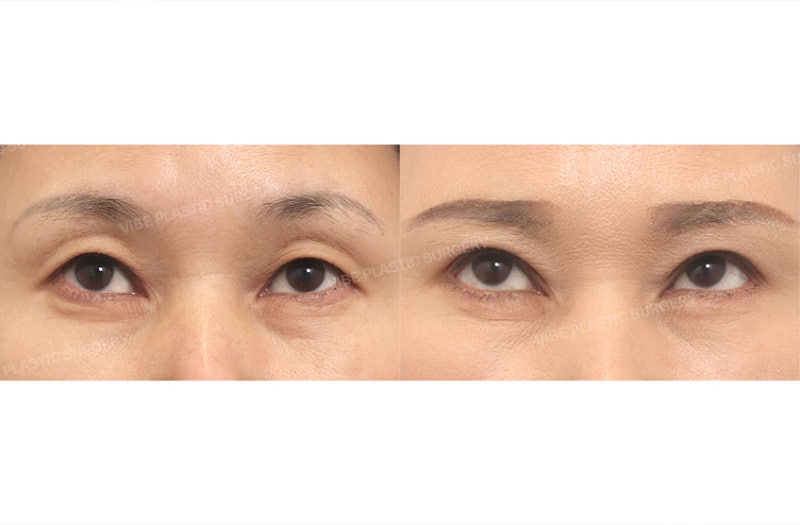
Another eyes-open comparison of the same woman: drooping upper lids on the left, a clearer, wider-looking eye shape on the right.
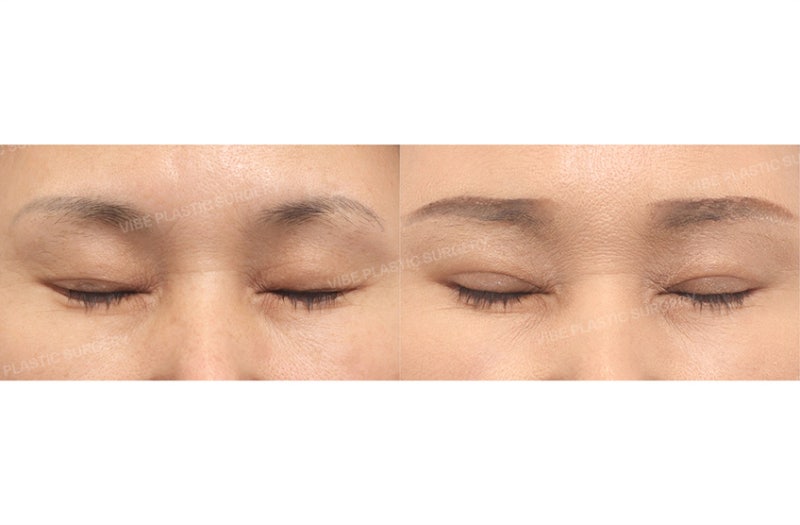
Eyes-closed comparison of the same woman, showing the upper eyelids before (left) and after (right) surgery.
7. Things to Check Before Mid-life Eye Surgery
Mid-life eye surgery requires considering not only how much skin will be removed, but also the positional relationship between the eyebrows and eyes, the shape of the double eyelid, and eye-opening function.
Before surgery, it is advisable to confirm the following:
Whether eyelid skin sagging or eyebrow position change is the main cause
Whether double eyelid surgery is needed, and if so, whether an incision or non-incision method may be considered
Whether the space between the eyebrows and eyes can be maintained appropriately after a subbrow lift
Whether there is a separate problem with eye-opening function
Whether the anatomical conditions call for a lateral canthal or lower-lid incision
What side effects are foreseeable, such as scarring, asymmetry, sensory changes, dry eye, or abnormal eyelid position
The incision site, recovery process, scar location, and changes in eye appearance vary depending on the surgical method.
Therefore, it is important to understand the limitations and risks of each method, as well as its advantages, before making a decision.
Conclusion: In Mid-life Eye Surgery, a Plan Matched to the Cause Is What Matters
Eyelid drooping after age 50 can be caused by a combination of factors, including sagging of the upper eyelid skin, changes in eyebrow position, the shape of the double eyelid, and eye-opening function,
which often act together.
Upper blepharoplasty, subbrow lift, and forehead lift each target different areas and serve different purposes.
Natural-adhesion double eyelid surgery or lateral canthal and lower-lid incisions may be combined when needed,
but adding more procedures does not necessarily lead to better results.
If you are considering mid-life eye surgery, rather than simply comparing which procedure is better,
it is important to first examine where the changes in your eye shape originate and whether each procedure is suited to address that cause.
* This article is medical information intended to explain the surgical methods and general considerations for mid-life eye surgery.
* Suitability, methods, and outcomes of surgery may vary depending on individual anatomical conditions and health status. Surgery may cause scarring, bleeding, infection, asymmetry, sensory changes, dry eye, abnormal eyelid position, and other complications.
Frequently Asked Questions
Does the surgical method change depending on the cause of eyelid drooping?
Yes, the surgical approach can vary depending on the pattern of eyelid drooping. The article explains that sagging of the upper eyelid skin, changes in eyebrow position, the shape of the double eyelid, and eye-opening function can act together as causes, so a plan that matches the cause is important.
What are the main methods of mid-life eye surgery?
Mid-life eye surgery can broadly be divided into upper blepharoplasty, subbrow lift, and forehead lift. Upper blepharoplasty adjusts the upper eyelid skin and double eyelid line, a subbrow lift adjusts the skin below the eyebrow, and a forehead lift repositions the tissue of the forehead and eyebrow area.
Can a subbrow lift be done together with natural-adhesion double eyelid surgery?
Yes, when it is judged that both skin sagging correction and double eyelid creation are needed, the two can be considered together. However, whether natural-adhesion surgery is possible is not determined by age alone. Skin and soft tissue thickness, the degree of sagging, the shape of any existing double eyelid, and eyelid function should be comprehensively assessed.
Do lateral canthal and lower-lid incisions make every eye look longer?
No, these incisions do not make every eye look longer or create the desired eye shape. Suitability and limitations vary depending on the horizontal width of the eyes, the position of the outer corners, lower eyelid support, conjunctival exposure, and eyeball protrusion.
What should be checked before mid-life eye surgery?
Before surgery, it is advisable to confirm the main cause of drooping (eyelid skin sagging or eyebrow position changes), whether double eyelid surgery is needed, whether eye-opening function has a separate problem, and whether lateral canthal or lower-lid incisions are anatomically indicated. Expected side effects such as scarring, asymmetry, sensory changes, and dry eye should also be understood.
Will a subbrow lift leave a scar?
Yes, because the incision is made just below the eyebrow, a scar may remain. You should receive a thorough explanation before surgery about how the scar matures and about possible changes in sensation around the eyebrow.