2026-09-21
Still Unsatisfied After 3–4 Years of Eyelid Tape? by Dr. Young-moon Yoo, VIBE Plastic Surgery Sinnonhyeon Station
Dr. Young-moon Yoo from VIBE Plastic Surgery explains how natural adhesion double eyelid surgery combined with epicanthoplasty frees long-term eyelid tape users with a natural in-out fold.
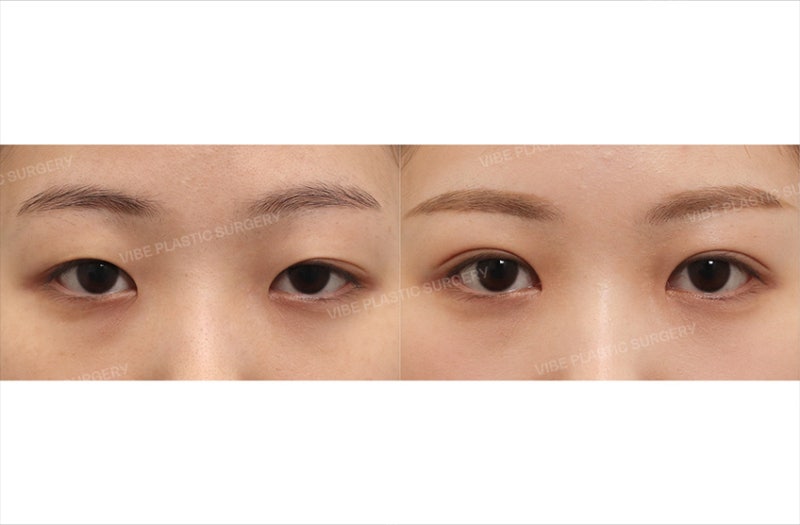
Natural Adhesion Double Eyelid Surgery + Epicanthoplasty & Upper Epicanthoplasty for a Natural In-Out Fold
Hello.
I am Dr. Young-moon Yoo, Chief Director of VIBE Plastic Surgery.
Today, I would like to introduce an eyelid surgery case for a patient who consistently used double eyelid tape for about 3 to 4 years.
At first, simply using eyelid tape feels convenient because you can easily shape your desired eye contour.
However, as the daily routine of applying and peeling off tape repeats, concerns often begin to arise:
“I wish I could have a double eyelid without relying on tape.”
“Creating the crease every single morning is exhausting.”
“I want a clearer, more defined double eyelid line.”
This patient visited our clinic with similar concerns.
Having used eyelid tape for roughly 3 to 4 years, she wanted a naturally maintained double eyelid without depending on tape anymore.
Rather than a dramatic or excessively high fold, she preferred a natural in-out fold that seamlessly extends from the inner corner of the eye.
After a thorough consultation considering her unique anatomical eye structure and desired aesthetic, we performed a combined procedure:
Natural Adhesion Double Eyelid Surgery + Epicanthoplasty / Upper Epicanthoplasty.
1. What are the concerns associated with prolonged use of eyelid tape?
While we cannot definitively say that eyelid tape ruins your eyelids immediately, using it repeatedly over a long period can cause several inconveniences and complications.
① The hassle of shaping the fold every day
This is the most common grievance.
Every time you go out, you must repeat the cycle of "apply tape → check crease height → apply makeup."
Even a slight discrepancy in positioning can make the eyes look asymmetrical, requiring constant attention daily.
② Skin irritation and dryness
The physical act of adhering and pulling off eyelid tape causes repeated mechanical irritation to delicate eyelid skin.
Those with sensitive skin may experience redness, itchiness, or localized inflammation.
Using strongly adhesive products repeatedly can also make the eyelid skin increasingly sensitive.
③ Anxiety over sagging or stretched eyelid skin
Peeling tape pulls on thin eyelid skin, leading many individuals to worry that their skin is stretching or drooping over time.
However, it is not guaranteed that eyelid tape alone causes true skin laxity.
Skin elasticity, age, eyelid thickness, and orbital fat volume all play complex roles together.
④ In the end, "the desired crease only exists when the tape is on"
This is ultimately the primary reason most people turn to surgery.
What began as a quick fix turns into an obligatory daily chore over time.
Eventually, patients reach a point of thinking,
“I'd rather have a crease that stays naturally on its own,”
prompting them to consider blepharoplasty.
2. Who is an ideal candidate for natural adhesion double eyelid surgery?
As in this patient's case, if you "desire a natural crease without significant skin laxity," natural adhesion double eyelid surgery can be considered.
Natural adhesion is a non-incisional technique that creates a crease through tiny micro-openings rather than a full incision across the skin.
It is particularly suitable for individuals who:
Have relatively thin eyelid skin
Do not have severe eyelid skin sagging
Do not possess excessive eyelid fat
Desire a natural, seamless double eyelid crease
Prefer an in-fold or in-out fold over an excessively high or wide fold
Want to eliminate the need for eyelid tape or eyelid glue
Seek a procedure with less surgical downtime and burden than the full incision method
Of course, this does not mean natural adhesion is universally optimal for everyone.
If there is significant skin redundancy, prominent herniated fat, or compromised levator muscle function (ptosis), incisional surgery or ptosis correction may be more appropriate.
Therefore, the crucial question is not
“Is natural adhesion good?”
but rather
“Are my eyes suitable for natural adhesion?”
3. Key factors for achieving a natural in-out fold
The crease style requested by this patient was an in-out fold.
An in-out fold begins subtly and thinly at the very inner corner of the eye and gradually widens as it extends outward.
It provides more definition than a classic in-fold without the overt drama of a high out-fold, making it a popular choice for those who desire "a natural look that still makes the eyes look distinctly defined."
However, there is an important caveat.
Simply performing double eyelid surgery does not automatically guarantee your desired crease design.
The starting point of the crease can be heavily influenced by the presence of epicanthic folds (Mongolian folds) and the vector of skin tension at the medial canthus.
Consequently, double eyelid surgery is frequently paired with "epicanthoplasty / upper epicanthoplasty."
4. What effect does epicanthoplasty provide?
Epicanthoplasty modifies the Mongolian fold covering the inner corner of the eye, relieving a crowded or hooded appearance to create a refreshed, open look.
However, it should not be viewed merely as a technique to elongate eye width.
When performed alongside double eyelid surgery, its critical role lies in designing a smooth, natural transition from the inner canthus into the main eyelid crease.
For example, epicanthoplasty is considered when:
You desire an in-out fold
A prominent Mongolian fold exerts downward tension on the inner crease
The fold gets muffled or trapped at the medial corner
The inner corner feels constricted relative to overall eye width
However, more resection does not mean better results.
It is essential to assess intercanthal distance, inner canthal angle, lacrimal caruncle exposure, and fold direction to perform only the necessary adjustment.
5. What role does upper epicanthoplasty play?
Upper epicanthoplasty should be distinguished from procedures that simply widen the eye horizontally.
By adjusting the skin tension and epicanthal fold at a "45-degree upward angle" from the inner corner, it clears obstruction above the canthus, allowing the inner crease to emerge smoothly.
In particular, it is highly useful when:
“I got a double eyelid, but the inner part of the crease is buried and hidden.”
“I want an in-out fold, but the inner corner looks heavy and restricted.”
In such instances, upper epicanthoplasty combined with blepharoplasty yields optimal results.
In clinical practice, epicanthoplasty and upper epicanthoplasty are often combined according to the relationship between the inner fold anatomy and the desired eyelid line.
7. Why did this patient choose natural adhesion with epicanthoplasty/upper epicanthoplasty?
This patient spent 3 to 4 years mimicking her desired crease using eyelid tape.
She reached the point where she wanted a long-lasting crease without tape, specifically an
“in-out fold that is distinct yet not overly theatrical.”
Therefore, rather than merely scoring a line on the eyelid, it was critical to formulate a surgical plan factoring in inner corner architecture and epicanthal tension.
Accordingly:
* Natural Adhesion Blepharoplasty: Created a crisp, natural double eyelid line.
* Epicanthoplasty / Upper Epicanthoplasty: Relieved medial canthal crowding to let the crease flow seamlessly.
Every detail was tailored to achieve facial harmony.
As a result, we achieved an eye shape that is "distinctly clearer compared to before, featuring a natural, refined in-out line without looking overdone."
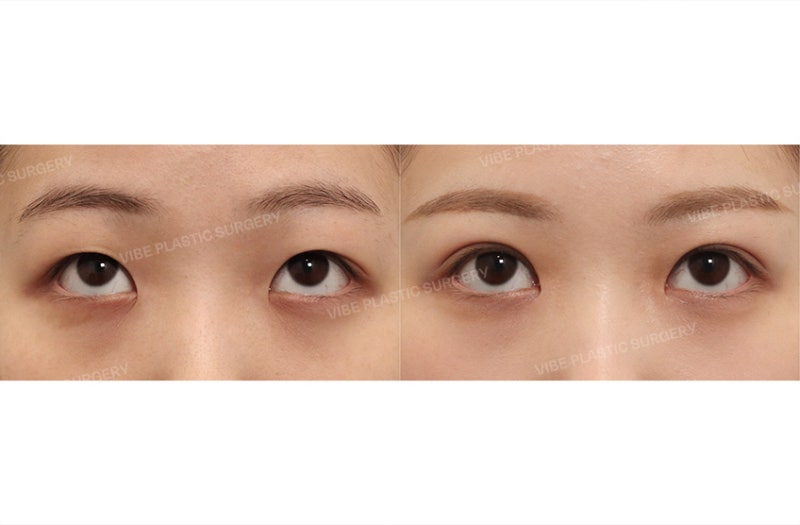

Blepharoplasty is not just about carving a 'line.'
When considering double eyelid surgery, many patients wonder:
“Should I get an in-fold or an in-out fold?”
“How many millimeters high should it be?”
However, there is something far more critical than millimeter measurements or fold classifications:
Determining which fold integrates most harmoniously with your innate ocular anatomy.
Even for the same in-out crease, canthal contours, skin thickness, tissue elasticity, and levator strength vary from person to person; identical designs cannot simply be replicated across individuals.
For patients who have used eyelid tape for years, the specific crease height and look they favored when taping provides helpful reference data during surgical planning.
Ultimately, superior blepharoplasty is not about
“making the eyes as large as possible,”
but rather
“crafting the eye shape that flatters your overall face most naturally.”
If you rely on eyelid tape daily and want to wake up with natural, effortlessly defined double eyelids,
it is best to start with an accurate assessment of your anatomical features to determine whether natural adhesion alone is sufficient or if combined canthoplasty is recommended.
At VIBE Plastic Surgery, we plan natural eye procedures by analyzing not only the requested line design, but also the inner canthal framework and total facial proportion.
A natural yet definitive transformation.
Defined eyes that remain unexaggerated.
Striking that exact balance is what matters most.
Frequently Asked Questions
Does prolonged eyelid tape use cause eyelid sagging?
It cannot be definitively stated that eyelid tape always leads to true skin sagging. However, repeatedly applying and peeling tape can cause chronic skin irritation or stretched appearance. Actual ptosis or laxity depends on varied factors including skin elasticity, tissue thickness, fat distribution, and age.
What type of eyes are suitable for natural adhesion blepharoplasty?
It is best suited for individuals with thin eyelid skin, minimal sagging, and little excess orbital fat. Because it is a non-incisional technique without extensive cutting, it is ideal for those seeking natural in-folds or in-out folds with reduced procedural downtime.
Why is canthoplasty often needed when creating an in-out fold?
Canthoplasty releases tension from the Mongolian fold, allowing the eyelid crease to start cleanly and smoothly from the inner corner. If the epicanthic fold is strong or covers the medial eyelid, the crease can end up blunt or buried, which canthoplasty corrects to yield a crisp in-out contour.
What is the difference between upper epicanthoplasty and standard epicanthoplasty?
Upper epicanthoplasty specifically addresses the tissue and epicanthal bands oriented at a 45-degree upward angle above the inner corner. While standard epicanthoplasty resolves horizontal narrowness and refines inner canthal exposure, upper epicanthoplasty prevents the inner portion of the crease from getting trapped beneath downward skin tension.