2026-09-20
Facelift in Your 40s: Is It Really Too Early? | When Mini Facelifts and Thread Lifts Fall Short, by VIBE Plastic Surgery
Dr. Young-Moon Yoo of VIBE Plastic Surgery explains why a facelift in your 40s can be the ideal solution when thread lifts and mini facelifts fail to correct deep SMAS laxity.
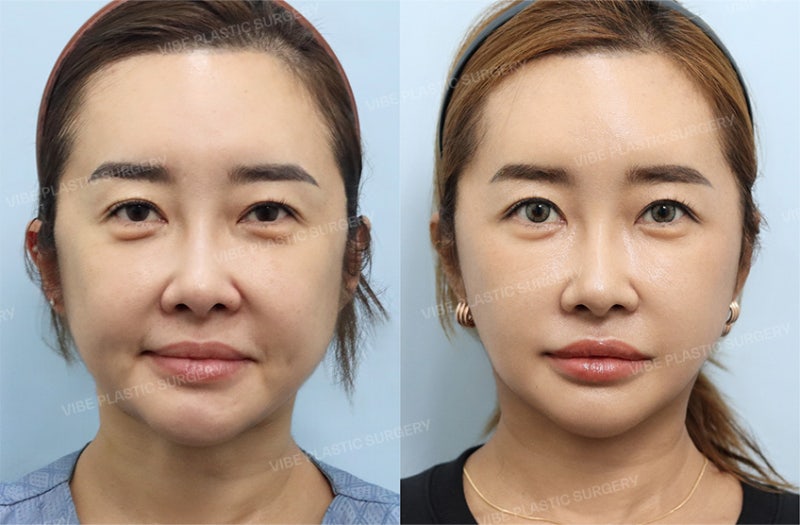
Do you really need a facelift in your 40s?
When mini facelifts and thread lifts are not enough: the choice for definitive lifting
Hello.
I am Dr. Young-Moon Yoo, Director of VIBE Plastic Surgery.
“I'm still in my 40s; is it okay to get a facelift?”
During facelift consultations, I receive this exact question quite often.
Because people in their 40s generally still feel young,
they frequently lean toward less burdensome alternatives,
such as mini facelifts, thread lifts, or energy-based laser treatments.
However, what truly matters is not chronological age.
Much more critical are the degree of structural facial laxity,
the specific areas causing concern,
and the level of lifting result you desire.
This female patient in her 40s had previously tried
a mini facelift,
double chin muscle plication,
and thread lifting,
undergoing various minimally invasive procedures and surgeries.
Despite all these, she was unable to achieve the clear, visible lift she hoped for.
Ultimately, she chose a full facelift to achieve a foundational, lasting improvement.
Why were repeated lifting procedures unsatisfactory?
There are multiple ways to lift facial tissues.
Thread lifts, ultrasound, radiofrequency tighteners, and mini facelifts
all possess unique advantages and can be excellent options for well-suited candidates.
However, when tissue laxity has already progressed noticeably
and the patient's goal is to definitively elevate the jawline and midface,
conservative, limited approaches often fall short of expectations.
In particular, when soft tissues and the SMAS layer have migrated downward alongside the skin,
simply pulling on the skin will not suffice.
The critical difference of a full facelift lies in its ability to
"reposition the underlying facial soft tissues, including the SMAS layer, along with the skin."
In a facelift, the most important element is not 'how much skin is pulled'
A common misconception is thinking of a facelift as merely
“cutting away excessive skin and pulling it upward.”
In reality, the procedure is far more intricate.
To achieve an exceptional, natural facelift outcome,
① how the incisions and vectors are planned,
② the precise direction of tension,
③ the anatomical layer accessed,
④ the method of SMAS manipulation, and
⑤ the redistribution of tension between deep structures and superficial skin
must all be factored in collectively.
Every single detail must be tailored to the individual's unique facial anatomy and vector of descent.
1. First is the 'Incision and Surgical Design'
A facelift incision is never just an arbitrary long cut around the ears.
The surgeon must evaluate:
Skin elasticity
Severity of ptosis
Hairline configuration
Position of the sideburns
Ear anatomy
Jawline definition
Degree of neck sagging
Pre-existing surgical scars
History of prior aesthetic procedures
All of these elements guide the surgical markings.
For female patients in particular,
ensuring that post-operative scars blend seamlessly and remain concealed is a vital consideration.
However, simply making an incision excessively short is not always the best solution.
Sufficient anatomical exposure is necessary to properly access and rearrange the deep structures.
In other words, achieving the right balance between
“minimizing visible scarring” and “securing adequate structural lifting”
is paramount.
2. Second is the 'Vector of Elevation'
This vector is of vital importance in facial rejuvenation.
Pulling facial tissues purely backward in a horizontal direction
often creates an unnatural, 'windswept' look.
Instead, the tissues must be elevated vertically or diagonally along a natural anatomical trajectory,
counteracting the exact direction in which gravity and aging caused them to descend.
This creates a supple, refined result.
The midface, cheeks, nasolabial folds, jawline, and neck
each display slightly different vectors of laxity and require tailored directions of elevation.
Modern facelift techniques prioritize structural repositioning according to human anatomy rather than indiscriminate lateral pulling.
3. The Crucial Foundation: The SMAS
Any thorough discussion of facelift surgery inevitably centers on the SMAS (Superficial Musculoaponeurotic System).
The SMAS is not a simple layer of subcutaneous fat;
it is a continuous fibromuscular network interconnected with the muscles of facial expression.
Simply put,
it is not just the skin being pulled,
but rather the structural framework supporting the overlying soft tissue from underneath.
This forms the core philosophy of a true facelift.
Within the surgery, the SMAS layer can be manipulated in various ways:
Plication (folding and suturing),
Imbrication and tightening,
Partial resection and overlapping,
or sub-SMAS dissection and deep mobilization as indicated.
The appropriate technique is chosen to match the patient's individual anatomical needs.
4. Is a deeper plane always better for SMAS dissection?
Not necessarily.
This is a critical point that deserves careful clarification.
With the recent popularity of the term "Deep Plane Facelift,"
many patients ask,
“Doesn't dissecting deeper automatically yield a better result?”
However, no single facelift technique is universally superior for all facial types.
There are numerous proven modalities—including SMAS plication, SMAS flaps, extended SMAS, and deep plane techniques—
each presenting distinct pros, cons, and clinical indications.
Recent systematic reviews have concluded that no single SMAS manipulation technique
proves universally superior in aesthetic outcome across all patient profiles.
Therefore, the question is not
“how deep one can dissect,”
but rather
“repositioning the tissues at the precise anatomical layer that that specific face requires.”
5. Selecting the proper depth of SMAS mobilization
This must vary on an individual basis.
For instance, if jowling and neck laxity are the primary complaints,
focused SMAS manipulation and cervical platysma work become the priority.
Conversely, if midfacial flattening and prominent cheek descent dominate,
anterior cheek tissue repositioning demands greater attention.
Prior to surgery, a detailed diagnostic assessment is required:
“Where did this patient's ptosis originate, and which specific structures have descended?”
Only then should the depth of dissection and range of release be decided.
Furthermore, any dissection around the SMAS must rigorously respect the path of the facial nerve branches.
Because transient facial nerve paresis is a recognized surgical risk,
an intimate knowledge of surgical anatomy and safe dissection planes is vital to protect patient safety while delivering reliable efficacy.
6. Determining the appropriate amount of skin excision
A common misconception is that
“the more skin removed, the better the lift.”
In reality, this is far from true.
If superficial skin is pulled taut without first addressing and anchoring the deeper structural layers,
the skin experiences excessive tension,
which can lead to widened scars, earlobe distortion, and an artificial, pulled expression.
An ideal facelift focuses on
properly anchoring and repositioning the deeper musculoskeletal layers,
allowing the overlying skin to drape over the new contour effortlessly and without tension.
In essence,
you do not lift the face by dragging the skin;
you lift the deep foundations first and let the skin follow smoothly.
This is the fundamental principle of natural facial restoration.
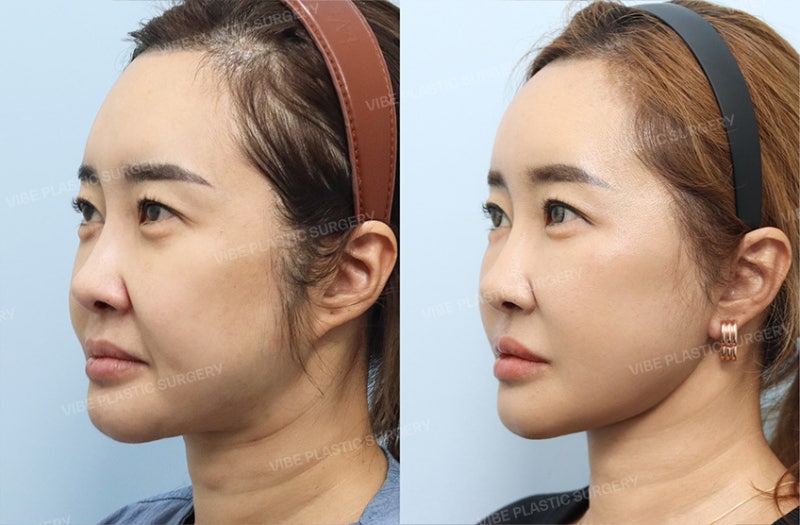
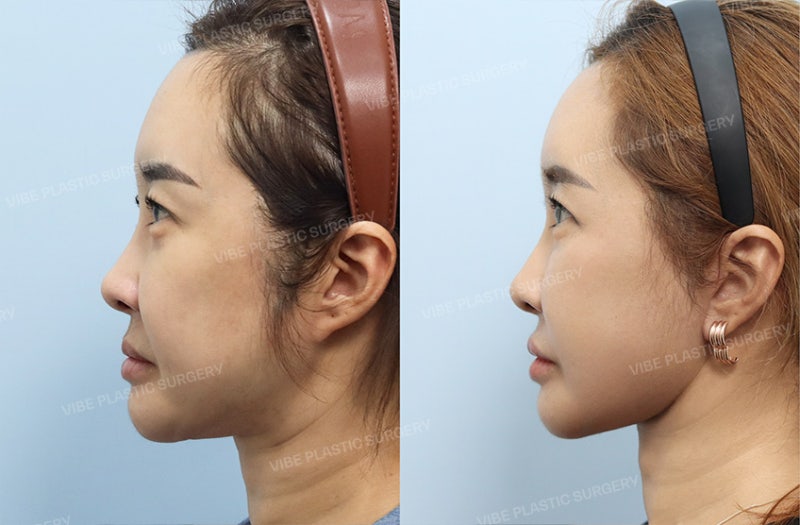
Why did this patient need a facelift?
This female patient in her 40s had already undergone several tightening procedures.
She had received a mini facelift,
submental muscle plication (platysmaplasty),
and multiple thread lifts.
Yet, the outcome fell short of her aesthetic expectations.
The relevant question here is not
“Why perform a facelift on someone in her 40s?”
but rather,
“Considering the degree of structural descent and the patient's goals, what procedure offers the most definitive, reliable outcome?”
The patient was not looking for subtle, temporary tightness;
she wanted a crisp, definitive correction of jowling, sagging cheeks, and lower face heaviness.
Given those goals, a comprehensive facelift was the most logical and effective solution.






Is a facelift in your 40s really premature?
Not at all.
A facelift is not a milestone procedure locked to a specific birthday.
Even in your 40s, if
facial descent is clearly noticeable,
the mandibular line is losing definition,
the cheeks and lower facial tissues have drifted downward,
prior non-surgical or minimally invasive modalities have yielded limited improvement,
and you seek a distinct, lasting transformation,
a facelift is a fully justifiable option.
Conversely, even for someone in their 50s or 60s with minimal tissue laxity,
an extensive facelift may not be required.
Ultimately, clinical tissue status and individual aesthetic expectations outweigh age alone.
The distinct advantage of a facelift: 'Definitive Transformation'
Thread lifts and energy-based lifting devices (such as Ultherapy and Shurink)
can be wonderful modalities when matched to the right candidate.
However, despite undergoing multiple sessions, some patients feel:
“It seems slightly better, but it's not the definitive change I had envisioned.”
When deeper soft tissues and skin have experienced progressive gravitational descent,
direct anatomical repositioning becomes essential.
In these cases, a facelift intervenes effectively
by repositioning both the skin and the deeper SMAS framework,
restoring crisp contours to the jawline, lower face, midface, and neck.
The goal is never 'pulling as tightly as possible'!
The ultimate aim of facial rejuvenation
is not to produce an obviously 'operated-on' appearance.
Rather, it is to ensure
the jawline looks clean and sharp,
cheek sagging is visibly smoothed,
heaviness around the corners of the mouth is lifted,
and the transition between the chin and neck becomes crisp,
bringing about an overall rejuvenated and refreshed countenance.
Especially for patients in their 40s,
the goal is not to erase every single fine line or stretch the skin taut,
but rather to naturally turn back the clock by 5 to 10 years,
maintaining an authentic, expressive, and rested appearance.
The key takeaway from this case
This patient had already undergone a spectrum of lifting interventions.
Therefore, our priority was not to simply repeat another generic procedure, but to ask:
“Why were the previous procedures insufficient?”
The clinical answer was straightforward:
The problem was not confined to superficial skin elasticity;
the deeper facial soft tissues had shifted downward.
Consequently, we decided on a foundational solution:
analyzing both the skin and the underlying SMAS layer,
and performing a targeted facelift tailored to her specific anatomical vectors of descent.
Lifting is about 'how' it is done, not 'how hard' it is pulled
A successful, harmonious facelift result is never born of sheer pulling force.
How the incision lines are drafted,
which directional vectors are utilized,
at which anatomical layer the SMAS is treated,
how carefully excess skin is tailored,
and how the different facial compartments are re-anchored cohesively—
all of these decisions must form a unified, patient-specific surgical plan.
Still wondering if a facelift in your 40s is premature?
Age alone should not dictate the timing of your facelift.
If you are in your 40s with defined tissue laxity,
if threads and mini facelifts have not achieved the results you hoped for,
and if you want a reliable, structural lift,
a facelift is an entirely reasonable and viable path forward.
The goal is not to undergo invasive surgery unnecessarily at a young age,
but to select the precise surgical intervention that aligns with your current tissue state and desired rejuvenation.
Just like this patient, who explored several options before deciding on a definitive procedure,
choosing a facelift can provide the transformative outcome you have been seeking.
The essence of an effective facelift is not pulling skin tightly,
but "accurately diagnosing the descended facial architecture,
and carefully returning the tissues to their rightful positions
at the appropriate layer and along the proper vectors."
This is where natural, lasting rejuvenation begins at VIBE Plastic Surgery.
Frequently Asked Questions
Is it safe and appropriate to get a facelift in my 40s?
Yes, absolutely. Suitability for a facelift depends on the degree of soft tissue laxity and individual goals rather than chronological age. If previous thread lifts or mini facelifts have failed to deliver satisfactory, lasting results, a full facelift can be an excellent option even in your 40s.
Why did thread lifting or a mini facelift yield limited results?
Because aging involves not just superficial skin stretching, but the descent of deeper soft tissues and the SMAS framework. Treatments that pull only on the skin surface or work through limited incisions may lack the mechanical leverage required to elevate fully descended deep compartments.
Is deeper SMAS dissection always better during a facelift?
Not necessarily. Systematic medical literature indicates that no single SMAS technique is universally superior. The most reliable and natural results come from tailoring the depth and vector of dissection to the patient's distinct facial anatomy and areas of descent, rather than indiscriminately dissecting deep planes.
Is lifting more effective if more skin is removed?
No. Removing excessive skin without properly repositioning the deep structural layers creates undue tension, resulting in an unnatural 'windswept' appearance and widened scars. Optimal results are achieved by anchoring deep tissues first, then gently redraping and trimming redundant skin without excessive tension.
Are there risks of nerve damage during facelift surgery?
Complications such as temporary facial nerve weakness can occur. To prevent this, your surgeon must possess an in-depth mastery of facial anatomy, respecting the precise pathways of the facial nerve branches and operating strictly within proven, safe anatomical planes.