2026-11-09
Sausage Eye Revision Surgery: How to Correct a Thickened Double Eyelid Crease
Explains the causes of “sausage eyes” after double eyelid surgery and how revision can correct them, including incisional canthoplasty, adhesion release, and posterior lower-lid extension.
Hello.
This is Dr. Yoo Young-moon, Director of Vibe Plastic Surgery.
Judging the outcome of eye surgery by the height of the double eyelid alone is difficult.
Several factors must work together for a good result, including the thickness of the crease when the eyes are open, eyelid movement, the direction of the eye shape, and the balance between the front and back of the eye.
Especially after a first eye surgery, the crease may form thicker than expected, or the eyes may look like what is commonly called “sausage eyes” when open.
In other cases, the back of the eye may look short and closed off compared with the front, or the direction of the outer corner may make the eye look heavy and cramped.
These concerns are hard to resolve simply by re-creating the double eyelid.
Today, I will explain the causes of sausage eyes and how they can be corrected, focusing on “incisional canthoplasty and posterior lower-lid extension,” which may be considered in actual eye revision surgery.
1. What are sausage eyes?
“Sausage eyes” is a common term for the look when the skin and soft tissue just below the double eyelid line appear thick and puffy when the eyes are open.
In particular, when the tissue between the crease and the lashes shows up thickly, the whole double eyelid can look unnatural and heavy.
<What causes sausage eyes?>
Several typical causes can be considered.
① The crease was made too high
When the crease is set high, the skin and soft tissue between the lashes and the crease can appear relatively wide.
In this case, the area below the crease may look thick and puffy when the eyes are open.
② Thick skin and orbicularis oculi
Everyone has different eyelid skin thickness, fat, and orbicularis oculi development.
If the eyelid tissue is naturally thick, even a crease set at the same height can look relatively bulky.
③ Adhesions and scar tissue from previous surgery
If adhesions form between the skin and deeper tissue during an earlier operation, or scar tissue develops, the crease may look deep and unnatural.
④ Levator function and crease fixation point
The function of the levator palpebrae superioris, which lifts the eyelid, and the position where the crease was previously fixed can also affect the shape of the double eyelid.
For this reason, sausage eyes cannot be attributed simply to excess fat.
The surgical approach should differ depending on the cause.
2. How should sausage eyes be corrected?
The first thing to consider when correcting sausage eyes is “the height of the crease and the condition of the existing tissue.”
Simply removing tissue that looks thick may not be appropriate.
Excessive removal of eyelid tissue can make the lid look sunken or make it difficult to close the eye.
<Lowering the crease / Creating a new, lower crease line>
If the existing crease was formed too high, you can consider creating a new crease line at a lower position.
An important part of this process is checking for adhesions that formed along the existing line and releasing the necessary sections.
The height and fixation point of the new crease are then adjusted with the thickness of the crease when the eyes are open in mind.
However, if there is insufficient skin or significant tissue damage from previous surgery, there may be limits to how far the crease can be lowered.
<Eye-opening function must also be checked.>
A thick-looking crease does not mean that eye-shape correction is needed in every case.
It is necessary to check whether there is accompanying blepharoptosis that weakens the ability to open the eyes, whether the forehead muscles are overused when opening the eyes, and whether the two eyes open to different degrees.
If there is a problem with eye-opening function, it can be taken into account when planning the surgery.
In other words, sausage eye revision is a process of evaluating the following factors together.
Height and depth of the existing crease
Thickness of the skin and orbicularis oculi
Amount and distribution of eyelid fat
Adhesions and scarring from previous surgery
Function of the eye-opening muscles
Extra skin and eye-closure function
Based on these evaluations, we choose among methods such as incisional canthoplasty, adhesion release, and crease adjustment.
3. When is incisional canthoplasty considered?
Incisional canthoplasty is a method in which the eyelid is incised so the internal tissue can be checked directly during surgery.
In revision surgery in particular, the adhesion status of the existing crease can be assessed,
and tissue can be released or the fixation point adjusted as needed.
It can be considered in the following cases.
The existing crease is so high that the eye looks thick
Previous surgery left the crease deep and unnatural
Internal adhesions or scar tissue within the eyelid are suspected
Eye-opening function is reduced
The crease needs to be redesigned while the existing tissue is being checked
What matters here is that even when the procedure is called incisional canthoplasty, the actual surgery can differ from patient to patient.
Revision surgery in particular requires more detailed anatomical evaluation than a first operation, because the existing tissue has already changed.
4. If the back of the eye looks closed off? Consider posterior lower-lid extension
Not only the shape of the crease but also the horizontal length of the eye and the direction of the outer corner affect the overall eye shape.
Some people say the back of the eye looks shorter than the front, or that the area around the outer corner feels closed in and cramped.
In such cases, a posterior extension or lower-lid extension may be considered, depending on the anatomical conditions.
<Cases where posterior lower-lid extension can be considered>
The eye looks short horizontally
The back of the eye feels closed, giving a cramped impression
The outer corner is upturned, making the eye look sharp
You want to adjust the direction and shape of the outer eye
However, the feasible range of surgery varies depending on the position of the lateral canthus and the support structure of the eyelid.
Especially if the lower eyelid has weak elasticity or there is scarring or adhesion from previous surgery, a more careful evaluation is needed.
5. Why consider incisional canthoplasty and posterior lower-lid extension together?
In eye surgery, the balance of the whole eye matters more than changes to individual parts.
In this case, the surgical plan was built around two main directions.
First, incisional canthoplasty
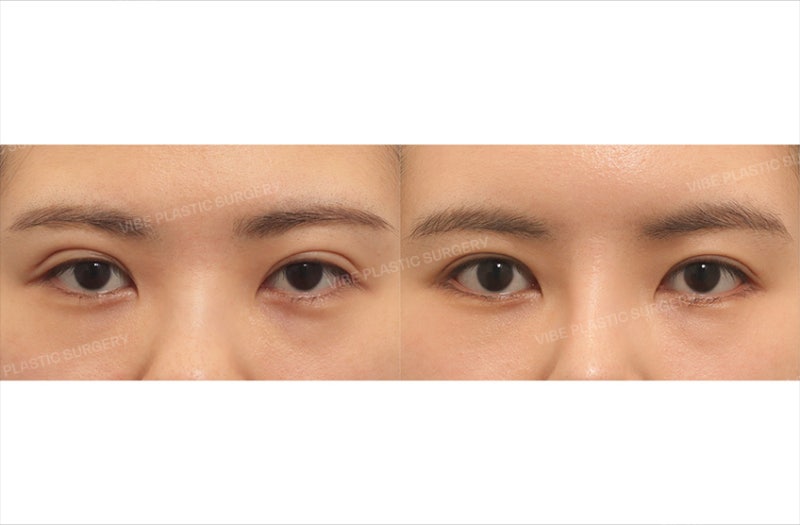
Because the crease formed high and thick after the previous surgery, we took the approach of lowering the line.
While checking the condition of the existing tissue, we adjusted the necessary adhesions and set a new crease line.
This aimed to ease the thick look below the crease and achieve a clearer eye appearance when open.
Second, posterior lower-lid extension
Because the back of the eye appeared relatively closed, we planned a posterior lower-lid extension.
With the anatomy around the outer corner in mind, the focus was on adjusting the horizontal direction at the back of the eye and the shape of the lower eye contour.
The two procedures target different areas, but they share the goal of considering the overall balance of the eye.
Side-by-side photos of the same eyes looking straight ahead: a thicker double-eyelid fold on the left, a slimmer fold on the right.
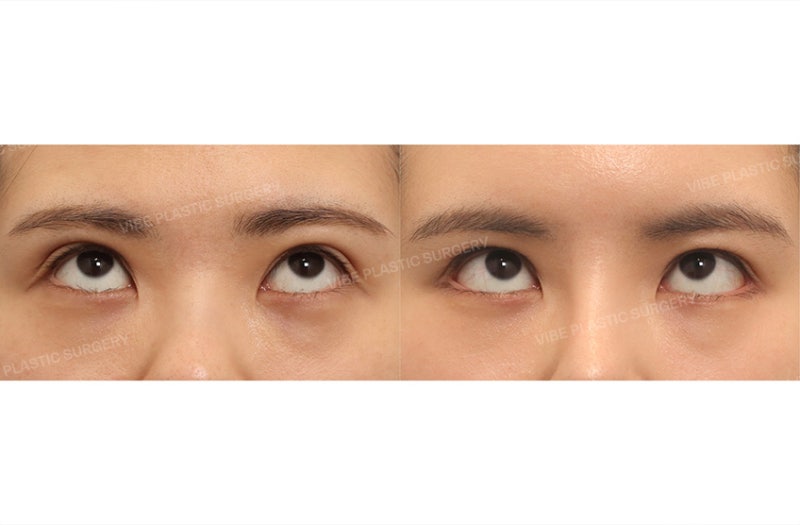
The same side-by-side comparison with the eyes looking upward, showing the double-eyelid creases in both photos.
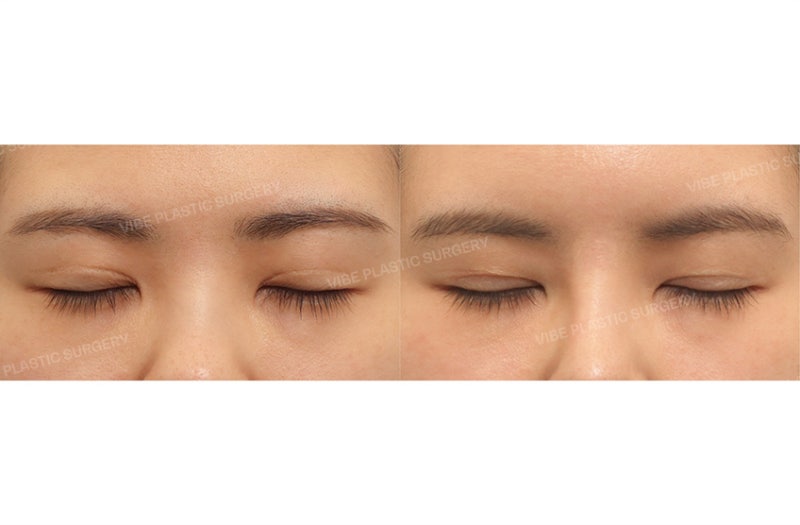
The same comparison with the eyes closed, showing the upper eyelids in both photos.
6. Key points to keep in mind for eye revision surgery
Eye revision surgery is often more complex than a first operation.
Tissue that has already been cut and sutured may retain scarring and adhesions,
and the amount of skin and fat may have changed due to earlier surgery.
In particular, the following points require attention.
① Lowering the double eyelid is not always the right answer.
Even if the existing line is high, it may be difficult to lower it as much as desired if there is insufficient skin or eyelid tissue.
② Do not remove too much fat.
If the eyelid looks thick and fat is removed excessively on the assumption that there is simply a lot of it, the eyelid may look sunken or unnatural.
③ Check eye-closure function.
Confirm whether the eye can close completely, whether there is a pulling sensation in the lid, and whether there are signs of eyeball exposure or dryness.
④ Stability of the lower eyelid is also important in posterior lower-lid extension.
When the back of the eye is widened, the support structure of the lower eyelid can be affected.
Excessive correction can be associated with outer corner deformity, scarring, conjunctival exposure, and lower-lid retraction, so an appropriate surgical range must be set.
⑤ The timing of revision surgery should be determined individually.
After the first operation, the swelling and scar tissue need time to settle.
A sufficient recovery period is generally considered, but if there is difficulty closing the eye, severe discomfort, or similar problems, it is better to have the condition checked through a consultation rather than simply waiting.
7. In eye surgery, overall harmony matters more than height.
When considering eye surgery, many people focus only on the height of the double eyelid or the size of the eye.
In reality, however, the thickness of the eyelid, the amount of extra skin, the function of the eye-opening muscles, and the position and direction of the outer corner must all be considered together.
Revision surgery in particular may have changed the anatomy of the tissue due to earlier operations, so accurately assessing the current condition is important.
Even when a double eyelid looks thick, as with sausage eyes, the causes are not always the same.
In some cases the height of the crease needs adjusting, while in others, releasing existing adhesions may be necessary.
If there is a problem with eye-opening function, that should also be evaluated.
Posterior lower-lid extension is also not simply a surgery to make the eye bigger;
whether it applies is judged by considering the structure around the outer corner and the direction of the eye shape.
Ultimately, what matters is not creating a particular eye shape,
but choosing the appropriate surgical approach by considering each person’s eye structure and function.
This was Dr. Yoo Young-moon, Director of Vibe Plastic Surgery.
Thank you.
Frequently Asked Questions
Do sausage eyes simply occur because of too much fat?
No, sausage eyes cannot be attributed simply to excess fat. Causes can include a crease set too high, thick skin and orbicularis oculi, adhesions and scarring from previous surgery, and the function of the eye-opening muscles. The surgical approach differs depending on the cause.
How is sausage eye revision surgery corrected?
After comprehensively evaluating the cause and current condition, options such as incisional canthoplasty, adhesion release, and crease adjustment are chosen. If the existing crease is high, creating a new crease at a lower position can be considered.
If the double eyelid crease is high, must it always be lowered?
No, lowering the double eyelid is not always the right answer. Even if the existing line is high, it may be difficult to lower it as much as desired if there is insufficient skin or eyelid tissue.
What should be checked before eye revision surgery?
It is important to check eye-closure and eye-opening function. Confirm whether the eye can close completely, whether there is a pulling sensation in the lid, and whether there are signs of eyeball exposure or dryness. It is also important to check for blepharoptosis that weakens the ability to open the eyes.
When should posterior lower-lid extension be considered?
It can be considered depending on anatomical conditions, such as when the horizontal length of the eye looks short or the back of the eye feels closed and cramped. However, the feasible range of surgery depends on the position of the outer corner and the support structure of the eyelid. If the lower eyelid has weak elasticity or there is scarring or adhesion, a more careful evaluation is needed.
When is the best time to have eye revision surgery?
The timing of revision surgery should be determined individually. The swelling and scar tissue after the first operation need time to settle. If there is difficulty closing the eyes or severe discomfort, it is better to have the condition checked through a consultation rather than simply waiting.