2026-11-12
What Are the Advantages of 3D Custom Implants?
Explains when 3D custom implants may suit the nasal bridge, how they are designed from CT scans, their benefits and limits, and how rib cartilage can refine a bulbous tip.
Hello.
This is Dr. Yoo Young-mun, director of Vibe Plastic Surgery.
Among those considering rhinoplasty, many are concerned not only with nasal bridge height
but also with the shape of the nasal tip and the overall proportions of the nose.
In particular, when the nasal tip looks round and blunt,
raising the nasal bridge alone may not achieve the desired nose shape.
In such cases, rather than treating the nasal tip and nasal bridge as separate issues,
it is important to consider the nose's anatomical structure, skin thickness, cartilage shape, and the proportions of the whole face.
In this article, we will look at bulbous nose correction
with a particular focus on the cases in which 3D custom implants are used.
1. What causes a blunt nasal tip?
Several anatomical factors contribute to a blunt-looking nasal tip.
The main factors to consider include the following.
① Shape and arrangement of the nasal tip cartilages
The width and contour of the nasal tip can vary depending on the size, shape, and degree of divergence of the left and right alar cartilages that form the tip.
② Thickness of the nasal tip skin and soft tissue
When the skin and subcutaneous tissue are thick, the shape of the underlying cartilage may not be clearly visible from the outside.
③ Structural support of the nasal tip cartilages
When the structural support of the nasal tip, including the septal cartilage and alar cartilages, is weak or poorly aligned,
it can affect the projection and direction of the nasal tip.
Therefore, when correcting a blunt nasal tip, rather than simply raising the tip,
it is important to identify the structures causing the problem and secure appropriate support.
2. Nasal tip correction using rib cartilage
Rib cartilage is cartilage tissue that forms part of the rib cage. In rhinoplasty, it is used as a material to provide structural support.
It may be considered especially when the necessary support cannot be secured with septal or auricular cartilage alone,
or when structural reconstruction of the nasal tip is required.
The main features of rib cartilage are as follows.
A relatively large amount of cartilage can be obtained.
It can be carved into the required shape and size.
It can be used to rebuild the structural support of the nasal tip.
It can be used for structural correction that takes into account the height, projection direction, and support strength of the nasal tip.
However, although rib cartilage is autologous tissue, there are possible risks such as pain or scarring at the harvest site, cartilage warping, resorption, and infection.
In addition, the appropriate amount and shape vary depending on the skin thickness and cartilage condition of the nasal tip, so an individual consultation is necessary.
3. What is a 3D custom implant for the nasal bridge?
Standard nasal implants are typically selected from pre-manufactured products in fixed shapes and sizes
and then chosen or trimmed to fit the patient's nose.
In contrast, 3D custom implants are made by analyzing the patient's nasal structure through imaging data
and then designing and fabricating a shape tailored to the individual.
In other words, the difference is that the implant's shape is designed to reflect the patient's anatomy and surgical plan,
rather than choosing an implant from a predetermined shape.
<When is a 3D custom implant worth considering?>
① When the nasal bridge is asymmetrical from side to side
If the shape of the nasal bones or the contour of the nasal bridge is not symmetrical,
an implant design that accounts for structural differences between the two sides may be helpful.
② When the nasal bridge has curvature or irregularities
When the width, contour, and curvature of the nasal bridge need to be considered along with its height,
a customized design can be one option.
③ When there are structural changes around an implant after previous rhinoplasty
In revision surgery, the position of the existing implant, the condition of surrounding tissue, scarring and adhesions, and skin thickness must all be evaluated.
In such cases, a custom design based on CT imaging and other data may be considered.
④ When the height and width of the nasal bridge require detailed planning
Beyond simply increasing height, it can be useful when the overall contour,
extending from the forehead through the nasal bridge to the nasal tip, needs to be considered.
However, not every rhinoplasty requires a 3D custom implant.
Depending on the nasal structure and the purpose of surgery, a standard implant or autologous tissue may be more suitable.
4. How are 3D custom implants made?
3D custom implants are generally produced through four stages: imaging analysis, design, fabrication, and preoperative confirmation.
<STEP 1. CT Imaging and Nasal Structure Analysis>
First, the nasal bones and surrounding anatomical structures are evaluated using imaging data such as facial CT scans.
During this stage, the following aspects can be examined.
The shape and left-right symmetry of the nasal bones
The width and height of the nasal bridge
Contours of the nasal bone and surrounding structures
In patients with prior surgery, the position of the implant and the surrounding structures
CT is useful for evaluating bone and internal structures,
but skin thickness and soft tissue characteristics cannot be fully assessed by CT alone.
For this reason, a physical examination and assessment of the external nasal shape must be performed alongside imaging.
<STEP 2. Designing the Ideal Nasal Bridge Shape>
Based on the imaging data, the implant design is planned in consideration of the patient's facial proportions, current nasal shape, and surgical goals.
At this stage, the following factors are considered together, not just raising the nasal bridge:
The starting point and height of the nasal bridge
The width and left-right balance of the nasal bridge
The line visible from the front
The curvature of the nasal bridge seen from the side
A natural contour that connects to the nasal tip
Because each person's nasal bone structure and skin conditions differ, the same design cannot be applied to everyone.
<STEP 3. 3D Modeling and Implant Fabrication>
The planned design is rendered in three dimensions, and the implant is fabricated using designated materials and manufacturing processes.
During fabrication, factors such as the implant's shape, thickness, edge margins, and fit with the nasal structure are taken into account.
The actual manufacturing methods and materials may vary depending on the medical institution and production system.
<STEP 4. Final Preoperative Confirmation>
The fabricated implant is checked to confirm it matches the surgical plan,
and whether to use it is determined during surgery based on the condition of surrounding tissue and anatomical factors.
3D design can help refine the surgical plan,
but it does not guarantee that the actual surgical result will match the design exactly.
5. Benefits and Considerations of 3D Custom Implants
The key feature of 3D custom implants is that they allow for an individualized design based on the patient's anatomy.
<Potential Benefits>
Implant design that reflects individual nasal structure
A design that considers the height, width, and contour of the nasal bridge together
Shape planning that accounts for left-right asymmetry and curvature
More refined surgical planning through three-dimensional structural analysis before surgery
However, being custom-made does not automatically mean it is superior in every respect or has fewer side effects than a standard implant.
Because implants are foreign materials, complications such as infection, inflammation, displacement, visibility through the skin, skin pressure, and protrusion can occur.
Therefore, the implant material and manufacturing method, the patient's skin and tissue condition, and the surgical technique should all be thoroughly reviewed.
6. A Surgical Plan Using Rib Cartilage for the Nasal Tip and a 3D Custom Implant for the Nasal Bridge
① Nasal tip: autologous rib cartilage
Rib cartilage was used in consideration of the structure of the blunt nasal tip.
The rib cartilage was shaped as needed and used to plan the structural support and contour of the nasal tip.
② Nasal bridge: 3D custom implant
Based on CT imaging and the nasal shape, a custom implant was made to account for the height, width, and contour of the nasal bridge and then applied.
As the nasal tip and nasal bridge have different anatomical characteristics,
it is important to select materials and surgical methods suited to each area.
Rhinoplasty is not simply a procedure to change height; it is a process that considers the structure of the nasal tip, the contour of the nasal bridge, and harmony with the whole face.
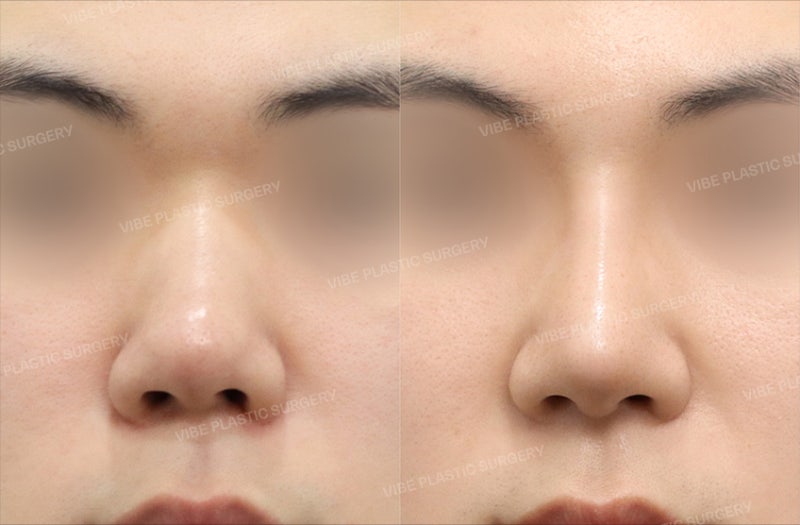
Front view of a man's nose, before (left) and after (right), with the eyes blurred for privacy.
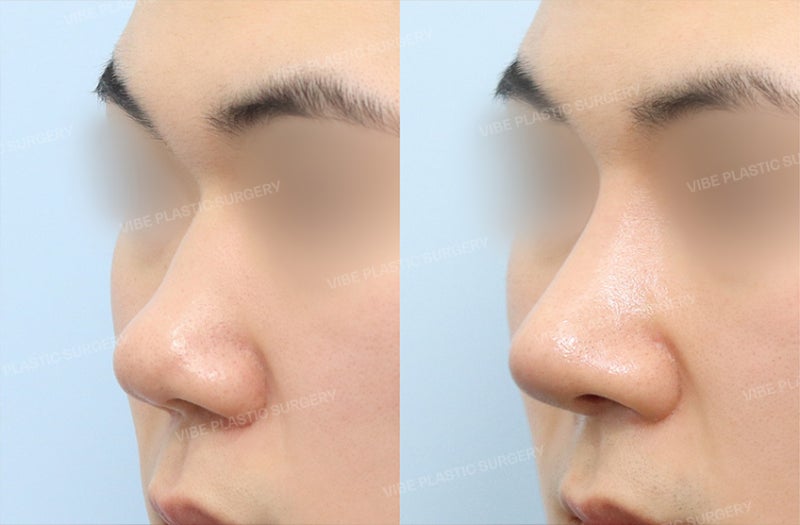
Angled (45°) view of the nose, before (left) and after (right).
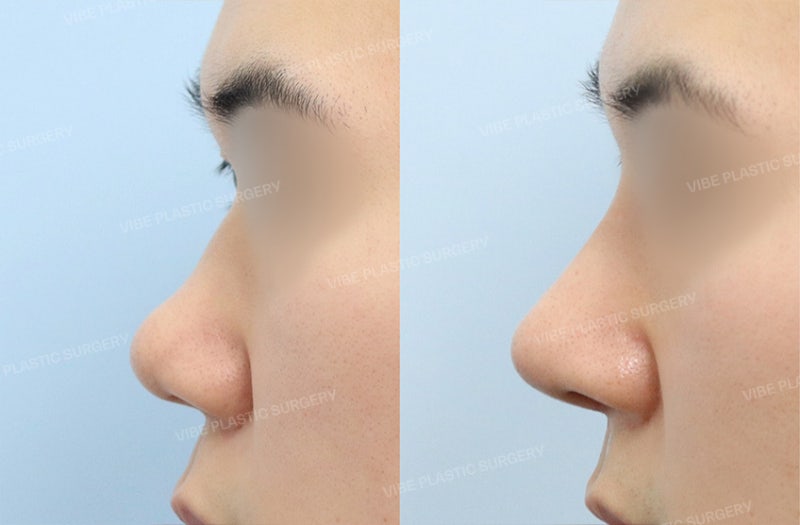
Side profile of the nose, before (left) and after (right), showing the line of the nasal bridge.
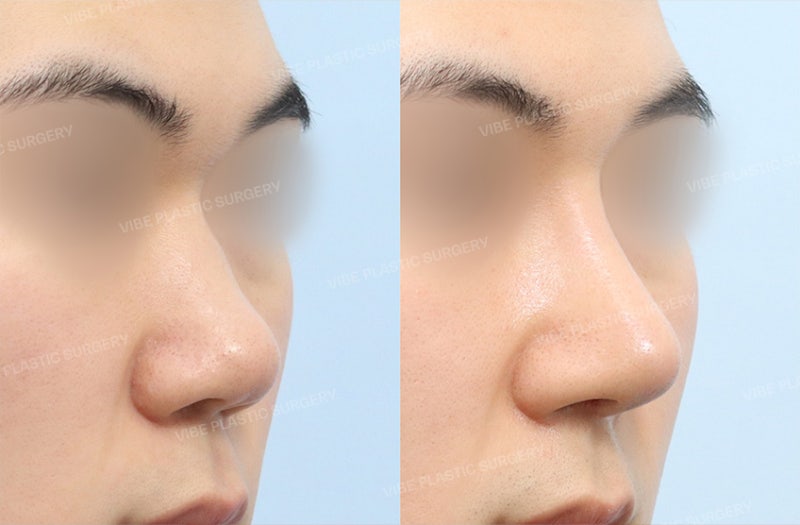
Angled (45°) view of the nose from the other side, before (left) and after (right).
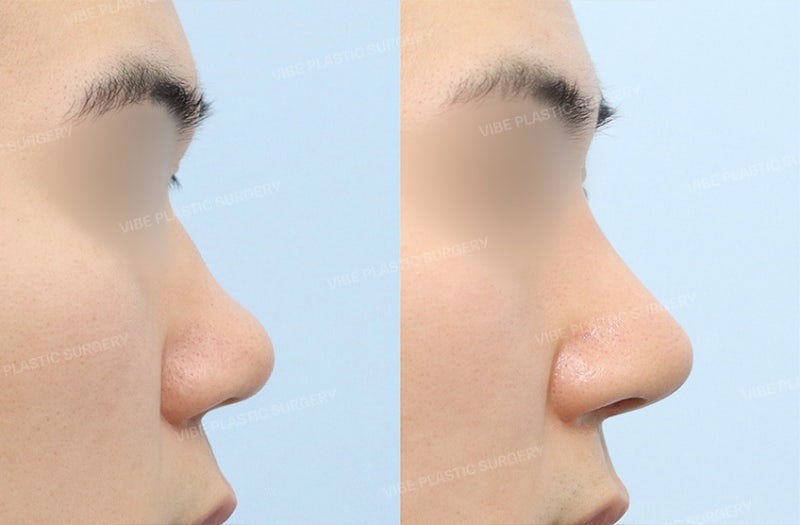
Side profile of the nose from the other side, before (left) and after (right).
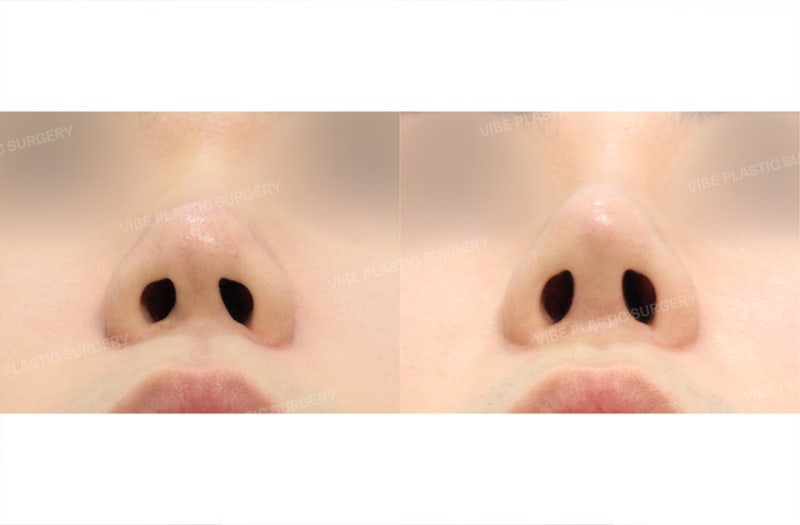
View of the nose from below, showing the nostrils and tip, before (left) and after (right).
Final Thoughts
When aiming to improve both the blunt nasal tip and the shape of the nasal bridge, it is important to accurately identify the cause of each.
Nasal tip correction using autologous rib cartilage and nasal bridge design using a 3D custom implant
are among the surgical options that may be considered depending on these goals.
However, the same surgical approach is not suitable for every patient,
and the plan may vary depending on the nose's anatomy, skin thickness, prior surgical history, and individual surgical goals.
At Vibe Plastic Surgery, we believe it is important to build a surgical plan that considers both the individual structure of the nose and the balance of the entire face.
If you are considering rhinoplasty, please look beyond height and shape
and fully understand the properties of the materials used, the surgical methods, and the possible complications and limitations before making a decision.
* This article is intended to provide general medical information. Actual surgical methods and suitability may vary depending on individual conditions.
* All surgeries carry risks, including bleeding, infection, inflammation, asymmetry, scarring, tissue damage, and the possibility of revision surgery.
Frequently Asked Questions
How do 3D custom implants differ from standard nasal implants?
3D custom implants are designed and fabricated to each individual by analyzing the patient's nasal structure through imaging data. Standard implants, on the other hand, are selected from pre-made shapes and sizes or trimmed to fit.
When can a 3D custom implant be considered?
It may be considered when the nasal bridge is asymmetrical from side to side or has curvature or irregularities. It may also be considered in revision surgery, where the structure around a previous implant has changed, with a custom design based on CT imaging and other data. However, it is not necessary for every rhinoplasty.
Do 3D custom implants have fewer complications?
Being custom-made does not automatically mean it is superior in every respect or has fewer side effects than a standard implant. Because implants are foreign materials, complications such as infection, inflammation, displacement, visibility through the skin, skin pressure, and protrusion can occur.
How are 3D custom implants made?
They are generally produced through imaging analysis, design, fabrication, and preoperative confirmation. After the nasal bones and surrounding structures are evaluated using CT or similar imaging, the implant is designed with consideration of the nasal bridge's height, width, and left-right balance, then fabricated using 3D modeling. However, the design does not guarantee that the surgical result will match it exactly.
What is rib cartilage used for in nasal tip correction?
Rib cartilage is cartilage tissue that forms part of the rib cage, and it is used to provide structural support to the nasal tip. Although it is autologous tissue, there are possible risks such as pain or scarring at the harvest site, cartilage warping, resorption, and infection, so an individual consultation is needed.