2026-10-20
What Are the Key Elements of a Youthful Face?!
Dr. Yu Yeong-mun of Vibe Plastic Surgery reviews causes and surgical options for uneven eye-opening strength, under-eye fat, and facial volume loss, with key risks and precautions.
From asymmetry in eye-opening strength to under-eye fat (dark circles) and facial volume /
What Are the Key Elements of a Youthful Face?!
Hello.
This is Dr. Yu Yeong-mun of Vibe Plastic Surgery.
When the eyes sit at different heights or there is a difference in eye-opening strength,
when under-eye fat stands out and creates a tired appearance,
or when volume in the forehead and temples is lacking and the facial contour looks flat,
each case needs to be examined separately to identify its cause.
These changes can be related to multiple factors, including the anatomical structure of the eyelids, the function of the muscles that open the eyes, the distribution of orbital fat,
and the soft tissue and fat layers of the face.
Today, I will walk you through the surgical methods and key considerations for "creating a youthful face" that can address asymmetry in eye-opening strength, under-eye fat protrusion, and loss of facial volume,
from a medical information perspective.
1. Asymmetry in Eye-Opening Strength: Identifying the Cause Comes First
Even when the size of the two eyes or the height of the eyelids differs, the same surgical method cannot be applied in every case.
Asymmetry in eye-opening strength can arise from several factors, including:
Differences in the function of the muscle that lifts the eyelid
Differences in the position or attachment of the structures that lift the eyelid
Differences in eyebrow height and in the habit of using the forehead muscles
Differences in existing double-eyelid structure and skin thickness
Neurological causes or other ophthalmic problems
Therefore, when considering surgery, rather than simply comparing eye size,
eyelid height, eye-opening strength, eyebrow movement, and the relationship between the eyeball and eyelid should all be evaluated comprehensively.
In particular, even without a clear medical history, if the asymmetry appears suddenly or is accompanied by other symptoms such as double vision or differences in pupil size,
an ophthalmologic or neurological evaluation may be needed before any cosmetic surgery.
<What Is Incision-Free Eye-Opening Correction?>
Eye-opening correction is a surgical procedure considered to improve eye-opening function by adjusting the structures involved in lifting the eyelid.
Incision-free eye-opening correction performed through the conjunctiva approaches the eyelid from its inner side, the conjunctival surface.
Its approach differs from procedures that involve cutting the skin, and its main feature is that it does not leave a scar from a skin incision.
However, "incision-free" does not mean there is no tissue damage or risk of complications.
Whether the procedure is suitable depends on the structure of the eyelid and the function of the eye-opening muscle,
and in some cases, correction through a skin incision may be more appropriate.
Also, eye-opening correction does not have to be performed together with double-eyelid surgery.
If you do not want to change your existing double-eyelid line, an incision-free approach can be considered based on the eyelid structure and your goals,
without performing a separate double-eyelid fixation.
2. Under-Eye Fat Protrusion and Under-Eye Fat Repositioning
The reason the under-eye area looks puffy is not simply that there is too much fat.
When the fat under the eye protrudes forward or the structures supporting the lower eyelid have weakened,
the lower eyelid contour can also become more noticeable when the tear trough deepens or the skin becomes thinner or less elastic.
These changes can create shadows depending on lighting or facial expression and may contribute to a tired appearance.
<How Under-Eye Fat Repositioning Works>
Under-eye fat repositioning does not simply remove protruding fat;
it is a procedure that moves or redistributes the fat based on its position and the condition of the surrounding tissue.
When access through the conjunctiva is possible, it can generally be performed in a way that leaves no incision scar on the outside of the skin.
However, if skin laxity is significant or the skin itself needs correction, other surgical methods may be considered in combination.
When deciding on the surgical approach, the following points should be checked:
Degree and distribution of under-eye fat protrusion
Depth of the tear trough and hollowing of the surrounding tissue
Skin elasticity and fine lines
Position of the eyelid and its supporting structures
Degree of eyeball protrusion and any existing ophthalmic conditions
Fat repositioning alone does not resolve skin sagging or fine wrinkles.
Excessive removal or repositioning of fat can actually make the under-eye area look hollow or result in an irregular contour,
so determining the right amount and position is important.
3. Fat Grafting
The three-dimensional look of the face is influenced not only by bone structure but also by the distribution of subcutaneous fat and the thickness of soft tissue.
When the forehead looks flat or the temples appear hollow,
or when the border between the under-eye area and the anterior cheek stands out, the volume status of the area can be comprehensively evaluated.
Autologous fat grafting involves harvesting fat from your own body and transferring it to the areas where it is needed.
<Considerations by Area>
① Forehead
The curve and left-right shape of the forehead, as well as the thickness of the skin and soft tissue, should be assessed.
Excessive volume can affect the overall facial proportions, so the injection amount must be carefully determined.
② Temples
In the temple area, the thickness of the fat layer, blood vessels, and surrounding anatomical structures must be considered.
Hollowing may differ between the left and right sides, so it is difficult to apply a uniform amount.
③ Under-eye area
The under-eye area is anatomically sensitive, with thin skin and a dense network of blood vessels.
Even when fat grafting is considered, its suitability must be judged by distinguishing between under-eye fat protrusion, the tear trough, and skin condition.
④ Anterior cheek
Volume in the anterior cheek can affect the contour of the under-eye area and the midface.
However, fat grafting does not improve every wrinkle or sag, so the proportions of the whole face must also be considered.
<What to Know After Fat Grafting>
Some of the transferred fat may be absorbed, and the degree of graft survival varies depending on individual tissue condition and surgical technique.
Therefore, it is difficult to assume that the volume achieved right after surgery will remain the same over the long term.
Possible complications include swelling, bruising, infection, fat necrosis, fat lumps, uneven contours, and left-right asymmetry.
Although rare, serious complications such as blood vessel injury or fat embolism can also occur, so anatomical knowledge and a well-planned surgical approach are essential.
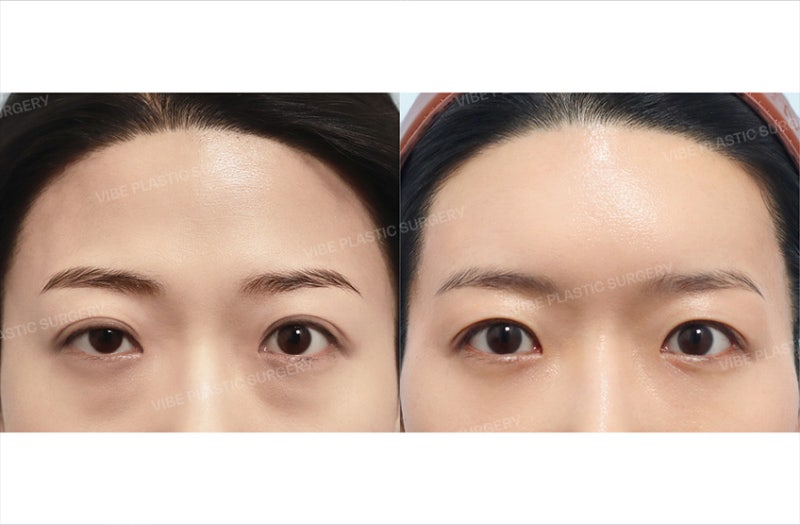
Front view, eyes open: side-by-side comparison of the same woman's forehead and eye area.
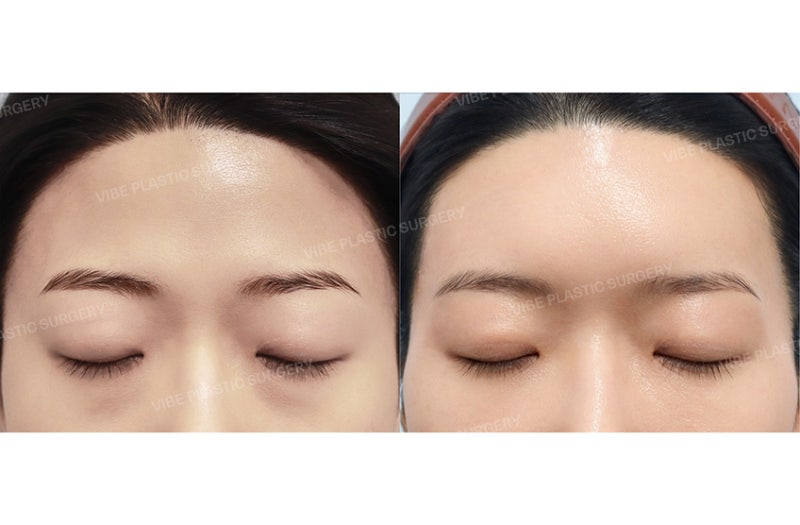
Front view, eyes closed: side-by-side comparison of the same woman's forehead and eye area.
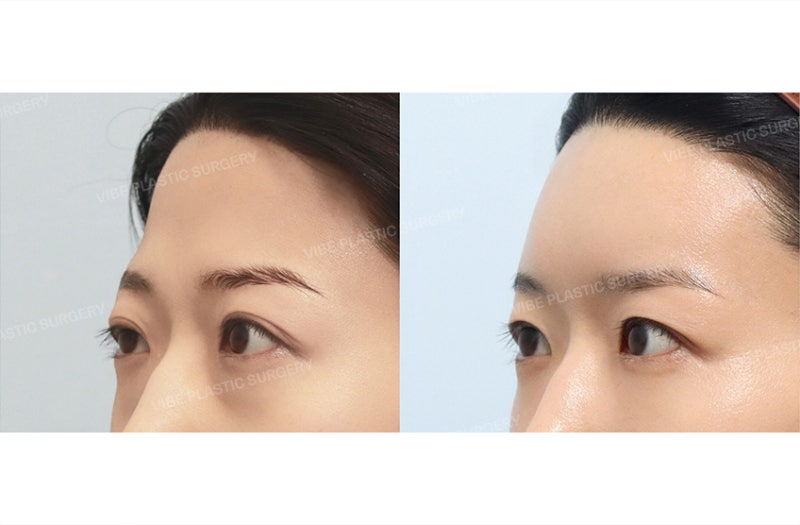
Angled view: side-by-side comparison of the same woman's forehead shape and eye area.
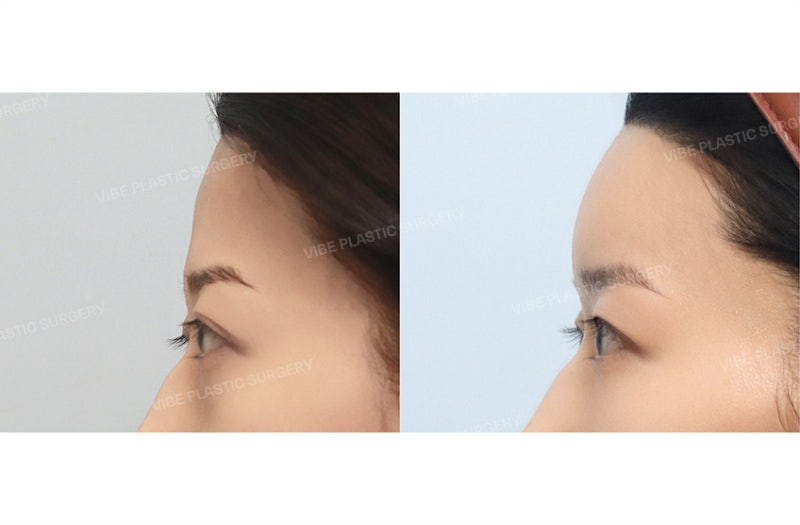
Side profile comparison of the same woman's forehead; the right photo shows a more rounded forehead line.
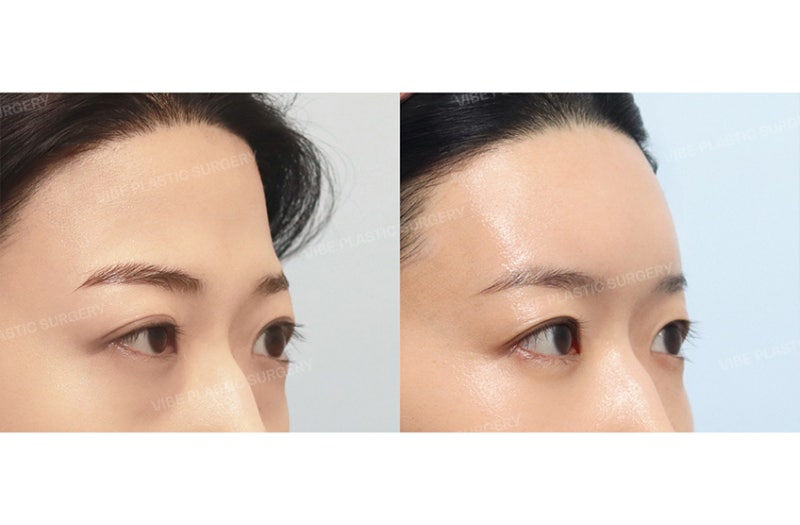
Angled view from the other side: comparison of the same woman's forehead shape and eye area.
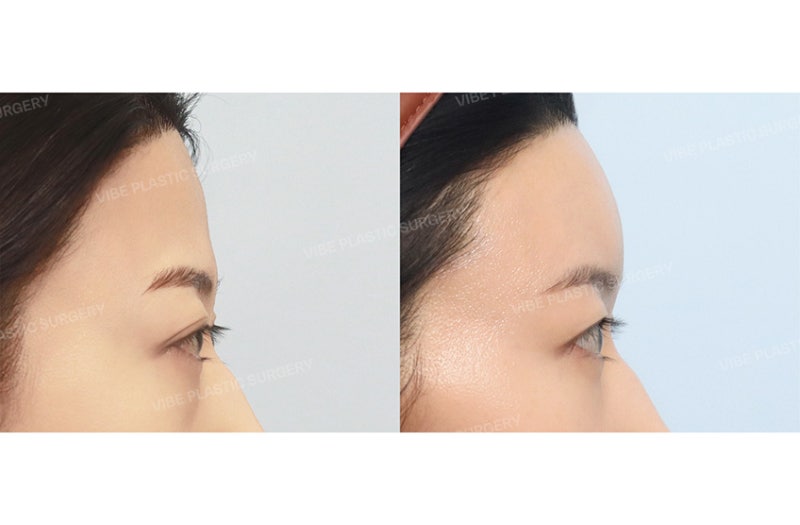
Side profile from the other side: the same woman's forehead compared, with a rounder forehead line on the right.
4. Considering Surgery on Multiple Areas Together
Even when asymmetry in eye-opening strength, under-eye fat protrusion, and volume loss in the forehead, temples, and anterior cheek are observed together,
not all areas necessarily need to be operated on at the same time.
Each issue may have a different cause, so functional problems and cosmetic goals should be evaluated separately.
For example, differences in eye-opening strength are evaluated with a focus on eyelid function,
under-eye fat protrusion is assessed by looking at the position of the fat and the eyelid's supporting structures,
and facial hollowing is judged based on the fat layers and overall contour.
When multiple procedures are performed together, factors such as operating time, swelling and recovery, bleeding and infection risk, and how each procedure may affect the others must be reviewed comprehensively.
5. Precautions to Check Before and After Surgery
Results and recovery from eye surgery and fat grafting can vary depending on individual anatomy and health status.
Before surgery, you should inform your medical team about any medications and supplements you take, bleeding-related conditions, eye problems such as dry eye syndrome,
and your past surgical history.
After surgery, follow your medical team's instructions and monitor your recovery.
If you notice changes in vision, severe eye pain, sudden visual disturbances, or rapidly worsening swelling, seek medical evaluation immediately.
Conclusion
Asymmetry in eye-opening strength, under-eye fat protrusion, and facial volume loss may look similar on the surface, but their causes can differ.
Incision-free eye-opening correction, under-eye fat repositioning, and autologous fat grafting are each surgical methods that address different anatomical issues.
What matters is not choosing a particular procedure across the board,
but comprehensively evaluating each person's structure and function, health status, and the risks associated with surgery.
This article is intended to provide general medical information
and is not meant to guarantee surgical results for any specific patient or to recommend individual surgery.
The suitability and method of actual surgery should be determined through examination and evaluation by a medical professional.
※ All surgeries and procedures carry the possibility of complications, including bleeding, infection, swelling, bruising, asymmetry, sensory changes, and under- or over-correction. Additional risks may apply depending on the surgical method and individual condition.
Frequently Asked Questions
Do people with different eye-opening strength on each side all receive the same surgery?
No, the same surgery is not applied to everyone. Asymmetry in eye-opening strength can result from several factors, including eyelid muscle function, eyebrow movement, existing double-eyelid structure, and neurological causes, so the cause must be identified first.
Does incision-free eye-opening correction involve cutting the skin?
Correct. The approach is made through the conjunctiva on the inner side of the eyelid, so it does not leave a scar from a skin incision. However, this does not mean there is no tissue damage or risk of complications at all, and whether it is suitable depends on the eyelid structure and the function of the eye-opening muscle.
Does under-eye fat repositioning remove all of the fat?
No. Rather than removing protruding fat outright, this surgery moves or redistributes it based on its position and the condition of the surrounding tissue. Removing or repositioning too much fat can make the under-eye area look hollow or cause an uneven contour, so determining the right amount and position is important.
Does the volume from autologous fat grafting last?
It is difficult to say that the volume immediately after surgery will stay the same over the long term. Some of the transferred fat may be absorbed, and the degree of graft survival varies depending on individual tissue condition and surgical technique.
What should I tell my medical team before surgery?
You should tell your medical team about the medications and supplements you are taking, any bleeding-related conditions, eye conditions including dry eye syndrome, and your past surgical history. Results and recovery for eye surgery and fat grafting can vary depending on individual anatomy and health status.
What should I do if my vision changes after surgery?
If you notice any change in vision, seek evaluation at a medical facility immediately. The same applies if you experience severe eye pain, sudden visual disturbances, or rapidly worsening swelling.