2026-05-25
7. Lower Blepharoplasty
This article by Dr. Yoo Young-moon, a plastic surgeon, delves into lower blepharoplasty, addressing common concerns like dark circles, under-eye sagging, and fat protrusion. It covers causes, diagnostic methods, and various surgical techniques, including transconjunctival fat removal, fat repositioning, and lower blepharoplasty, sometimes combined with mid-face lift. The article also discusses potential complications and their treatments.
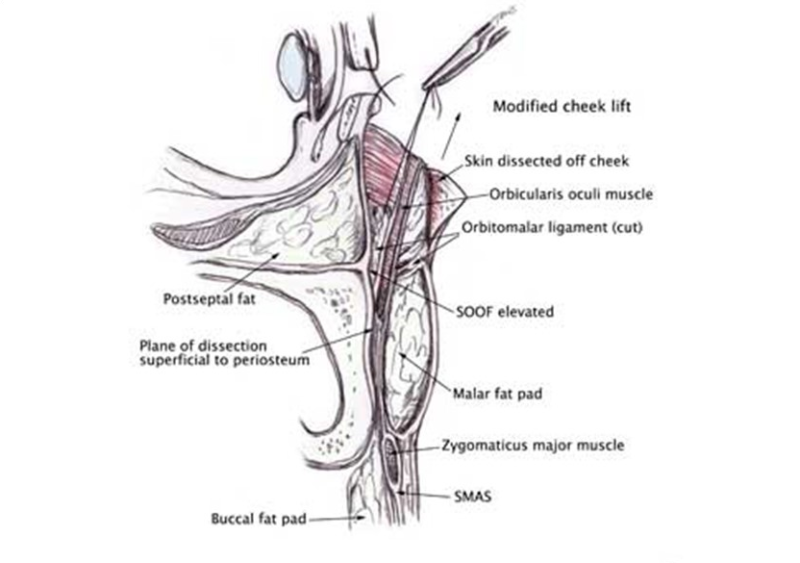
Hello.
I am Yoo Young-moon, a board-certified plastic surgeon.
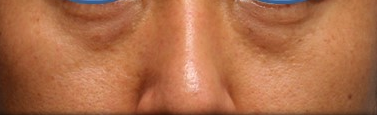
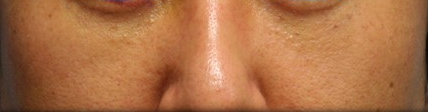
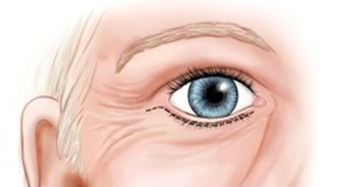
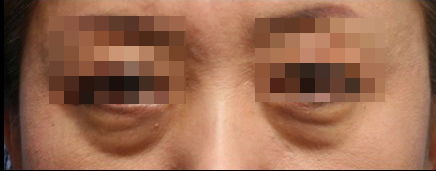
Let's take a look at #tear_trough_deformity (a more accurate medical diagnosis), commonly known as #dark_circles, #under_eye_sagging, and #under_eye_fat_protrusion.
Recently, I saw a video on YouTube where a director of a clinic claimed that dark circles cannot be treated with surgery... After watching that video, I found very little to agree with regarding the causes and treatment methods.. ^^;;
It seems he is not a board-certified plastic surgeon and likely focuses more on simple procedures rather than surgery.
Of course, there might be cases where simple procedures can bring improvement, and it would be even better if that were always possible, but in reality, surgical intervention is often necessary, especially for older patients.
The content I've prepared today may not be attention-grabbing or sensational (I don't have that talent ㅠ), but I believe it will be helpful if you read it calmly.
* Causes
So, why do they appear?
There are many different causes, and they are complexly intertwined to create dark circles. Therefore, accurate diagnosis is essential to achieve appropriate treatment and satisfactory results.
1. Bulging Fat
: More specifically, it's the 'shadow effect' created by bulging fat.
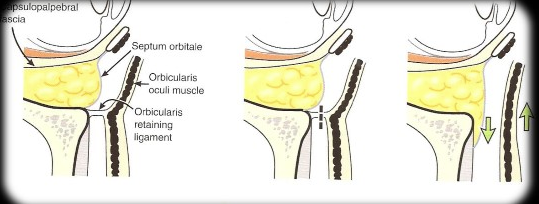
: As we age, the walls and membranes surrounding the under-eye fat naturally loosen, causing it to protrude.
: This is actually the most common cause and also the case where surgery can achieve the greatest effect.
2. Skin Characteristics
: The skin on our face is not a single sheet or lump.
: The skin is connected in pieces in each area (around the eyes, cheeks, mouth, forehead, etc.).
: And the skin of each piece differs in thickness, color, pore size, texture, and more.
: The dark circle area happens to be exactly at the boundary of these skin pieces, making it an area where the heterogeneity arising from differences in skin texture and thickness is strongly felt.
3. Location of Blood Vessels and Pigments
: If you touch the dark circle area, you can feel the bone right underneath, right?
: Since the skin is thin, blood vessels and pigments inevitably run very superficially.
: The bluish phenomenon resulting from this is also a cause (also known as the Tyndall effect).
* Physical Examination
Let's look at the diagnostic methods.
To understand the causes and decide on a treatment method, the following items should be checked:
- Skin elasticity
- #Snapback_test
- Degree of fat protrusion
- Presence of tear trough
- Sagging and hollowing of the anterior cheek
* Surgical Methods
Skin/Muscle Elasticity | Good | Good | Poor | Poor | Poor |
snapback test | Good | Poor | Poor | ||
Degree of fat protrusion | Moderate | Moderate | Moderate ~ Severe | Severe | Severe |
Tear trough | (-) | (+) | (-) | (+) | (+) |
Other | Sagging and hollowing of the anterior cheek | ||||
Surgical Method | #Transconjunctival_Fat_Removal | #Transconjunctival_Fat_Repositioning | #Lower_Blepharoplasty | Lower Blepharoplasty + #Lateral_Canthopexy | Lower Blepharoplasty + Lateral Canthopexy + #Midface_Lift |
Based on the physical examination, an appropriate surgical method is selected.
1. Transconjunctival Fat Removal
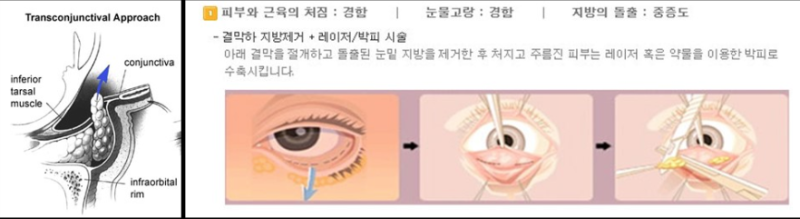
This method involves accessing through the conjunctiva (the red inner lining of the eye, do you see it?) to remove the bulging fat under the eyes.
For wrinkled skin, additional treatments like lasers or injections (#PRP, #PN, etc.) can be performed, right?
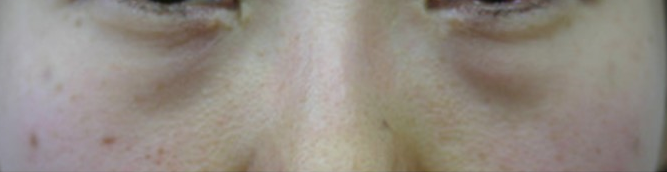
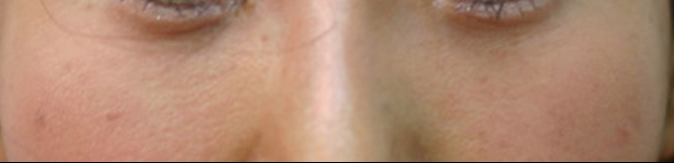
2. Transconjunctival Fat Repositioning
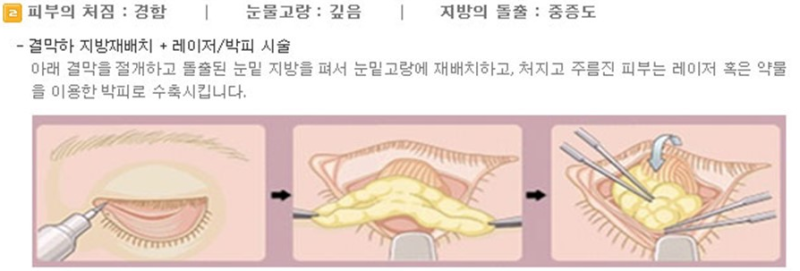
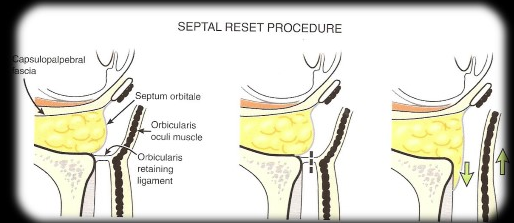
This method involves incising the conjunctiva, spreading the protruding under-eye fat, and repositioning it under the tear trough.
When the tear trough is deep, fat removal alone is insufficient, so repositioning is necessary to achieve more satisfactory results.
3. Lower Blepharoplasty
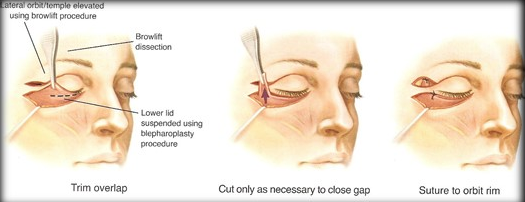
This method involves incising just below the eyelashes of the lower eyelid, repositioning the fat, excising the sagging skin and soft tissues, and then firmly fixing them.
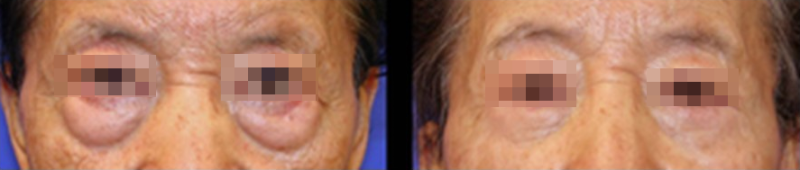
It is useful for more severe sagging than methods performed through the conjunctiva (numbers 1 and 2 above) and has the advantage of resolving both skin wrinkles and sagging.
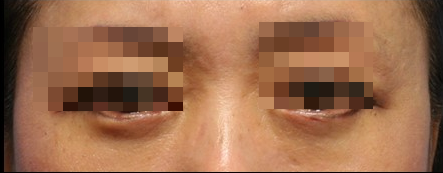
4. Lower Blepharoplasty + Midface Lift
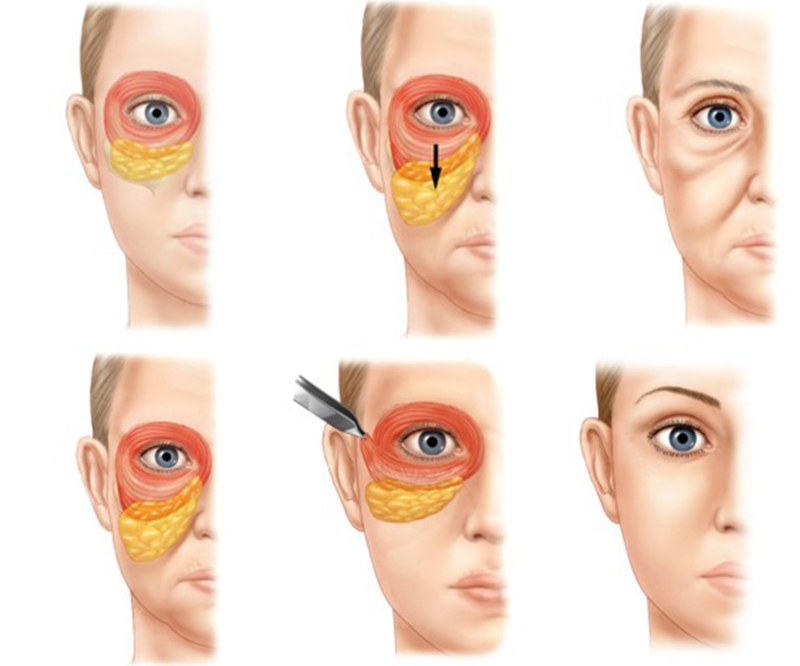
In the aging process, sagging of the anterior cheek often accompanies under-eye fat.
In such cases, performing a midface lift together can reposition the volume not only under the eyes but also in the anterior cheek, resulting in a more natural and youthful appearance.
* Possible Post-Surgical Complications and Treatment Methods
1. Conjunctival Edema
This usually occurs due to damage to the lymphatic vessels, leading to poor lymphatic circulation.
Lymphatic vessels are not visible to the naked eye and spread like a spiderweb, so they are structures that are inevitably severed during surgery.
Lymphatic vessel connections regenerate during recovery after surgery.
However, if the dissection range is too wide, the extent of lymphatic vessel damage can worsen, and this conjunctival hyperemia can persist for a long time.
From the surgeon's perspective, there is no other way than to perform surgery with minimal dissection. Once it occurs, it tends to persist for a long time, making it a rather concerning complication. However, in most cases, it fully recovers within 3-4 weeks, so you don't need to worry too much.
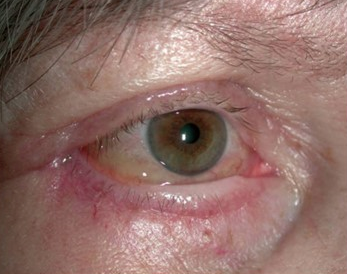
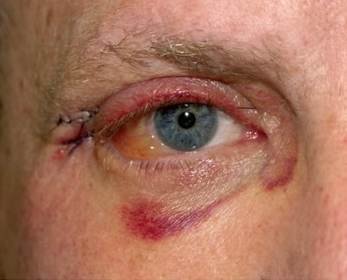
Treatment methods: artificial tears, steroid eye drops, hyaluronidase injection therapy, considering oral steroids if it persists for a long time.
2. Ectropion
Cutting off too much skin just because it's severely sagging is absolutely not a method that should be done.
Firm suspension fixation of the muscle and soft tissue must be performed to prevent re-sagging and maintain the results for a long time, and to avoid serious complications like ectropion.
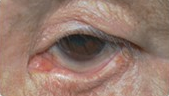
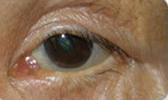
Treatment: In the early stages, taping or eyelid suturing may be effective, but if it persists for a long time, surgical correction is necessary.
With this, I will conclude my post on under-eye surgery.
In fact, there is so much content that this post alone cannot cover it all, but I have summarized the content that I consider most important.
What do you think? Did it help you understand the under-eye area to some extent?
Happy New Year to everyone, and may this year be filled with only good things! ^^
Frequently Asked Questions
What are the main causes of dark circles?
The main causes include shadows from bulging undereye fat, differences in skin thickness and texture, and visible blood vessels and pigmentation due to thin skin. As people age, the membrane surrounding the undereye fat often loosens, causing fat to protrude, which is the most common cause and can be effectively treated with surgery.
What is the difference between undereye fat removal and fat repositioning?
The surgical method differs depending on the presence of a tear trough. If the tear trough is not deep, only the bulging fat is removed through the conjunctiva. However, if the tear trough is deeply indented, simple fat removal is insufficient, and fat repositioning is needed to spread the protruding fat into the undereye hollow.
When is lower blepharoplasty necessary?
Lower blepharoplasty is necessary when there is severe skin sagging and wrinkles. It involves making an incision just below the eyelashes, repositioning undereye fat, excising some loose skin and muscle, and then firmly fixing it to the bone. This method has the advantage of providing a more significant improvement in sagging than surgery through the conjunctiva.
What should I do if conjunctival edema occurs after surgery?
Most cases resolve naturally within 3-4 weeks, so there is no need to worry excessively. Conjunctival edema occurs due to impaired circulation from lymphatic vessel damage during surgery. Artificial tears or steroid eye drops are used to aid recovery, and if symptoms persist for a long time, injections or oral medications may be considered.
How can I prevent the side effect of eyelid eversion after lower blepharoplasty?
The key is to avoid excessive skin removal and to firmly fix the muscle and soft tissues. If too much skin is excised due to severe sagging, ectropion can occur. If it does occur, initial management involves taping, and if it persists for a long time, surgical correction may be necessary.