2026-10-03
Eye Surgery in Your 50s: When to Combine a Subbrow Lift with Lower Blepharoplasty
Dr. Yoo Young-mun explains when to pair a subbrow lift with lower blepharoplasty and cheek lift for sagging upper lids and under-eye bags in your 50s.
Hello, I am Dr. Yoo Young-mun of Vive Plastic Surgery.
Many people in their 50s feel that the area around their eyes has changed from before.
“My double eyelid still looks fine, but my eyes feel heavy.”
“The skin on the outer part of my eyes keeps drooping.”
“The area under my eyes puffs out and looks shadowed.”
“I feel more tired and look older than before.”
Changes around the eyes after middle age are hard to explain by the crease line alone.
This is because the position of the brows, sagging of the upper eyelid skin, bulging of the under-eye fat, reduced skin elasticity, and drooping of the anterior cheek often appear together.
As aging progresses, the position of the brows and eyelids changes,
and under the eyes, fat may protrude or the midface tissue may shift downward, making the boundary between the tear trough and the cheek more noticeable.
That is why in eye surgery for patients in their 50s,
it is important to assess not just one eye,
but the entire area from the brow to the under-eye and anterior cheek as one unit.
What has changed in the sagging around the eyes of a woman in her 50s?
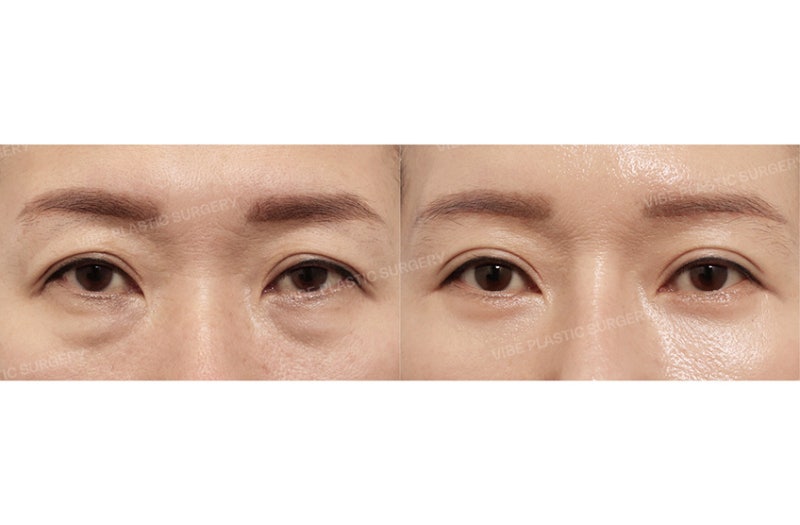
This case also involves a woman in her 50s who came to our clinic to improve sagging around her eyes.
Looking at her pre-surgery appearance, her double eyelid crease was relatively well preserved.
However, the upper eyelid skin was sagging, mainly on the outer side of the eye,
and fat was bulging under the eyes.
In cases like this, rather than simply redoing the double eyelid surgery, it is more helpful for a natural result to examine each of the following and correct the necessary areas together:
① Sagging below the brow
② Sagging of the outer upper eyelid
③ Protrusion of under-eye fat
④ Sagging of under-eye skin
⑤ Position of the anterior cheek
① The subbrow lift is especially effective for these patients!
A subbrow lift is a procedure that removes the sagging skin directly below the eyebrow to improve drooping of the upper eyelid.
What is especially important is that it is not a procedure that creates a new double eyelid crease.
It can be a good option when your existing double eyelid crease is well preserved,
but the upper eyelid skin, especially on the outer side, has sagged.
It may be worth considering for those who:
have a relatively well-preserved double eyelid crease
have sagging concentrated on the outer part of the eye
feel their eyelids are heavy and look tired
do not want to redo the double eyelid surgery
want to improve sagging skin around the eyes after middle age
want to tidy up their current eye shape rather than change it significantly
As aging causes the brows to drop or the eyelid skin to stretch, the eyelid skin can look even more sagging because of the brow position, not just because of the eyelid itself.
Therefore, a double eyelid revision is not always the right answer.
If you want to keep your current double eyelid as much as possible
and only tidy up the sagging skin, a subbrow lift may be worth considering.
What is the biggest advantage of a subbrow lift?
In my view, its greatest advantage is that it lets you ‘tidy up your appearance without significantly changing the shape of your eyes.’
In middle-aged eye surgery, the goal is not necessarily to make the eyes bigger.
Rather, in many cases it is more important to keep the existing natural double eyelid and eye shape,
remove the sagging skin,
ease the heaviness on the outer part of the eye,
make the area around the eyes cleaner,
and create a clearer, more relaxed impression.
Especially for those who think, “I like my double eyelid, but my eyelids are sagging and look heavy,” this can be a highly satisfying procedure.
② Lower blepharoplasty + anterior cheek lift
If aging has progressed beyond the upper eyelid and extends to the under-eye area, lower blepharoplasty may also be considered.
As we age, several changes can happen simultaneously under the eyes.
Typical examples include “under-eye fat protrusion + skin sagging + tear trough + anterior cheek sagging,” and so on.
When the fat under the eyes bulges, people often feel that
‘the fat under my eyes has popped out,’
‘the area under my eyes looks puffy,’
or ‘my dark circles have gotten worse.’
Also, as the midface tissue shifts downward, the boundary between the under-eye area and the cheek can become more pronounced.
Therefore, rather than simply removing the fat under the eyes,
it is important to assess the skin sagging, the position of the fat, and how the under-eye area connects to the anterior cheek.
What effects can lower blepharoplasty provide?
Lower blepharoplasty can
improve the bulging under-eye fat
and tighten loose skin to create a smoother lower eyelid contour.
Especially when fat under the eyes protrudes significantly, strong shadows can form, making you look more tired and older than you are.
So by correcting the protrusion and sagging under the eyes,
you can expect a change in impression from “looks tired” to “looks much fresher.”
However, lower blepharoplasty is not a procedure that removes all dark circles.
Pigmentation or vascular dark circles can have different causes, so it is important to accurately distinguish the condition under the eyes.
Why combine an anterior cheek lift?
Aging in the area under the eyes in your 50s does not stop at the under-eye area.
It progresses as one connected area: under-eye → tear trough → anterior cheek.
As fat protrudes under the eyes and the area beneath it looks hollow, and at the same time the anterior cheek sags, the boundary between the under-eye and cheek can become more pronounced.
When lower blepharoplasty is performed together with an anterior cheek lift,
you can expect not only a cleaner look under the eyes,
but also a smoother transition from the under-eye area to the anterior cheek.
In other words, the goal is to reduce the ‘puffiness’ under the eyes while improving the ‘sagging’ of the anterior cheek, creating a smoother and more natural midface contour.
Before (left) and after (right), eyes open: the puffy under-eye bags on the left look smoother on the right.
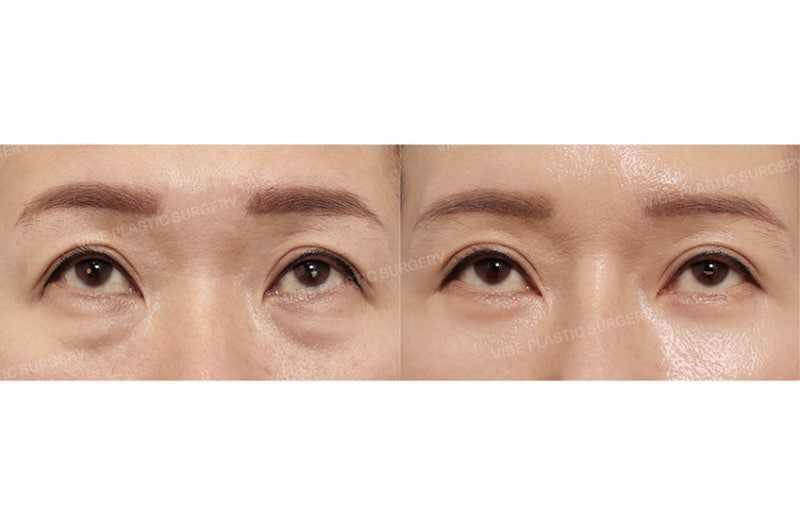
Another eyes-open comparison of the same woman: under-eye bags on the left, a flatter lower-eyelid area on the right.
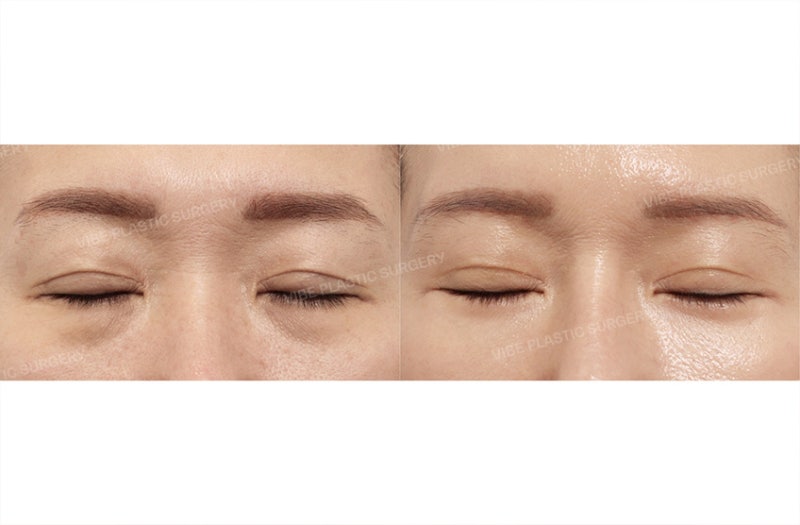
Eyes-closed comparison of the same woman, showing the upper eyelids and under-eye area before (left) and after (right).
So when is it best to combine both procedures?
As with this woman in her 50s,
in the upper area:
the double eyelid crease is relatively well preserved,
the outer upper eyelid skin is sagging,
and the eyelids look heavy and tired;
in the lower area:
the under-eye fat is bulging,
the under-eye skin is sagging,
and the anterior cheek also appears to be sagging,
a combination of 1. subbrow lift and 2. lower blepharoplasty & anterior cheek lift can be considered.
Since each procedure addresses a different area, rather than trying to solve all aging changes with a single surgery,
it is important to evaluate the brow, eyelid, under-eye area, and anterior cheek as a whole when planning surgery.
These patients tend to be especially satisfied
① Those who want to keep their double eyelid as it is
“I don’t want to redo my double eyelid surgery.”
A subbrow lift can be a good option for these patients,
because it allows the approach to focus on tidying sagging skin while keeping the current double eyelid crease as much as possible.
② Those whose outer skin sags significantly
When viewed from the front, skin sagging on the outer side of the eye may be more pronounced than on the inner side.
In such cases, it is important to accurately assess the location and degree of sagging and select the appropriate surgical technique.
③ Those who look tired because of under-eye fat
If under-eye bulges create shadows, and you hear comments like
“You always look tired”
or “You look older than your age,”
lower blepharoplasty may be worth considering.
④ Those whose anterior cheek also sags, not just the under-eye area
If improving only the under-eye fat does not change your overall face much,
it may be worth checking whether anterior cheek sagging is also present.
Sometimes the midface only looks more natural and balanced when both the under-eye area and the anterior cheek are improved together.
What matters most is not ‘doing many surgeries’!
In middle-aged eye surgery, the most important thing is not performing every possible procedure,
but accurately identifying what is actually the problem with your face right now.
Even within the same age group in their 50s, for one person the main issue may be sagging below the brow,
while for another it may be fat under the eyes.
And for someone else, sagging of both the under-eye area and the anterior cheek may be present together.
Therefore, the extent of surgery should be decided by comprehensively evaluating brow position, the double eyelid crease, the amount of upper eyelid skin, the degree of under-eye fat protrusion, skin elasticity, and anterior cheek position.
For eye surgery in your 50s, if you want a natural, youthful look
Eye surgery after 50 is not simply “making the eyes bigger.”
It means tidying what sags, lifting what needs lifting, and correcting what is lacking,
while preserving your natural eye shape as much as possible.
I believe this is the right direction in middle-aged eye surgery.
As in this case,
a subbrow lift can improve the sagging of the outer upper eyelid,
lower blepharoplasty can tidy up the puffy under-eye fat and sagging skin,
and an anterior cheek lift can refine the line from the under-eye area to the anterior cheek,
so that you can expect the central part of your face to look cleaner and more balanced, rather than changing the eye area alone.
Especially if you are in your 50s and feel
“I like my double eyelid.”
“I don’t want to make my eyes bigger.”
“But the area around my eyes is sagging and makes me look older.”
“The fat under my eyes makes me look tired.”
it is a good idea to consult about a middle-aged eye surgery approach that suits your current condition.
In the end, what matters is knowing which procedures you actually need.
After analyzing the overall aging changes from the brow to the under-eye area and anterior cheek,
selectively correcting only the areas that need it is the core of natural middle-aged eye surgery.
Frequently Asked Questions
When is a subbrow lift suitable?
It is suitable when the existing double eyelid crease is well preserved and the skin of the outer upper eyelid mainly sags. Because only the loose skin beneath the brow is removed, you can effectively relieve eyelid heaviness without creating a new crease, preserving your original eye shape.
Why are lower blepharoplasty and anterior cheek lift performed together?
Because aging in the under-eye area extends through the tear trough to the anterior cheek. By improving under-eye fat and skin sagging while lifting the drooping anterior cheek, the boundary between the under-eye area and the cheek blends smoothly, creating a more natural and smooth midface contour.
Who should consider a subbrow lift and lower blepharoplasty at the same time?
People who have sagging of the outer upper eyelid, bulging under-eye fat, and drooping anterior cheek together. The upper double eyelid crease is kept while sagging skin is tidied, and the lower area is smoothed by addressing bulging fat and loose skin, so that the overall signs of aging around the eyes are corrected in harmony.
Will dark circles disappear completely after lower blepharoplasty?
No, not all dark circles will disappear completely. Lower blepharoplasty can improve shadow-type dark circles caused by protruding fat, but dark circles caused by pigmentation or vascular factors are not resolved by surgery alone, so an accurate diagnosis of the cause is needed.
Do I need to redo my double eyelid surgery in middle-age eye surgery?
No, you do not necessarily need to redo your double eyelid surgery. If your existing double eyelid crease is in good condition, removing only the sagging skin through a subbrow lift can be far more effective for preserving your natural eye shape and avoiding an artificial change in appearance.