2026-10-14
Non-Implant Rhinoplasty: Am I a Candidate, Too?
Explains non-implant rhinoplasty, which reshapes the nose with the patient's own cartilage. Covers cartilage types, candidacy criteria, pre-surgery checks such as CT scans, and possible side effects.
Hello.
This is Director Yoo Young-mun of Vibe Plastic Surgery.
When considering rhinoplasty, whether or not to use an implant is one of the key concerns.
In particular, some people are interested in correcting the nose tip using only their own cartilage, without any artificial implant.
Non-implant rhinoplasty is not a method that can be applied equally to everyone.
It requires a comprehensive review of factors such as the nasal skeleton, skin thickness, the condition of the cartilage, and the degree of change desired.
In this article, we will look at the basic principles of non-implant rhinoplasty, the conditions under which it may be considered,
what to check before surgery, and the possible side effects.
1. What Is Non-Implant Rhinoplasty?
Non-implant rhinoplasty refers to a surgical method that reshapes the nose using the patient's own cartilage or other tissue, rather than artificial implants such as silicone.
Typically, septal cartilage or ear cartilage may be used, and if these are not sufficient, rib cartilage may also be used.
Each type of cartilage differs in shape, thickness, and structural support, so the choice depends on the area to be corrected and the goal of the surgery.
However, "non-implant" does not mean that all tissue is corrected with cartilage alone.
For areas where the skin has become too thin or where cartilage alone cannot provide adequate support, dermal tissue may also be used.
In addition, depending on the condition of the nose, bone or cartilage may be further contoured during the same procedure.
2. What Role Does Autologous Cartilage Play?
The main types of the patient's own cartilage that can be used to correct the nose tip are septal cartilage, ear cartilage, and rib cartilage.
① Septal Cartilage
The nasal septum is the structure inside the nose that divides the left and right nasal cavities.
Septal cartilage has a relatively flat shape and good structural strength, so it can be used to reinforce the support structure of the nose tip or to adjust the overall shape of the nose.
Reviewing the shape, size, and surrounding structures of the septum through a pre-operative CT scan helps in planning the surgery.
However, CT images alone cannot fully determine how much cartilage can actually be harvested or how strong it is, so an in-person examination and intraoperative assessment are also important.
② Ear Cartilage
Ear cartilage is relatively flexible and curved, so it can be used to refine the contour of the nose tip.
When septal cartilage alone cannot create the required shape, or when the curves and soft contours of the nose tip need adjusting, using ear cartilage in combination may be considered.
③ Rib Cartilage
Rib cartilage can be used when a large amount of cartilage must be secured or when a strong support structure needs to be built.
It may be considered when the necessary structure cannot be created with septal or ear cartilage alone, when the nose needs stronger structural support, or when usable cartilage is lacking due to a previous surgery.
Rib cartilage has the advantage of being available in relatively large quantities, and it can be shaped and sized to create a variety of structures.
For this reason, it can be used to rebuild the support structure of the nose tip or to correct complex nasal shapes.
However, harvesting rib cartilage requires an additional incision and carries risks such as pain, scarring, and infection at the donor site.
Complications such as warping of the grafted cartilage, resorption, and irregular contours can also occur.
Although rare, complications related to the chest wall should also be considered.
Therefore, rib cartilage is not always superior to other cartilage sources.
The choice should be made after comprehensively weighing the required structural support, the amount of cartilage needed, the extent of the surgery, and the patient's anatomical conditions.
3. When Might Non-Implant Rhinoplasty Be Considered?
Whether non-implant rhinoplasty is possible is not determined simply by whether you prefer to avoid artificial implants.
The most important factor is whether the desired change can be achieved with the patient's own cartilage alone, based on the current structure of the nose.
To assess this, it is necessary to examine the nasal bridge and the nose tip separately.
<① When correcting the nose tip is the primary goal rather than the bridge>
When planning rhinoplasty, it is important to distinguish between cases where the height and contour of the nasal bridge need to be changed and cases where the shape of the nose tip mainly needs correction.
For example, if the nasal bridge already has adequate height and the overall contour is appropriate, but the nose tip looks round or wide, the focus may be on adjusting the cartilage structure of the nose tip.
In this case, using septal cartilage or ear cartilage to adjust the support structure and contour of the nose tip may be considered.
The evaluation is whether the shape of the nose tip can be changed without inserting a separate implant into the bridge.
Conversely, if the bridge is low and needs to be raised considerably, or if the contour of the entire bridge needs to be significantly altered, it must be separately examined whether the desired height and shape can be achieved with autologous cartilage alone.
In other words, non-implant rhinoplasty is worth considering when the main goal is correcting the nose tip.
<② When the current height and framework of the nasal bridge are sufficient to achieve the target shape>
When planning non-implant rhinoplasty, one should evaluate not only the current height of the nasal bridge, but also the shape of the nasal bones and upper lateral cartilages, the connection between the bridge and the nose tip, and the proportions of the entire face.
If the current height and contour of the bridge are appropriate, a method that focuses on the nose tip without adding an artificial implant to the bridge may be considered.
However, if the bridge is low or the middle section is sunken, or if the line running from the bridge to the nose tip needs to be substantially changed, correcting only the nose tip may not be enough to achieve the desired contour.
In such cases, the possibilities and limitations of various surgical methods, including those using autologous tissue, should be compared.
The key point is not the simple rule that the higher the bridge, the better suited it is to non-implant surgery. Rather, it is about evaluating how much difference exists between the current framework of the nose and the target shape.
<③ When enough autologous cartilage can be secured to support the nose tip>
The shape of the nose tip is not determined simply by adding cartilage to increase its height.
Maintaining the position, rotation, and projection of the nose tip requires an appropriate support structure.
Septal cartilage can be used to form the support structure of the nose tip, while ear cartilage can be used to complement the contour and curvature of the tip.
Before surgery, the shape and size of the septal cartilage and the condition of the existing support structure are checked, and the surgical plan is made with reference to CT scans if necessary.
However, imaging alone cannot fully determine the amount and strength of cartilage that is actually usable, so physical examination and intraoperative evaluation are also important.
If septal cartilage and ear cartilage alone can provide the necessary support and shape, a method that does not harvest rib cartilage may be considered.
Conversely, if the amount of autologous cartilage is insufficient or strong support is required, or if septal cartilage is inadequate due to a previous rhinoplasty, the use of other materials such as rib cartilage may be considered.
Therefore, the feasibility of non-implant surgery depends not only on whether artificial implants are used, but also on whether enough autologous cartilage can be secured to form the required structures.
Non-implant rhinoplasty is characterized by not using artificial implants, but that does not mean it is definitively more suitable or safer for every nose.
When the height of the nasal bridge needs to be significantly increased, when the overall contour needs to be extensively reconstructed, or when there is not enough autologous cartilage to provide the necessary support, other surgical approaches should be considered.
Conversely, if the shape of the nasal bridge suits the surgical goal, correcting the nose tip is the primary objective, and the necessary support structure can be formed with autologous cartilage, non-implant surgery can be considered as one option.
Ultimately, the criterion for choosing a surgical method is not an unconditional refusal to use implants, but a comprehensive comparison of the nose's anatomical conditions, the desired changes, and the limitations and risks of each method.
4. Why Pre-Operative CT Scans and Examination Matter
Even when noses look similar from the outside, their internal structures can differ.
Before surgery, it is necessary to check the shape and size of the septum, whether the septum is deviated, the internal structure of the nasal cavity, and any history of previous surgery.
CT scans help in understanding these anatomical structures, and when needed, the function of the nasal airway is also evaluated.
Even if the septal cartilage appears to be in good condition, it must be separately determined whether a sufficient amount can be secured for the actual surgery and whether it can be harvested while preserving the existing support structure.
In addition, how much the nose tip can be raised or rotated depends on skin thickness and elasticity, cartilage strength, and the existing shape of the nose.
Therefore, rather than deciding on a surgical method based on CT results alone, a comprehensive evaluation of the external appearance, internal structure, and functional status is necessary.
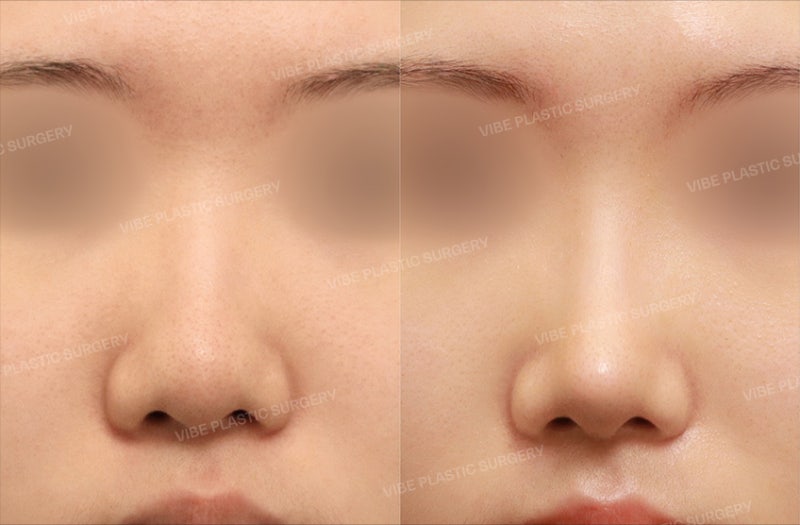
Front view of the nose: before (left) and after (right), with the eyes blurred.
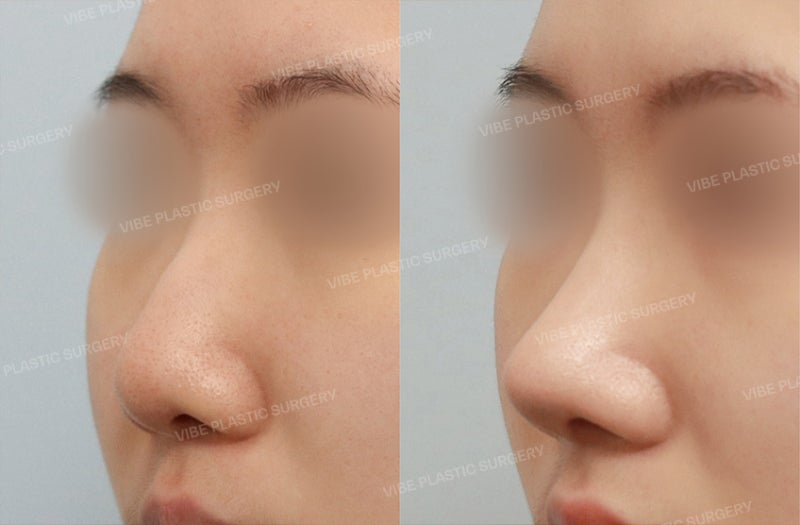
Nose at a 45-degree angle, face turned left: before (left) and after (right).
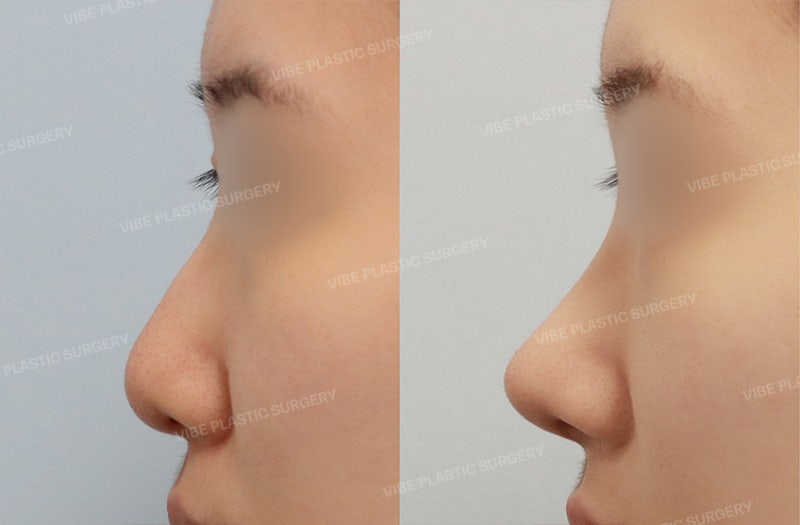
Side profile of the nose, facing left: before (left) and after (right).
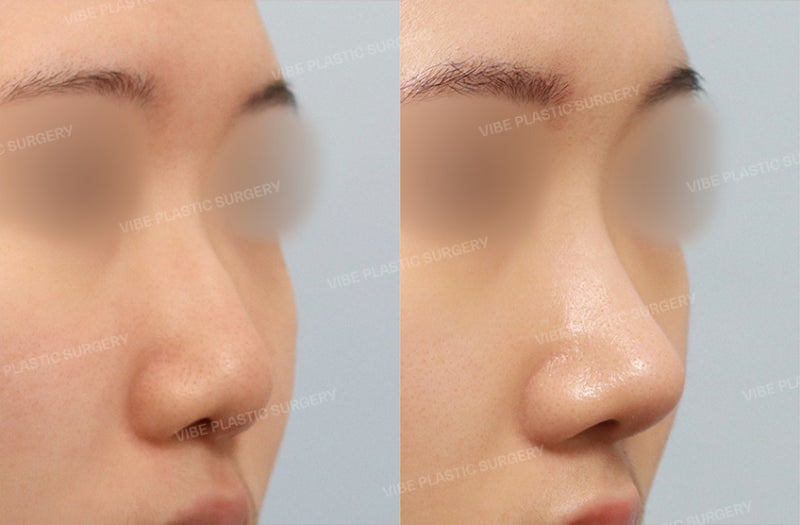
Nose at a 45-degree angle, face turned right: before (left) and after (right).
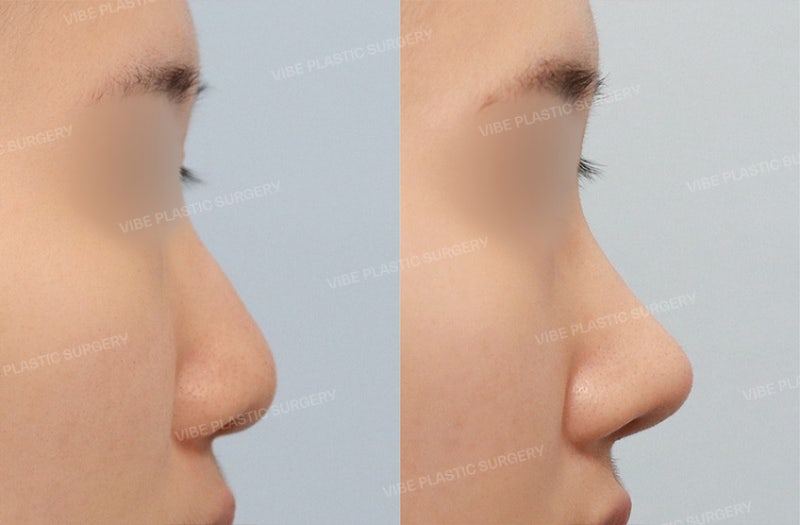
Side profile of the nose, facing right: before (left) and after (right).
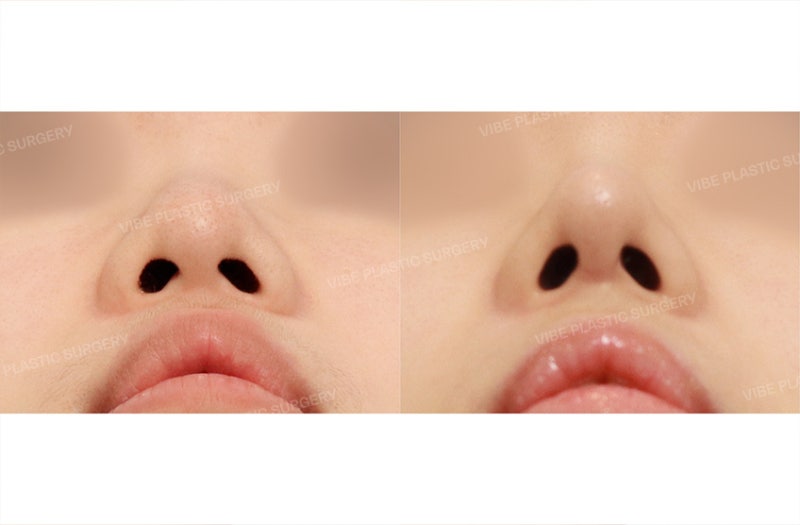
View from below showing the nostrils and nose tip: before (left) and after (right).
5. Advantages and Limitations of Non-Implant Rhinoplasty
Non-implant rhinoplasty is characterized by not using artificial implants, but it cannot be declared safer or more suitable in every respect.
Using autologous cartilage has the advantage of avoiding some of the problems associated with artificial implants.
On the other hand, problems that can arise during the harvesting and grafting of the patient's own tissue, as well as the inherent limitations of cartilage, must also be considered.
For example, if the height of the nasal bridge needs to be dramatically increased, it may be difficult to achieve the desired contour with autologous cartilage alone.
In such cases, other surgical methods and their respective pros and cons should be compared before deciding.
What matters is not whether an implant is used, but choosing the method that suits the current structure of the nose and the goals of the surgery.
6. Possible Side Effects and Precautions After Surgery
Because non-implant rhinoplasty is still a surgical procedure, the following side effects may occur.
Bleeding, hematoma, infection, and inflammation
Swelling, bruising, pain, and scarring
Asymmetry or a nose shape that differs from expectations
Excessive projection or an irregular contour of the nose tip
Warping, displacement, resorption, or reduced support of the cartilage
Changes in breathing function, such as nasal obstruction
Insufficient correction or changes in shape over time
Need for additional corrective surgery
When autologous cartilage is harvested, pain, scarring, and infection may also occur at the donor site.
If ear cartilage is harvested, changes in ear shape or abnormal sensation may occur. If septal cartilage is harvested, the possibility of damage to the septal support structure or perforation must also be considered.
The problems that may occur and their severity can vary depending on individual anatomical conditions and the extent of the surgery.
Before surgery, you should receive a thorough explanation not only of the expected benefits, but also of these risks and alternatives, and then make your decision.
Conclusion
Non-implant rhinoplasty is a method of reshaping the nose using the patient's own cartilage and other tissues, without artificial implants.
However, it cannot be applied to every nose. Its suitability varies depending on the structure of the nasal bridge and nose tip, skin thickness, the condition of the cartilage, and the correction goals.
In particular, when correction focused on the nose tip is needed, it is important to understand the characteristics of each option, such as septal cartilage and ear cartilage, and to plan the approach with the necessary support and contour in mind.
When deciding on a surgical method, do not rely solely on the "non-implant" label or on a particular nose shape. Instead, judge carefully after fully understanding the changes you can realistically expect given your anatomy, the limitations, and the possible side effects.
※ This article has been written to provide general medical information about rhinoplasty.
※ The surgical method and its suitability depend on individual anatomical conditions. Before deciding on surgery, be sure to confirm the expected results, limitations, and possible side effects through an examination by your medical team.
Frequently Asked Questions
Can anyone get non-implant rhinoplasty?
No, it is not a method that can be applied equally to everyone. Eligibility should be judged by considering the nasal skeleton, skin thickness, the condition of the cartilage, and the degree of change desired.
What type of autologous cartilage is used in non-implant rhinoplasty?
Septal cartilage or ear cartilage may be used, and if these are not sufficient, rib cartilage may also be used. Each type of cartilage differs in shape, thickness, and support strength, so the choice depends on the area to be corrected and the goal of the surgery.
Can non-implant surgery be considered if the goal is correcting the nose tip?
Yes, it may be considered if the main goal is correcting the nose tip and the necessary support structure can be created with autologous cartilage. If the bridge needs to be raised significantly or the overall contour needs extensive changes, it is necessary to compare it with other surgical methods.
Is a pre-operative CT scan essential?
A CT scan helps in planning surgery by checking the shape and size of the septum, among other things. However, the surgical method is not finalized based on CT results alone; physical examination and intraoperative evaluation are also taken into account.
What are the side effects of non-implant rhinoplasty?
Bleeding, hematoma, infection, swelling, bruising, pain, scarring, asymmetry, and cartilage warping may occur. If autologous cartilage is harvested, pain, scarring, and infection may also occur at the donor site. The severity varies depending on individual anatomical conditions.
When is rib cartilage used?
It may be considered when the necessary structure cannot be created with septal or ear cartilage alone, when stronger structural support of the nose is needed, or when cartilage is lacking due to a previous surgery. Because rib cartilage requires an additional incision, there are risks of pain, scarring, and infection at the donor site.