2026-10-18
Do You Really Need Platysma Muscle Plication for a Double Chin?!
Explains how fat, skin elasticity, platysma muscle condition, and jaw shape affect double chin treatment, and when liposuction alone may be enough or muscle plication should be considered.
Do you really need double chin liposuction or even platysma muscle plication?
Hello.
This is Dr. Yoo Young-mun, director of Vibe Plastic Surgery Clinic.
Many people are concerned about a double chin.
So, is a double chin simply caused by excess fat under the chin?
It is not.
When the area under the chin looks thick, or when the boundary between the chin and neck is not clearly defined, the cause can differ from person to person.
This is because the amount of subcutaneous fat is not the only factor. Skin elasticity, the shape of the jawbone and chin tip, and the condition of the neck muscles all play a role.
Therefore, the methods for improving a double chin do not apply equally to everyone.
In this article, we will look at the principles of double chin liposuction, the features of the Liposound device,
and why liposuction and platysma muscle plication should be considered separately, from a medical information perspective.
1. Why does a double chin develop?
A double chin can appear when fat accumulates under the chin or when the structure connecting the chin and neck changes.
The main causes are as follows.
① Accumulation of subcutaneous fat under the chin
When fat builds up between the skin and muscle under the chin, the jawline can be hidden and the area under the chin may look thick from the side.
This becomes more noticeable with weight gain, but fat can also concentrate in the face and under the chin even when body weight is within the normal range.
② Decreased skin elasticity
As skin loses elasticity with age, the skin under the chin may sag and the jawline can become blurred.
In this case, not only the amount of fat but also how well the skin can contract and recover should be taken into account.
③ Condition of the platysma muscle
The platysma is a superficial muscle located at the front of the neck, and it contributes to the contour of the lower face and neck.
If the platysma becomes loose or the two muscles separate, the contour under the chin may look uneven.
④ Shape of the jawbone and chin
If the chin tip is relatively short or the lower jaw sits further back,
the boundary between the chin and neck may not be clearly defined even without much fat under the chin.
As such, a double chin can result from several anatomical factors acting together.
Depending on which structure is the main cause, the appropriate method of improvement also differs.
2. How does double chin liposuction work?
Double chin liposuction aims to reduce the volume of the area by removing subcutaneous fat under the chin,
and to refine the boundary between the chin and neck.
Generally, the procedure is performed through a small incision, where a thin tube called a cannula is inserted
and the fat is suctioned out.
What matters here is not simply removing as much fat as possible,
but removing an appropriate amount while considering the thickness under the chin, the condition of the skin, and the balance with surrounding tissue.
Removing too much fat can make the skin surface irregular or cause adhesions and depressions.
Conversely, if the fat is not reduced sufficiently, the thickness under the chin may remain.
Therefore, before surgery, the distribution and depth of the fat, skin elasticity, and the structure of the chin and neck need to be evaluated together.
3. What is the Liposound device?
Liposound is an ultrasound-assisted liposuction device that uses “ultrasonic energy” to separate and emulsify fat tissue,
and then suctions it out.
It works by using ultrasonic vibrations to make fat tissue easier to separate from surrounding tissue,
and then removing the fat through the suction process.
<Key Features of Liposound>
Separation of fat tissue using ultrasound: Ultrasonic energy helps separate and emulsify fat tissue.
Assistance in the liposuction process: It helps the emulsified fat be suctioned out and removed.
Useful for contouring small areas: It can also be helpful in areas with a small surface, such as the face, where changes in contour are important.
4. Are there cases where liposuction alone is enough?
If the main cause of a double chin is the accumulation of subcutaneous fat, the surgical plan can be built around liposuction alone.
For example, if the fat under the chin is thick but skin elasticity is relatively well maintained,
and the sagging or separation of the platysma is not pronounced, the approach can focus on removing fat.
In such cases, reducing the volume under the chin through liposuction may make the boundary between the chin and neck clearer than before.
However, liposuction alone cannot correct all skin sagging or structural problems of the muscles.
In particular, if the skin does not contract sufficiently after fat removal, or if the condition of the muscles affects the contour,
the results may fall short of expectations.
Therefore, when judging whether liposuction alone is sufficient, the condition of the skin and muscles should be checked along with the amount of fat.
5. Then why is platysma muscle plication considered?
Platysma muscle plication generally refers to checking the platysma under the chin and, if necessary, gathering the two sides toward the midline and suturing them together.
When sagging of the platysma or separation between the two muscles affects the contour under the chin,
there may be areas that cannot be resolved by fat removal alone.
In such cases, a sleeker jawline may be achieved through muscle plication.
< Difference Between Liposuction and Muscle Plication >
Liposuction: Aims to reduce the volume of subcutaneous fat under the chin.
Muscle plication: After evaluating the condition of the platysma, if necessary, the muscles are gathered toward the midline and sutured to adjust the structure at the front of the neck.
Not every double chin patient needs muscle plication.
If the muscles are in good condition, additional surgery may not be necessary.
Conversely, if skin sagging or deeper structural problems are the main cause, muscle plication alone may not be sufficient.
Performing muscle plication does not necessarily resolve skin sagging or create a consistent jawline shape.
Therefore, the scope of surgery and the indications should be determined based on the examination results.
6. Factors to consider when deciding between liposuction and muscle plication
Which of the two surgical methods is appropriate is determined by comprehensively evaluating the following factors.
< First, the amount and distribution of fat under the chin >
We check whether subcutaneous fat is the main cause and whether the fat is distributed across multiple layers.
The approach can vary depending on where the fat is located.
< Second, skin elasticity and degree of sagging >
We need to consider how much the skin can contract after fat removal.
If skin sagging is severe, it may be difficult to expect sufficient improvement from liposuction alone.
< Third, condition of the platysma muscle >
We check whether loosening or separation of the muscle actually affects the contour.
< Fourth, shape of the chin tip and lower jaw >
If the chin tip is short or the lower jaw recedes, reducing the fat under the chin may not make the boundary between the chin and neck as distinct as hoped.
These factors are evaluated together because, even with the same double chin, the postoperative changes and limitations can differ depending on the cause.
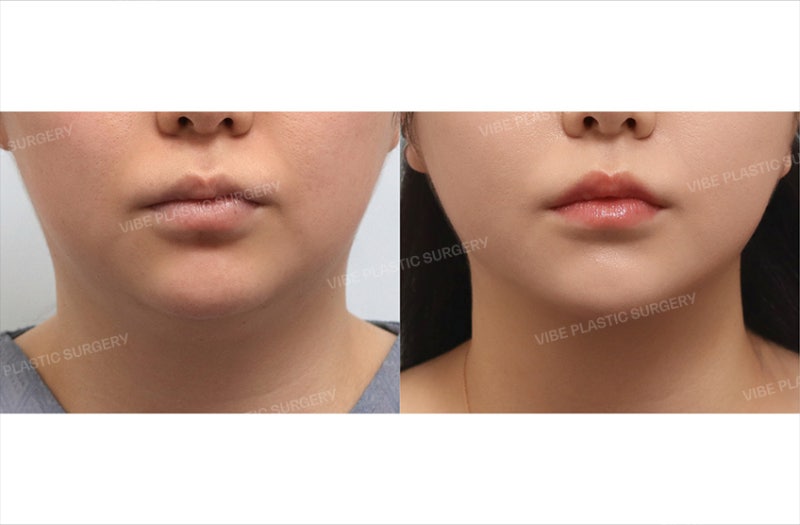
Front view of the chin and neck before (left) and after (right), comparing the double chin area.
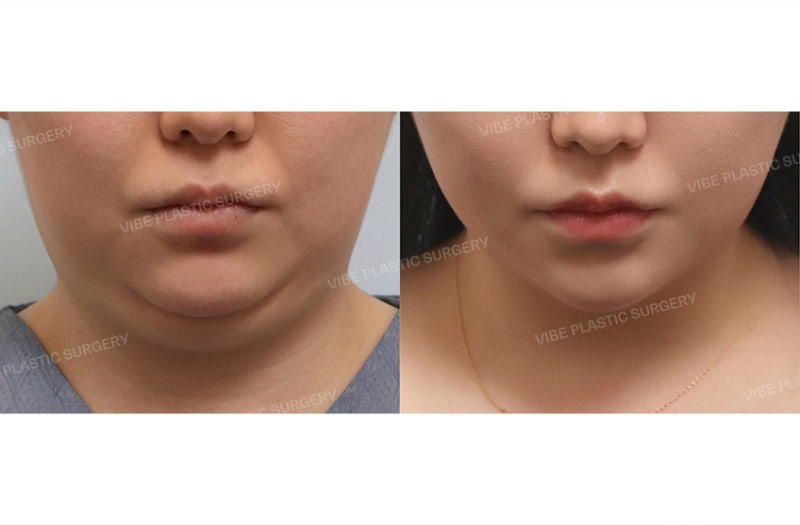
Another front-view before-and-after comparison of the jawline and the area under the chin.
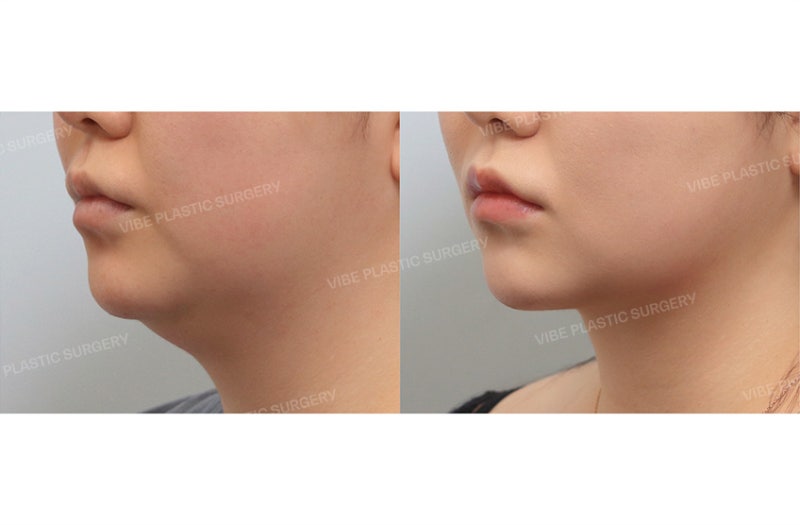
Left oblique view before (left) and after (right), showing the line from the chin to the neck.
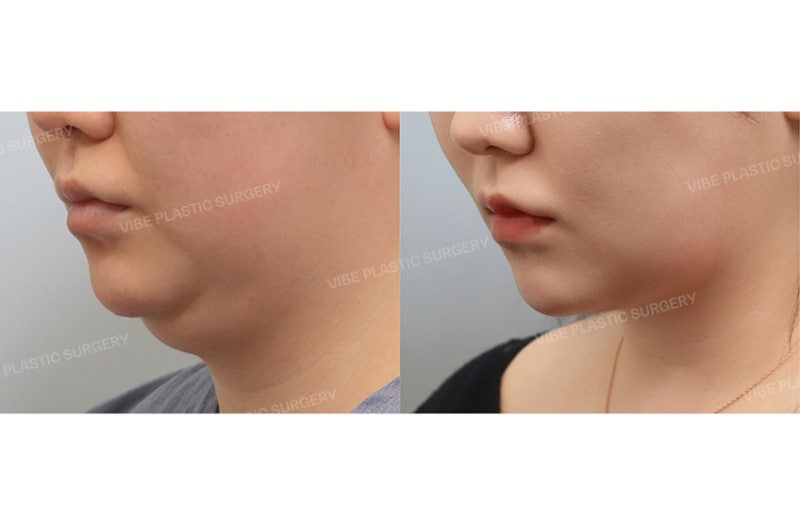
A second left oblique comparison, before and after, focusing on the double chin and jawline.
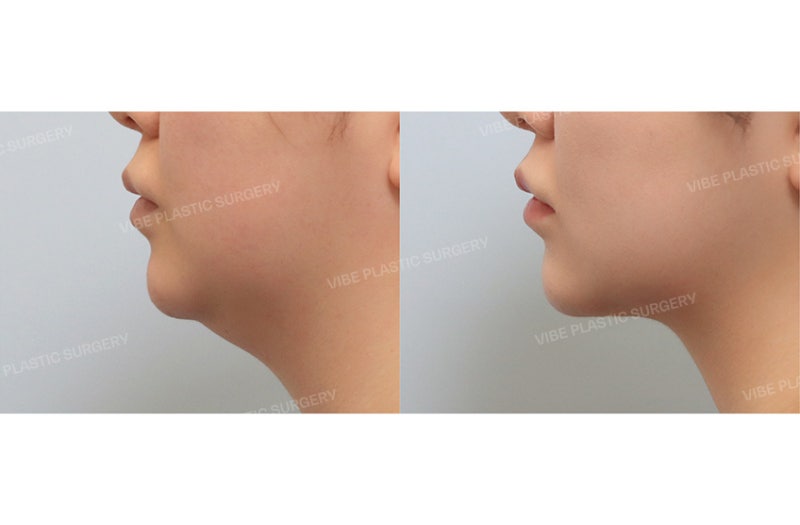
Left side profile before (left) and after (right), showing the contour from the chin to the neck.
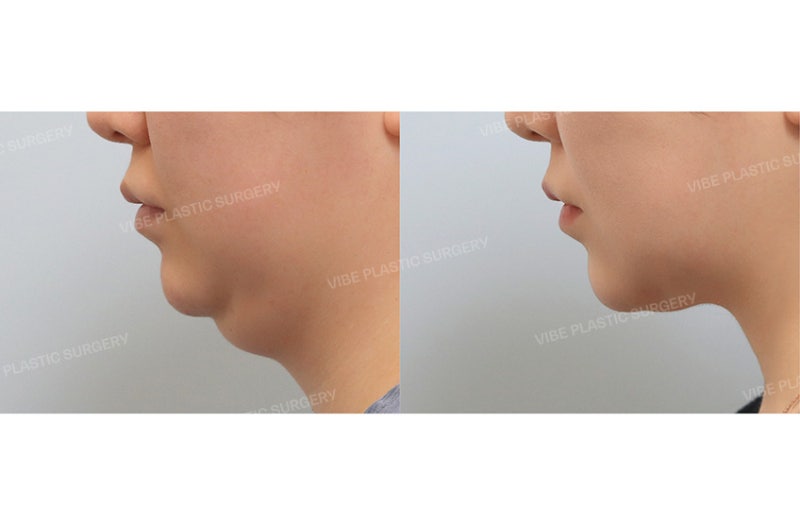
Another left profile comparison of the area beneath the chin, before and after.
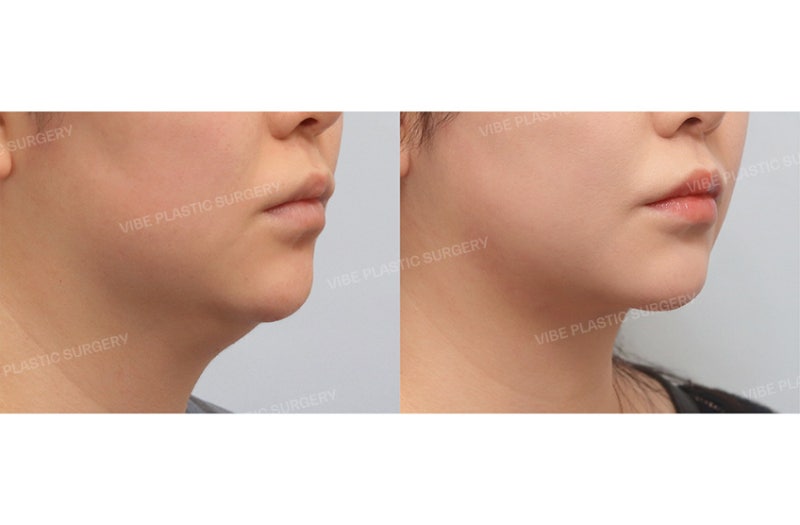
Right oblique view before (left) and after (right), showing the jawline and under-chin area.
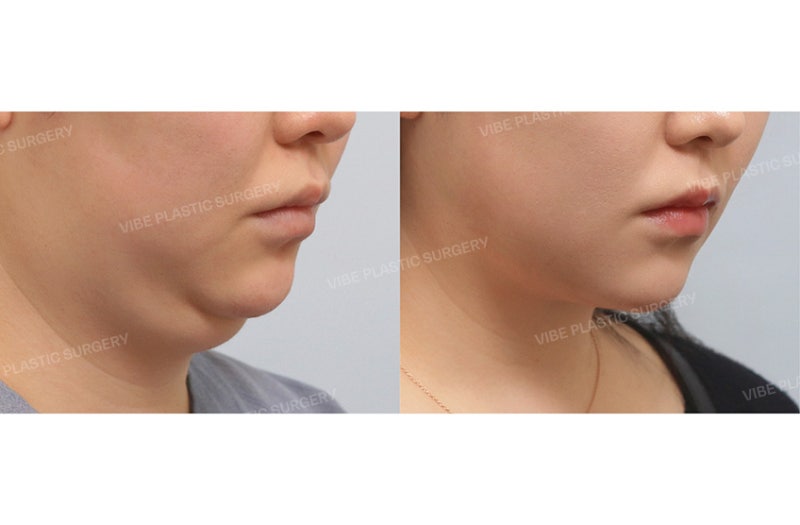
A second right oblique comparison, before and after, focusing on the double chin area.
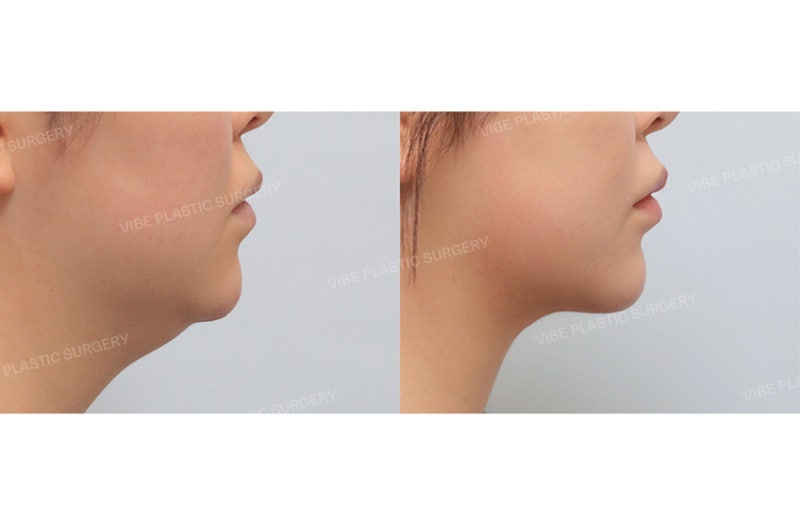
Right side profile before (left) and after (right), comparing the line from the chin to the neck.
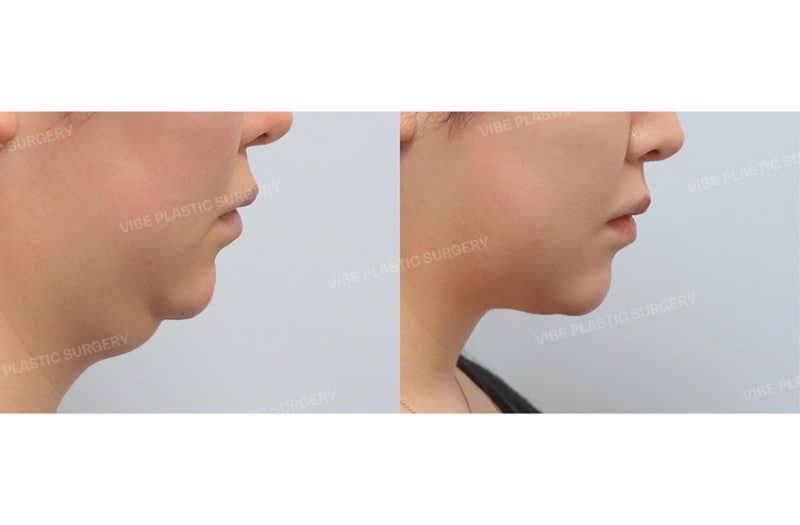
Another right profile comparison of the under-chin contour, before and after.
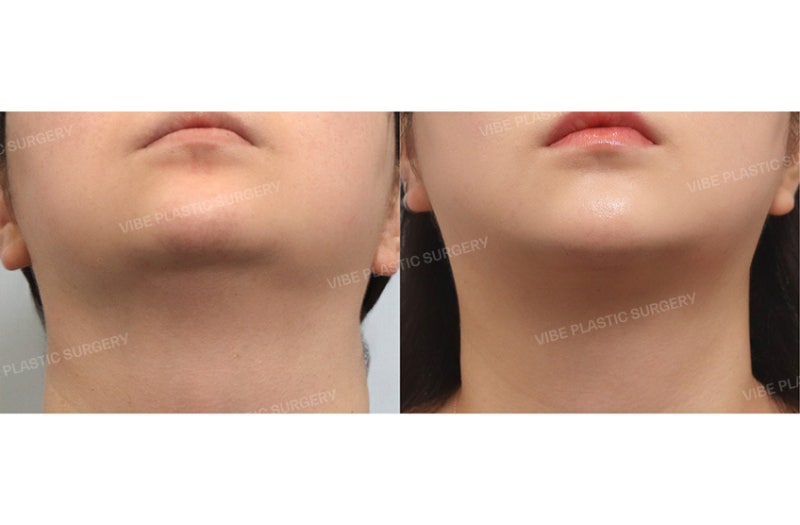
View from below with the chin raised, before (left) and after (right), showing the under-chin area.
7. Pre- and post-operative precautions and possible side effects
Because double chin liposuction and muscle plication are surgical procedures, it is important to understand the recovery process and possible side effects.
* After surgery, swelling, bruising, pain, tightness, and reduced sensation may occur, and the speed and extent of recovery vary from person to person.
Other possible risks include bleeding, infection, hematoma, irregularities of the skin surface, asymmetry, adhesions, skin sagging, and nerve damage.
* With Liposound liposuction, the possibility of thermal injury to the skin or surrounding tissue during energy delivery should also be considered.
* Performing muscle plication requires additional sutures and tissue manipulation, so the scope of surgery and the recovery pattern may differ.
* Liposuction also does not change the shape of the jawbone, and depending on skin elasticity and muscle condition, there may be limits to the degree of improvement.
Therefore, before surgery, it is important to receive a thorough explanation not only of the expected changes but also of these limitations, possible side effects, and postoperative care.
Conclusion
When deciding how to improve a double chin, it may not be enough to look only at the amount of fat under the chin.
If the accumulation of subcutaneous fat is the main cause, the approach can center on liposuction,
and if the condition of the platysma affects the contour under the chin, muscle plication can be considered as well.
If skin sagging or the shape of the jawbone is the primary cause, a different approach may be needed.
Liposound, like other ultrasound-assisted liposuction devices, is a tool used in the process of removing fat,
and the device itself does not guarantee surgical results.
What matters is not deciding on a specific device or surgical method first,
but identifying what is causing your double chin and choosing the method that fits.
If you are considering double chin liposuction or muscle plication,
please comprehensively evaluate the amount of fat, skin elasticity, the condition of the platysma, and the structure of the chin and neck,
and then confirm the necessity and limitations of surgery.
* This article is medical information intended to explain the anatomical causes of double chin and the general principles of liposuction and platysma muscle plication.
* It does not guarantee the effects or results of any specific surgery, and the actual surgical method and whether it applies may vary depending on individual conditions.
* Surgery may cause bleeding, infection, asymmetry, sensory changes, skin irregularities, and other complications, so please consult thoroughly with your medical team.
Frequently Asked Questions
Is double chin liposuction alone enough?
It depends on the case. If subcutaneous fat is the main cause, skin elasticity is relatively well maintained, and sagging of the platysma is not pronounced, the plan can focus on liposuction. However, skin sagging and structural problems of the muscles may not be fully corrected.
Is platysma muscle plication necessary for every patient?
No, it is not necessary for every patient. If the platysma is in good condition, additional surgery may not be needed. It can be considered when loosening or separation of the platysma affects the contour.
What does platysma muscle plication involve?
This method involves checking the platysma under the chin and, if necessary, gathering the two sides toward the midline and suturing them. Its purpose is to adjust the structure at the front of the neck. Because it requires additional sutures and tissue manipulation, the recovery pattern may differ.
What is the Liposound device?
Liposound is an ultrasound-assisted liposuction device that uses ultrasonic energy to separate and emulsify fat tissue before suctioning it out. However, the device itself does not guarantee surgical results, and the possibility of heat-related tissue injury during energy delivery should also be considered.
What causes a double chin?
Several factors can act together, including the accumulation of subcutaneous fat under the chin, decreased skin elasticity, the condition of the platysma, and the shape of the jawbone and chin. Fat can concentrate in the face and under the chin even when body weight is within the normal range.
What side effects may occur after double chin surgery?
Swelling, bruising, pain, tightness, and reduced sensation may occur. Other possible risks include bleeding, infection, hematoma, skin irregularities, asymmetry, and nerve damage. The extent of recovery varies from person to person.