2026-10-20
Harmonious Change for Heavy-Looking, Drooping Eyes and a Crooked, Spread-Out Nose: Endoscopic Forehead Lift & Revision Rhinoplasty with Autologous Rib Cartilage (by Dr. Yu Yeong-mun, Vibe Plastic Surgery, Sinnonhyeon Station)
A patient in her 30s with uneven brows, a cramped eye area, and a crooked, wide nose had an endoscopic forehead lift and revision rhinoplasty with rib cartilage.
Hello.
This is Dr. Yu Yeong-mun of Vibe Plastic Surgery.
In consultations, I often hear comments like these~
“My eyes aren’t small, but they just look heavy and stuffy.”
“My eyebrows look uneven on each side.”
“The gap between my eyes and eyebrows seems too narrow.”
“My nose is crooked and looks spread out, so my face looks dull.”
In cases like these, rather than relying on eye surgery or nose surgery alone, it is necessary to look at the balance of the entire face.
The patient in her 30s I’m introducing today also had concerns about asymmetrical eyebrow height, a narrow space between her eyebrows and eyes, and a crooked, spread-out nose.
In this case, we improved the overall facial balance through:
Endoscopic forehead lift
Revision rhinoplasty using autologous rib cartilage
As a result, the area around her eyes looks more open and brighter than before, and her nose has changed into a straighter, more neatly defined look.
These Were the Concerns of a Woman in Her 30s!
This patient had two main concerns.
① Asymmetrical eyebrow height and a heavy-looking eye area
Before surgery, the height of her eyebrows looked somewhat asymmetrical,
and the narrow space between her eyebrows and eyes made the area around her eyes look heavy and stuffy overall.
This was not just a matter of eye size.
The position of her eyebrows and the balance of her upper face were both contributing to the impression.
② A crooked, spread-out nose
Her nose was also not straight due to the effects of a previous surgery and looked somewhat crooked.
Its wide appearance made the central part of her face look relatively dull and spread out.
For this surgery, rather than simply reshaping the tip of the nose,
we planned revision rhinoplasty to restore the central axis and overall structure of the nose.
Endoscopic Forehead Lift?!
When people hear “forehead lift,”
many think of it as “a surgery to get rid of forehead wrinkles.”
However, the role of a forehead lift is not limited to wrinkle improvement.
In particular, an endoscopic forehead lift can be used to adjust the position of the eyebrows and the balance of the upper face.
When the eyebrows droop or the gap between the eyes and eyebrows is excessively narrow,
it can sometimes look like an eyelid problem.
In such cases, rather than automatically opting for double eyelid surgery or canthoplasty,
it is important to first check the position of the eyebrows.
What are the advantages of an endoscopic forehead lift?
An endoscopic forehead lift is performed through small incisions, with an endoscope used to view the tissue around the forehead and eyebrows during the procedure.
Results vary depending on each person’s condition, but it may help improve the following areas:
1. Lifting drooping eyebrows upward
When the eyebrows sit low and the space between the eyes and brows looks narrow, adjusting the eyebrow position can help create a more open-looking upper face.
2. Improving eyebrow asymmetry
When the height or position of the two eyebrows differs, rather than pulling both sides equally,
it is important to correct them while taking the difference between the left and right sides into account.
In this patient’s case as well, the forehead lift was performed with the asymmetry in brow height taken into account.
3. Easing the heavy look around the eyes
Rather than making the eyes themselves larger, by adjusting the relationship between the eyebrows and eyes,
you can expect the area around the eyes to look more open and brighter.
If the Nose Looks Crooked and Spread Out?!
Rather than a simple tip procedure, the structure of the nose needs to be re-evaluated.
The second concern was the nose.
This patient was concerned that her nose looked crooked and, overall, wide and spread out.
In cases like this, rather than simply reducing the nostril wings or only sharpening the tip,
it is important to first assess the overall structure and central axis of the nose.
Especially in revision surgery, the condition of the cartilage and tissue inside the nose may have changed due to previous operations,
so more meticulous planning is required.
Taking these factors into account, this patient underwent revision rhinoplasty using autologous rib cartilage.
Why use autologous rib cartilage?
Autologous rib cartilage refers to using cartilage harvested from the patient’s own rib in rhinoplasty.
In revision rhinoplasty, there may be insufficient septal cartilage available due to previous surgery,
or the nasal structure may need to be rebuilt to be firmer.
In such cases, the key advantage of rib cartilage is that a sufficient amount of autologous cartilage can be secured.
Especially in revision surgeries that require re-establishing the central axis of the nose or strengthening tip support,
autologous rib cartilage can be very useful.
That said, not every revision rhinoplasty requires rib cartilage.
The decision is made by comprehensively evaluating the current nasal structure, the condition of the previously used cartilage, and the condition of the skin and soft tissue,
and rib cartilage is selected when necessary.
What Matters Most in Autologous Rib Cartilage Revision Rhinoplasty Is a “Sturdy Structure”
In revision rhinoplasty, what I consider important is not simply
“making the nose taller.”
Especially for a crooked or deformed nose, what matters is structural rebuilding that re-centers the nose
and keeps the tip stably in the desired position.
Because autologous rib cartilage can be obtained in sufficient quantity,
it is highly useful when such a structure needs to be rebuilt.
In other words, revision rhinoplasty requires considering both shaping the nose beautifully and stably rebuilding its structure together.
Alar Base Reduction for a Spread-Out Nose
In this patient’s case, along with the crooked appearance of the nose itself,
the nostril wings also appeared wide.
In such cases, separate from correcting the central structure of the nose,
the width of the nostril wings also needs to be evaluated.
So in this case, alar base reduction was performed together with the autologous rib cartilage revision rhinoplasty.
That said, alar base reduction is not a procedure where more reduction is always better.
Taking into account the overall width of the nose, the size of the nasal tip, the shape of the nostrils, and the width of the face,
adjusting only as much as necessary is important for a natural result.
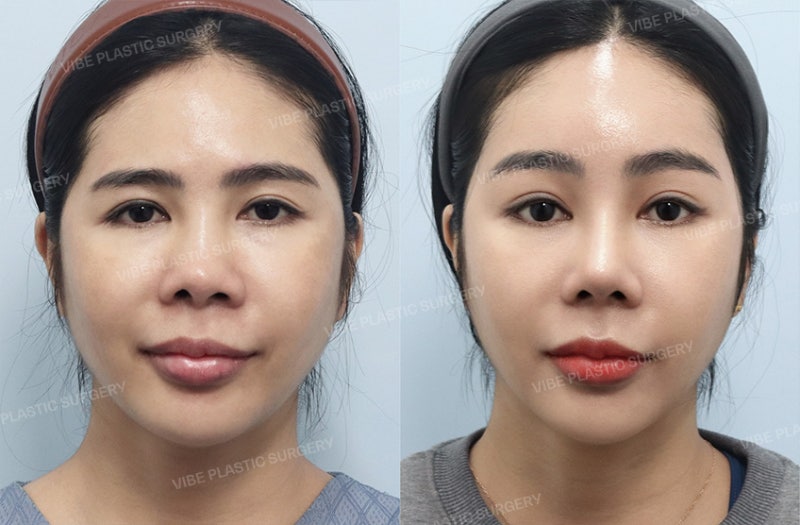
Front view before (left) and after (right) endoscopic forehead lift and rib cartilage revision rhinoplasty.
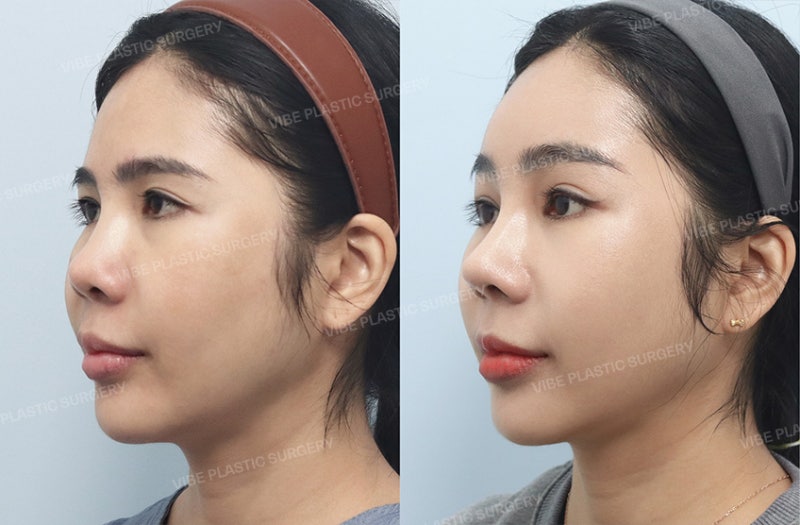
45-degree angled view before (left) and after (right) surgery.
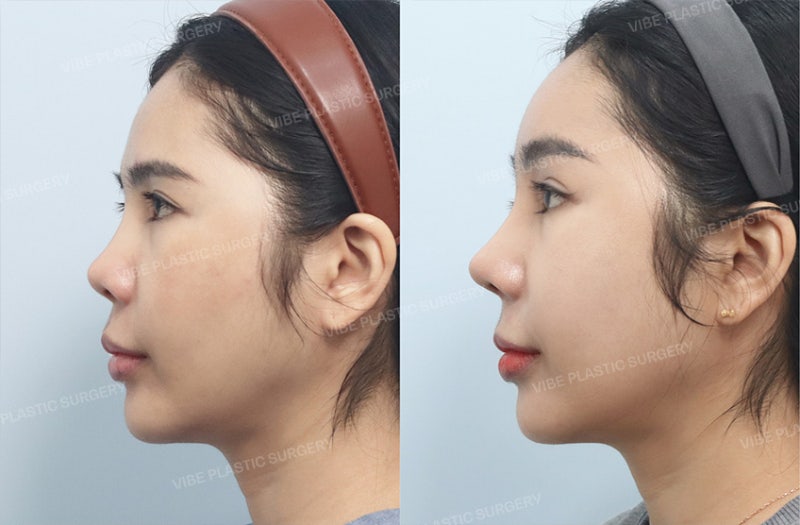
Side profile before (left) and after (right) surgery.
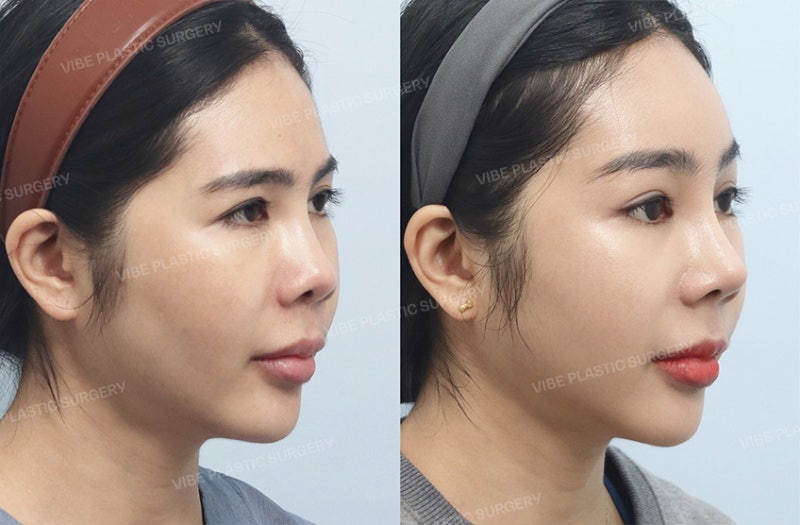
45-degree angled view from the other side, before (left) and after (right).
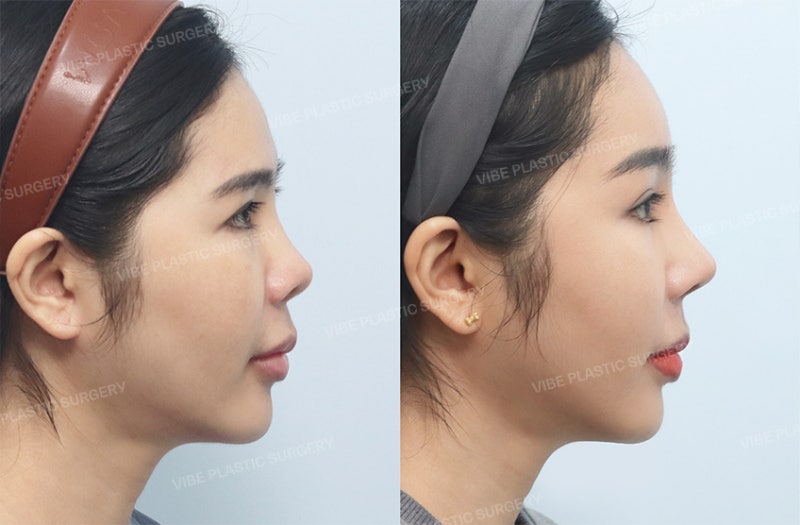
Side profile from the other side, before (left) and after (right).
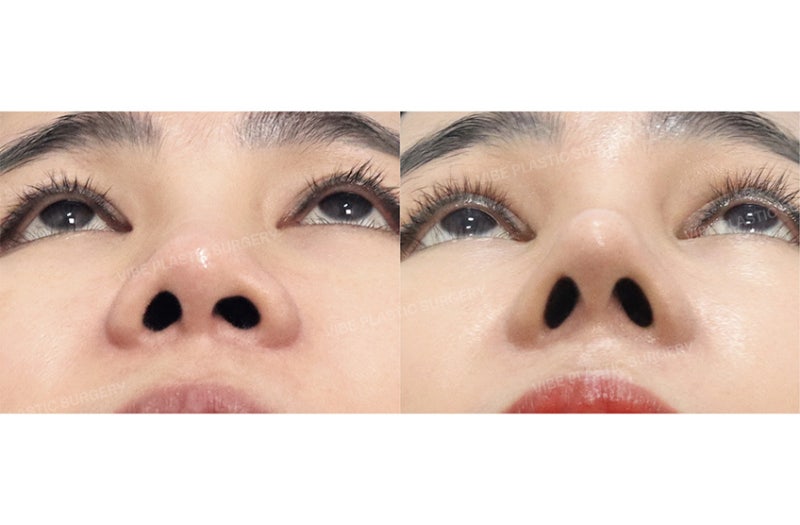
View from below the nose showing the nostrils and tip, before (left) and after (right).
Why the Face Became More Harmonious
What is interesting about this case is less the result of each individual surgery,
and more the overall change in impression created by the two procedures together.
Before surgery,
Asymmetrical eyebrow height
A narrow gap between the eyebrows and eyes
A heavy-looking area around the eyes
A crooked-looking nose
A wide, spread-out nose
All of these concerns were present at the same time.
After surgery,
the eyebrows were better balanced and the area around the eyes looked more open,
and the nose also changed into a straighter, more well-defined shape.
So rather than feeling that just one feature, the eyes or the nose, had become prettier,
“the overall impression has become much brighter and more refined”
is the change you can actually feel.
If You Are Considering a Forehead Lift & Rhinoplasty in Your 30s
Being in your 30s does not mean you don’t need a forehead lift,
and likewise, a revision rhinoplasty does not necessarily mean a major operation.
What matters is not age, but the current structure of your face and the root of your concerns.
In particular, if any of the following apply, you can check whether surgery is an option through a consultation.
If you are considering an endoscopic forehead lift:
Your eyebrows look different in height on each side
The space between your eyes and eyebrows is narrow, making the area look heavy
Your eyelids look heavy and droopy
Your eyebrows sit low
Double eyelid surgery alone is unlikely to achieve the change you want around your eyes
If you are considering revision rhinoplasty with autologous rib cartilage:
Your nose looks crooked after a previous nose surgery
The nasal tip has collapsed or lacks support
Your nose has deformed again
There is insufficient cartilage available for revision surgery
The overall structure of the nose needs to be rebuilt
Of course, the actual surgical approach varies depending on the condition of each person’s nose and facial proportions.
Natural Change Begins with Balance Across the Entire Face!
In cosmetic surgery, what matters is not dramatically changing a single feature,
but finding a balance that harmonizes across the entire face.
This patient in her 30s
used an endoscopic forehead lift to refine the balance of her upper face,
used revision rhinoplasty with autologous rib cartilage to correct the structure of the central face,
and used alar base reduction to adjust the width of her nose,
and overall she was able to achieve a brighter, more refined look.
In particular, a forehead lift and rhinoplasty are not simply “surgeries that raise the brows and heighten the nose,”
but procedures that must consider the overall proportions and structure of the face.
Before deciding on surgery, it is important to first accurately analyze which parts of your current face are actually making your overall impression look heavy or dull.
Frequently Asked Questions
Is an endoscopic forehead lift only a surgery for improving forehead wrinkles?
No, the role of a forehead lift is not limited to wrinkle improvement. The article explains that an endoscopic forehead lift can be used to adjust the position of the eyebrows and the balance of the upper face.
If my eyebrows are asymmetrical, can I consider a forehead lift?
Yes, if your eyebrows look different in height, you can check whether a forehead lift is an option through a consultation. The article explains that in this case, it is important to correct the difference between the left and right sides rather than pulling both sides equally.
If the space between my eyes and eyebrows is narrow, do I need double eyelid surgery right away?
Not necessarily. The article explains that rather than automatically opting for double eyelid surgery or canthoplasty, it is important to first check the position of the eyebrows.
When is autologous rib cartilage used in revision rhinoplasty?
It can be used when there is insufficient septal cartilage available due to a previous surgery, or when the nasal structure needs to be rebuilt to be firmer. However, it is not necessary for every revision rhinoplasty. The article explains that the decision is made by comprehensively evaluating the nasal structure, the condition of the existing cartilage, and the condition of the skin and soft tissue.
When should I consider revision rhinoplasty with autologous rib cartilage?
Cases include when the nose looks crooked after a previous nose surgery or when the nasal tip lacks support. In such cases, you can check whether surgery is an option through a consultation.
Is it better to reduce the alar base as much as possible?
No, alar base reduction is not a procedure where more reduction is always better. The article explains that it is important to adjust only as much as necessary, taking into account the overall width of the nose, the size of the nasal tip, the shape of the nostrils, and the width of the face.