2026-11-02
Sagging Face in Your 70s: Surgical Approaches to Age-Related Changes, from Eyelid Surgery to Facelift | Vibe Plastic Surgery
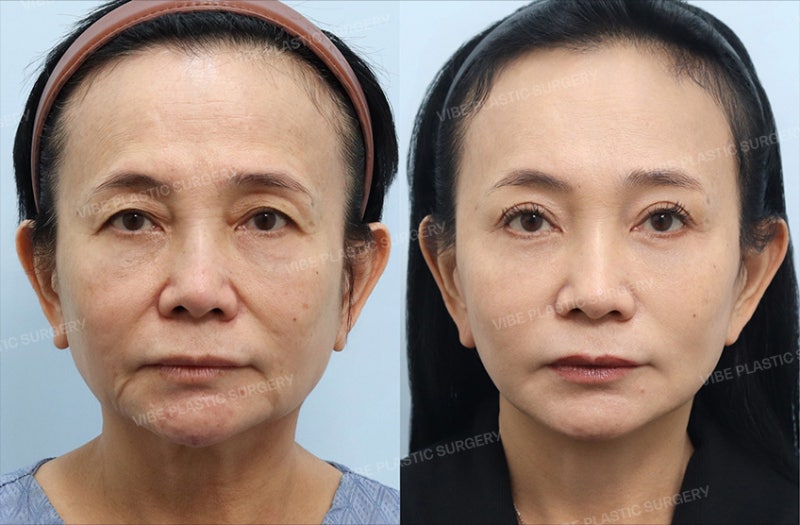
This post explains a surgical plan for a woman in her 70s with overall facial sagging, covering brow, eyelid, midface, and neck procedures and the checks needed before surgery.
Hello.
I am Yoo Young-moon, director of Vibe Plastic Surgery.
As we age, the face undergoes a variety of changes.
Skin elasticity decreases, and as the position of fat and soft tissue shifts, the forehead and eyebrows may descend.
The eyelid skin may become loose, and the cheeks and jawline may sag.
In the 60s and 70s, aging changes often appear not only around the eyes but also in the midface, lower face, and neck.
Several areas may show complex signs of aging at the same time.
In such cases, simply removing loose skin may not be enough.
A comprehensive evaluation is needed to determine where the sagging began and which tissues have lost their support.
It is also important to check whether muscle function is normal.
The case we will look at here is the surgical plan for a woman in her 70s who visited the clinic with concerns about overall facial sagging.
Considering the aging pattern across the entire face, the surgical approach was planned in four areas, as follows.
Endoscopic brow lift
Upper eyelid correction
Lower blepharoplasty and midface lift
Facelift and neck lift
Let's look at when each procedure is needed and which anatomical changes it corrects.
1. Endoscopic Brow Lift – Improving Drooping Eyebrows and Sagging Around the Forehead
Facial aging does not begin only with the eyelids.
With age, the skin and soft tissue around the forehead and brows can loosen, causing the eyebrows to sit lower.
This brow ptosis can also make the upper eyelid skin look looser than it actually is.
In particular, when the outer part of the eyebrow drops, the outer corner of the eye can look heavy and dull.
<What Is an Endoscopic Brow Lift?>
An endoscopic brow lift is performed through small incisions inside the scalp.
An endoscope is used to separate the tissue around the forehead and eyebrows.
The tissue is then repositioned and secured based on the underlying anatomy.
The main goals of the surgery are as follows.
Correcting the position of drooping eyebrows
Adjusting the position of soft tissue around the forehead and eyebrows
Improving the heavy look of the upper face caused by brow ptosis
Correcting asymmetry between the left and right forehead and eyebrows
<When Can It Be Considered?>
When the eyebrows have dropped overall
When the outer part of the eyebrows sags and makes the outer eye area look heavy
When the soft tissue around the forehead and eyebrows has loosened
When upper eyelid skin sagging and brow ptosis occur together
However, a brow lift repositions the eyebrows; it does not correct the muscle that opens the eyes.
It is therefore important to distinguish between brow ptosis, upper eyelid skin laxity, and blepharoptosis when planning surgery.
<Things to Keep in Mind>
Temporary numbness, tightness, and swelling of the forehead and scalp may occur after surgery.
Asymmetry in brow height or an unnatural look caused by excessive lifting should also be considered.
Recovery can also vary depending on the fixation method and the extent of tissue dissection.
2. Upper Eyelid Correction – Evaluating Loose Eyelid Skin and Eye-Opening Function Together
With age, loose upper eyelid skin can cover the lid crease or droop toward the lashes.
These changes can make the eye area look heavy and tired, and in severe cases may even affect vision.
However, not all upper eyelid sagging in older adults can be explained by skin laxity alone.
This is because blepharoptosis, a weakening of the muscle that opens the eyes, may also be present.
<What Is Upper Eyelid Correction?>
Upper eyelid surgery involves appropriately adjusting the loose skin.
Evaluating the function of the muscle that lifts the eyelid is equally essential.
If blepharoptosis is confirmed, correction that adjusts the tension or position of the levator muscle may be considered.
The approach depends on the function and condition of the levator muscle.
The main goals of the surgery are as follows.
Improving eyelid coverage caused by loose upper eyelid skin
Adjusting eyelid height when blepharoptosis is present
Improving the height and symmetry of the two eyes
Adjusting the eyelid position with consideration for eye-opening function
<When Can It Be Considered?>
When loose upper eyelid skin covers the eye
When the forehead muscles are overused to open the eyes
When the eyelid covers part of the pupil
When skin laxity and blepharoptosis occur together
<Things to Keep in Mind>
In older adults, lifting the eyelids too much can actually cause problems.
Before surgery, the degree of blepharoptosis, levator function, dry eye, and eye-closing function should be checked.
In particular, lagophthalmos, in which the eyelids cannot fully close, worsening dry eye, and corneal exposure must be considered.
The extent of correction should be decided with these risks in mind.
Therefore, rather than simply making the eyes look bigger, it is important to weigh eyelid function and safety together.
3. Lower Blepharoplasty and Midface Lift – Under-Eye Sagging and Age-Related Changes in the Anterior Cheek
Aging around the eyes does not appear only in the upper eyelids.
The lower eyelid also loses skin elasticity, and as the orbital septum weakens, fat can bulge forward.
As a result, the fat under the eyes may become more prominent, and the tear trough may deepen.
The border between the under-eye area and the anterior cheek may also become more distinct.
In particular, when the midface soft tissue shifts downward, the area from under the eyes to the anterior cheek can look sunken.
Overall, this entire region may appear to droop.
<What Is Lower Blepharoplasty?>
Lower blepharoplasty evaluates the condition of the skin, muscle, and fat of the lower eyelid and corrects whatever is needed.
Representative surgical approaches include the following.
Appropriate removal of loose lower eyelid skin
Repositioning of protruding under-eye fat, or adjustment within the necessary range
Reinforcement of weakened lower eyelid support structures
Tissue adjustment to improve the transition between the under-eye area and the anterior cheek
Simply removing fat is not always appropriate.
Under-eye fat that protrudes while the tissue beneath it is sunken requires particular caution.
In such cases, removing too much fat can make the under-eye area look even more hollow.
Therefore, the amount and position of fat, the available skin, and the support of the eyelid should all be considered together.
<What Is a Midface Lift?>
The midface generally refers to the central area of the face, extending from under the eyes to the anterior cheek and the area around the cheekbones.
With age, the fat and soft tissue in this area shift downward.
As a result, the anterior cheek can flatten and the border between the under-eye area and the cheek can deepen.
A midface lift repositions and secures the sagging tissue upward, taking these changes in soft tissue position into account.
The main goals of the surgery are as follows.
Repositioning the midface soft tissue that has shifted downward
Improving the transition between the under-eye area and the anterior cheek
Adjusting the position of the sagging anterior cheek
Improving the anatomical connection between the lower eyelid and the midface
<When Can It Be Considered?>
When under-eye fat protrusion and skin laxity occur together
When the under-eye groove is deep and the anterior cheek sags
When the boundary between the lower eyelid and the midface has become distinct
When complex aging changes extend from the under-eye area to the anterior cheek
<Things to Keep in Mind>
In lower eyelid surgery, the support of the eyelid is especially important.
Removing too much skin can cause ectropion, in which the lower eyelid is pulled outward.
Other eyelid position abnormalities may also occur.
Swelling, hematoma, asymmetry, dry eye, and under-eye hollowing should also be considered as possible complications.
Outcomes and recovery after a midface lift can also vary depending on the extent of dissection and the fixation method.
A surgical plan tailored to each patient's anatomy is therefore necessary.
4. Facelift and Neck Lift – Improving Overall Sagging of the Lower Face and Neck
In the lower face, the border between the cheeks and jawline can become blurred.
Skin and soft tissue may also sag around the mouth corners and under the chin.
The neck also shows skin laxity and changes in the platysma muscle.
As a result, the angle between the jaw and neck can become blunted, and neck lines can become more pronounced.
These changes reflect more than simple skin aging.
They are also related to changes in deeper tissues beneath the skin, such as the SMAS and the platysma.
<What Is a Facelift?>
A facelift evaluates sagging of the facial soft tissues, including the skin and the SMAS (superficial musculoaponeurotic system).
It repositions and secures tissue as needed.
This differs from simply pulling the skin tight and removing the excess.
It is important to adjust the tissue appropriately, taking into account the anatomy of the face and the direction of sagging.
The main goals of the surgery are as follows.
Repositioning sagging cheek and lower facial soft tissue
Improving the blurred contour of the jawline
Improving soft tissue sagging around the mouth corners
Correcting overall aging changes in the lower face
<What Is a Neck Lift?>
A neck lift corrects sagging and contour of the neck by evaluating structural changes, including the skin and platysma muscle.
The following factors are considered in a neck lift.
Degree of skin laxity in the neck
Separation of the platysma muscle and whether platysma bands have formed
Distribution of fat under the chin
Angle between the chin and neck
Support of the skin and deeper tissues
When neck sagging is severe, a facelift and neck lift may be planned together.
<When Can It Be Considered?>
When the boundary between the cheeks and jawline has become unclear
When the soft tissue around the deep cheek and jawline sags
When sagging accompanies the mouth corners
When the skin under the chin is loose and neck lines are prominent
When aging changes in the face and neck appear together
<Things to Keep in Mind>
Recovery time and the pattern of complications for a facelift and neck lift can vary depending on the extent of dissection and the surgical method.
Common complications include hematoma, infection, scarring, reduced skin sensation, skin necrosis, and left-right asymmetry.
Rarely, facial nerve injury can also occur and should be considered.
In particular, smoking, diabetes, high blood pressure, and anticoagulant use must be checked before surgery.


5. Why Combine Several Procedures for Facial Sagging in Your 70s?
Facial aging rarely occurs in isolation in just one area.
More often, it appears in a complex way across anatomically connected regions.
For example, when the eyebrows descend, the upper eyelid skin can appear to cover more of the eye.
When the midface sags, the border between the under-eye area and the anterior cheek can become deeper.
In addition, when the soft tissue of the lower face shifts downward, the jawline can blur and contour changes can extend down to the neck.
Therefore, when there is overall facial sagging, it is important to assess the aging pattern of each area separately.
The procedures planned in this case are summarized by anatomical region below.
Surgical Area | Procedure | Main Target of Correction |
Forehead and brow | Endoscopic brow lift | Brow ptosis and sagging of forehead soft tissue |
Upper eyelid | Upper eyelid correction | Skin laxity and accompanying blepharoptosis |
Lower eyelid and midface | Lower blepharoplasty + midface lift | Under-eye fat protrusion and sagging of the anterior cheek |
Lower face and neck | Facelift + neck lift | Sagging soft tissue of the cheeks, jawline, and neck |
Of course, not every patient needs all four procedures.
If the eyebrows are in an appropriate position and upper eyelid function is normal, a brow lift or eyelid correction may not be necessary.
Similarly, the scope of surgery needed depends on the degree of sagging in the midface and lower face.
What matters most is not the number of procedures, but identifying exactly which anatomical areas have aged.
The goal is to correct only the range that is truly needed.
6. Key Considerations for Cosmetic Surgery in Your 70s
Being older does not mean cosmetic surgery should be uniformly restricted.
Conversely, eligibility for surgery should not be judged by age alone.
In particular, when several areas are planned for surgery together, the following points must be thoroughly checked.
① Overall health status
Underlying conditions such as cardiovascular disease, respiratory disease, diabetes, and high blood pressure, as well as overall health, must be evaluated.
② Medications being taken
Medications that affect bleeding risk, such as aspirin, anticoagulants, and antiplatelet agents, as well as other medications, must be reviewed.
Whether to stop any medication should be decided in consultation with the prescribing physician.
③ Anesthesia and operating time
Performing several procedures together can lengthen the operating time.
Considering the patient's overall condition and anesthesia risk, it must be determined whether combined surgery is appropriate or whether staging the procedures is safer.
④ Eye function and healing potential
In older patients, dry eye, corneal condition, and eyelid closure function must be carefully checked.
⑤ Recovery and aftercare
Swelling, bruising, and changes in sensation may occur for a certain period after surgery.
Because recovery time varies with individual healing capacity and the extent of surgery, a thorough recovery and follow-up plan is needed.
Conclusion – Aging Management That Considers Overall Facial Balance
Facial aging in the 70s is difficult to explain by skin sagging alone.
The forehead and brows, upper and lower eyelids, midface, lower face, and neck each have different anatomical structures, and each can show different changes.
Therefore, when planning surgery to improve facial sagging, it is better not to focus on a single area.
Instead, the structure and function of the entire face should be evaluated together.
The endoscopic brow lift, upper eyelid correction, lower blepharoplasty with midface lift, and facelift with neck lift are distinct procedures.
Each targets a different anatomical area and serves a different purpose.
Rather than age itself, the patient's overall health, tissue condition, functional concerns, and surgical risks should be considered.
Choosing the right procedure requires taking all of these factors into account.
The goal of surgery is not simply to make a face look younger.
The aim is to restore a natural, well-balanced facial structure that takes each person's anatomical characteristics and function into account.
※ This post is intended to provide general medical information and does not guarantee the effects or results of any specific surgery.
Actual surgical methods and whether they apply depend on each individual's anatomy, health status, and the findings of the medical examination.
Frequently Asked Questions
When is an endoscopic brow lift considered?
It may be considered when the eyebrows have dropped overall, or when the outer part of the eyebrow sags and makes the outer eye area look heavy. However, it is a procedure that adjusts the position of the eyebrows and does not correct the eye-opening muscle itself.
Why is blepharoptosis checked during upper eyelid correction?
Blepharoptosis, a weakening of the muscle that opens the eyes, may be present alongside skin laxity. Surgeons assess both the presence of blepharoptosis and levator muscle function to determine the extent of correction. In older patients, lifting the eyelids too much can actually cause problems.
When can a midface lift be considered?
It may be considered when under-eye fat protrusion and skin laxity occur together, or when the under-eye groove is deep and the anterior cheek sags. A midface lift repositions soft tissue that has shifted downward to improve the border between the under-eye area and the anterior cheek.
Are a facelift and neck lift sometimes planned together?
Yes. When neck sagging is severe, a facelift and neck lift may be planned together. This may be considered when the boundary between the cheeks and jawline is unclear, or when the skin under the chin is loose and neck lines are prominent.
Do all areas need to be treated together in facial surgery in your 70s?
No. If the eyebrow position and upper eyelid function are normal, a brow lift or eyelid correction may not be needed. The extent of surgery required also depends on the degree of sagging in the midface and lower face.
What should be checked before cosmetic surgery in your 70s?
Overall health status and current medications should be reviewed. Underlying conditions such as cardiovascular and respiratory disease, diabetes, and high blood pressure need to be evaluated. Medications that affect bleeding risk, such as aspirin or anticoagulants, should be discussed with the prescribing physician before deciding whether to stop them.