2026-11-16
Crooked Nose and Breathing Discomfort? Understanding Crooked-Nose Revision and Functional Rhinoplasty by Dr. Yoo Young-moon, Vive Plastic Surgery
Explains crooked-nose revision and functional rhinoplasty for patients with nasal bending and breathing discomfort, including the roles of autologous rib cartilage and 3D custom implants.
Hello.
This is Dr. Yoo Young-moon, director of Vive Plastic Surgery.
Some patients considering revision rhinoplasty are concerned not only about the shape of their nose, but also about nasal congestion or breathing discomfort.
In particular, after a previous nose surgery, some people notice over time that their nose looks bent to one side, that the asymmetry has become more noticeable, or that breathing through the nose has become difficult.
In such cases, along with the external changes, it is necessary to examine the internal structure of the nose.
In this article, based on a case of a patient who had a crooked nose and breathing discomfort after a previous nose surgery using implants and ear cartilage, we will look at the surgical options that can be considered for crooked-nose revision, and the roles of autologous rib cartilage and 3D custom implants.
1. What causes a crooked nose?
A crooked nose refers to a condition in which the central axis of the nose appears shifted to one side when viewed from the front.
There are various causes.
Congenital bending of the septum or nasal bones
Deformity of the nasal bones and septum due to trauma
Asymmetry remaining after previous nose surgery
Weakened or deformed support structure of the septal cartilage
Asymmetry becoming more noticeable due to changes in the position of a dorsal implant or the surrounding tissue
The important point here is that the external bending of the nose and the curvature of the internal septum may be closely related.
The "nasal septum" is the structure that divides the two nasal cavities. It not only forms the internal space of the nose, but also contributes to the support structure of the nasal tip and dorsum.
Therefore, when correcting a crooked nose, it is important to evaluate not only the visible central axis of the nose, but also the condition of its internal structure.
2. Real revision case: external crooked nose and breathing discomfort
This case involves a patient who had a nose surgery several years ago using implants, ear cartilage, and other materials.
After some time, the patient complained of the following discomfort.
Main concerns
External asymmetry, with the nose appearing noticeably bent to one side when viewed from the front
Breathing problems, with difficulty breathing through the nose
Rather than making a surgical plan based only on the external bending, it was necessary to check the structural problems inside the nose.
Accordingly, the inside of the nose was evaluated with a CT scan, which showed that the septum was severely bent.
As this shows, in revision rhinoplasty it is important to distinguish between external changes and functional problems when assessing the patient.
In this case, a functional rhinoplasty that included septal correction along with correction of the crooked nose was planned.
3. Can cosmetic and functional nose surgery be performed together?
The two types of surgery differ in their purpose.
<Cosmetic Rhinoplasty>
Correction of the central axis of a bent nose
Improvement of nasal dorsum asymmetry
Adjustment of the shape and support structure of the nasal tip
Consideration of a nose shape that harmonizes with the overall face
<Functional Rhinoplasty>
Correction of a bent nasal septum
Improvement of structural problems inside the nasal cavity
Correction of the causes that obstruct breathing
When necessary, evaluation and treatment of surrounding structures such as the nasal valve
When the septal deviation is severe, a process of correcting the internal structure through "septoplasty" may be needed.
However, nasal congestion can be caused by several factors besides septal deviation, including inferior turbinate hypertrophy, nasal valve stenosis, and allergic rhinitis.
Therefore, in addition to CT imaging, it is important to identify the cause of breathing difficulty through an ENT evaluation that includes nasal endoscopy.
To take both cosmetic results and functional improvement into account, a surgical plan that comprehensively analyzes the internal and external structures of the nose is necessary.
4. Why autologous rib cartilage is used in crooked-nose revision
In revision surgery, the septal cartilage may already have been used in a previous operation, or the remaining cartilage may not be sufficient in quantity or condition.
In addition, repeated surgeries may weaken cartilage support or cause tissue adhesions and scarring, and these possibilities must also be considered.
In such cases, "autologous rib cartilage" may be considered as one of the materials for reconstruction.
<What Is Autologous Rib Cartilage?>
Autologous rib cartilage is cartilage harvested from the patient's own rib and used for surgery.
The main features of autologous rib cartilage are as follows.
① Sufficient amount of cartilage
Compared with septal or ear cartilage, a relatively large amount of cartilage can be secured, so it may be considered for complex revision surgery or cases that require structural reconstruction.
② Structural support
Its shape and strength can be used to reconstruct the septum or to create a structure that supports the central axis of the nose.
③ Can be shaped in various forms
It can be carved into the required shape and size according to the patient's anatomy, and is used for septal reconstruction, columellar support, reinforcement of the nasal tip structure, and more.
When is autologous rib cartilage considered?
When a large portion of the septal cartilage has been lost due to previous surgery
When the septum is severely deformed and structural reconstruction is needed
When repeated nose revisions have left the existing cartilage insufficient in amount and support
When a severe crooked nose is accompanied by weakened nasal tip support
However, autologous rib cartilage requires an additional incision for harvesting, and possible outcomes such as scarring, pain, chest wall-related complications, and cartilage warping or resorption must also be considered.
Therefore, it is not required for every nose revision, and the choice should be made by considering the condition of the existing cartilage and the scope of reconstruction.
5. When can 3D custom implants be helpful?
One of the challenges in crooked-nose revision is correcting the asymmetry of the nasal dorsum itself.
Even if the septum or nasal bones are corrected, asymmetry may still be visible from the front if the surface of the dorsum is irregular, or if a height difference between the left and right sides remains due to an existing implant.
In such cases, a 3D custom implant, designed after analyzing the patient's nasal structure, may be considered.
<What Is a 3D Custom Implant?>
A standard implant is a prefabricated product that is adjusted to fit the patient's nose. A 3D custom implant, by contrast, is designed individually using imaging data and other information to reflect the shape of the patient's nose and the required correction area.
The production process is as follows.
① CT imaging and securing imaging data
Check the shape of the nasal bones and surrounding structures, the position of any existing implant, and the left-right asymmetry.
② 3D data analysis
Based on the imaging data, analyze the shape of the nasal dorsum, its central axis, and the height difference between the left and right sides.
③ Implant design
Design the shape, thickness, height, and left-right contour of the implant, taking into account the patient's anatomical features and the surgical plan.
④ Custom manufacturing and incorporation into the surgical plan
Manufacture the implant based on the designed data, then check its fit with the surrounding tissue and any additional adjustments needed during the actual surgery.
Key features of 3D custom implants
Individual design that accounts for left-right asymmetry is possible
Fine reflection of the curves and height differences of the nasal dorsum
Can be considered when it is difficult to fit a standard-size implant to the shape
Can be used in the correction plan when the dorsal surface is irregular due to revision surgery
Especially useful when the dorsum is skewed to one side, or when a difference in left-right contour has been caused by an existing implant
Individual design can help plan the direction of correction.
However, a 3D custom implant itself does not correct a bent nasal bone or septum.
When internal structural correction is needed, septal correction or nasal bone correction should be considered together. It is therefore appropriate to understand the custom implant as a means of complementing the external contour of the dorsum.
In addition, regardless of whether an implant is custom-made, there is still a possibility of infection, inflammation, displacement, and capsule formation associated with implant insertion.
6. How was surgery performed in this case?
In this case, because the external crooked nose and the severe curvature of the internal septum were both identified, both functional and cosmetic correction were considered comprehensively.
<Key Points of the Surgical Plan>
Septal reconstruction and support structure reinforcement using autologous rib cartilage
Correction of the bent septum and central axis of the nose
Correction of the external asymmetry of the crooked nose
Adjustment of the shape and left-right asymmetry of the nasal dorsum using a 3D custom implant
Autologous rib cartilage was used to rebuild the internal structure and secure support, while the 3D custom implant was used for external correction that took the asymmetry of the dorsum into account.
In this way, in revision surgery it is important not to approach the problem simply by changing the shape of the implant, but to examine both the internal structure and the external contour together.
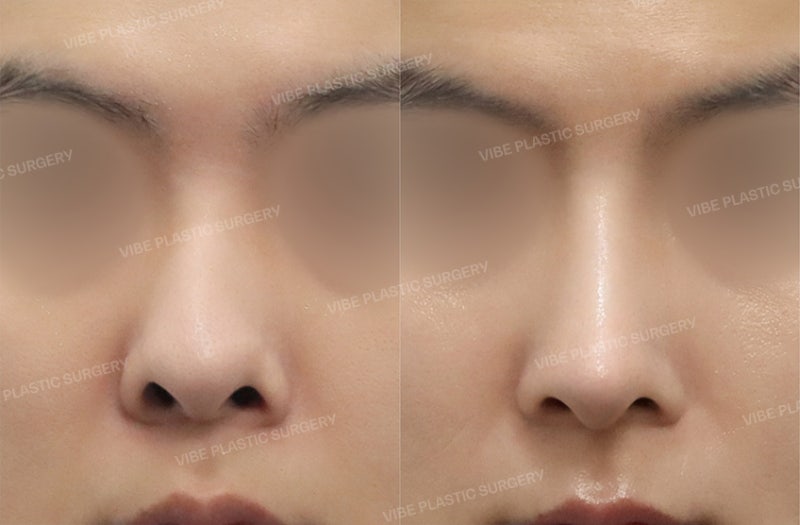
Front-view comparison photos of a nose shown side by side, with the eyes blurred for privacy.
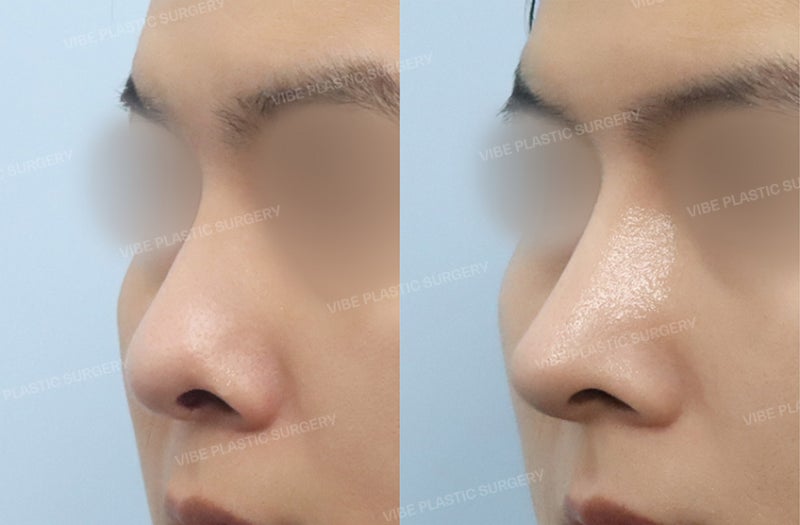
Side-by-side comparison of the nose from a 45-degree angle (facing left), with the eyes blurred.
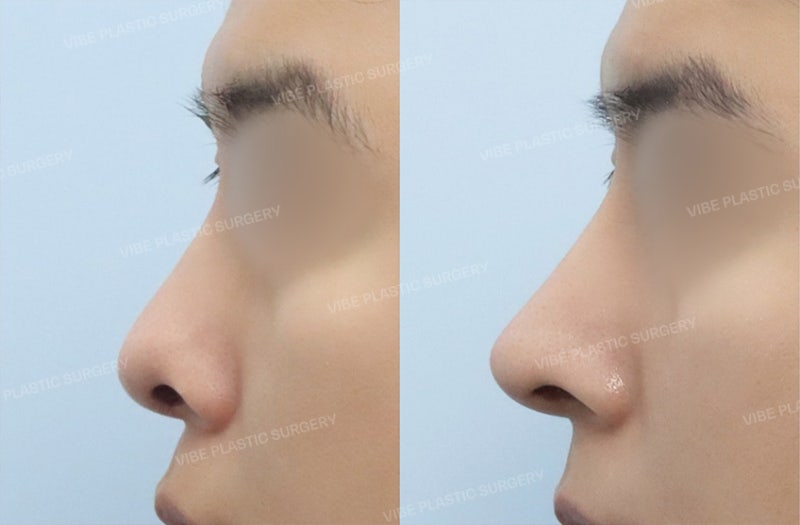
Side-by-side profile photos (facing left) comparing the line of the nasal bridge and tip, eyes blurred.
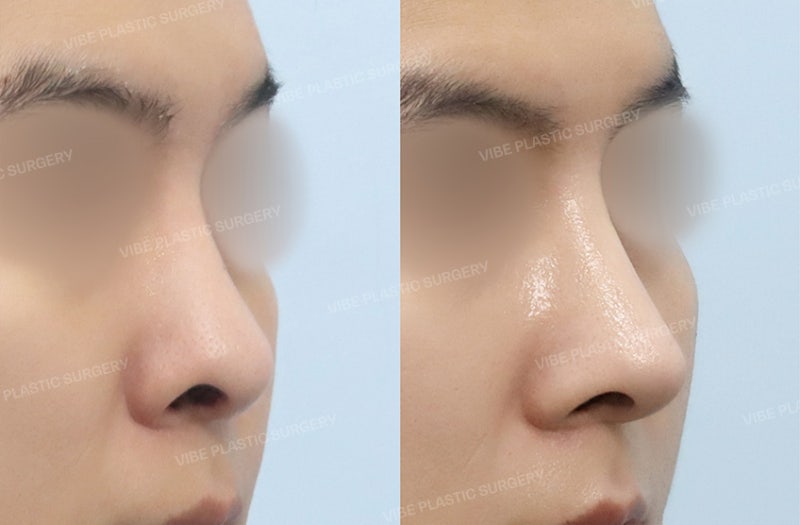
Side-by-side comparison of the nose from a 45-degree angle (facing right), with the eyes blurred.
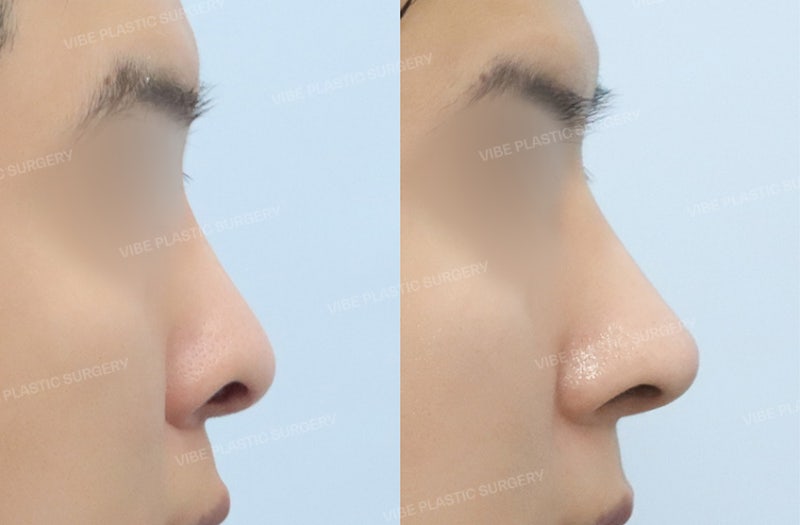
Side-by-side profile photos (facing right) comparing the line of the nasal bridge and tip, eyes blurred.
7. Points to check before nose revision surgery
Revision rhinoplasty differs from a first surgery in that tissue changes from previous surgery may be present.
In particular, the following should be checked carefully.
Type and position of any existing implant
Remaining amount and condition of the septal cartilage
Degree of deformation of the nasal bones and septum
Extent of internal adhesions and scar tissue
Structures involved in breathing, such as the nasal valve and inferior turbinates
Skin thickness and condition of the soft tissue
Types and amounts of autologous cartilage available
In addition, revision surgery may involve differences in the extent of the operation and in the recovery process, depending on the condition of the tissue.
When functional problems are involved, it is necessary to evaluate not only the cosmetic changes but also the actual breathing condition, and to continue monitoring after surgery.
Conclusion
When a crooked nose and difficulty breathing through the nose occur together, it is hard to judge based on external appearance alone.
In particular, for patients who have had previous nose surgery, it is important to comprehensively evaluate the septum, the nasal bones, the position of any existing implant, and the internal support structure.
Autologous rib cartilage is a material that may be considered in revision surgery where cartilage is insufficient or structural reconstruction is needed, while 3D custom implants can be used in external correction planning that reflects each patient's unique nasal dorsum shape and asymmetry.
Ultimately, the core of revision rhinoplasty is not the use of any specific material, but accurately identifying the current structural and functional problems of the nose and choosing the surgical method that suits them.
Frequently Asked Questions
Does revision surgery for a crooked nose also take breathing discomfort into account?
Yes. Some people considering revision rhinoplasty also experience nasal congestion or breathing discomfort, so it is necessary to examine the internal structure of the nose along with its external appearance. In the case described in this article, a CT scan confirmed that the septum was severely bent.
What causes a crooked nose?
A crooked nose can result from various causes, including congenital bending of the septum or nasal bones, trauma, and asymmetry remaining after previous nose surgery. It also includes cases in which weakened or deformed septal cartilage support, or a change in the position of an implant, makes the asymmetry more noticeable.
What is the difference between functional and cosmetic nose surgery?
The main purpose of cosmetic rhinoplasty is to improve appearance, while the main purpose of functional rhinoplasty is to improve the structures involved in breathing. Cosmetic rhinoplasty addresses correction of the central axis of a bent nose, improvement of nasal dorsum asymmetry, and adjustment of the nasal tip shape. Functional rhinoplasty addresses correction of a bent septum and improvement of the internal structure of the nasal cavity.
Is autologous rib cartilage used in every nose revision?
No, it is not necessary for every nose revision. It may be considered when a large portion of the septal cartilage has been lost due to previous surgery, or when repeated revisions have left the cartilage insufficient in amount or support. However, the additional incision needed for harvesting, along with possible scarring and pain, must also be considered.
Can a 3D custom implant correct a bent nasal bone?
No. A 3D custom implant itself does not correct a bent nasal bone or septum. It is best understood as a means of complementing the external contour of the nasal dorsum. If internal structural correction is needed, septal correction or nasal bone correction should be considered together.
Is septal deviation the only cause of nasal congestion?
No. Besides septal deviation, nasal congestion can be caused by inferior turbinate hypertrophy, nasal valve stenosis, allergic rhinitis, and other factors. For this reason, in addition to CT imaging, it is important to identify the cause of breathing difficulty through an ENT evaluation that includes nasal endoscopy.